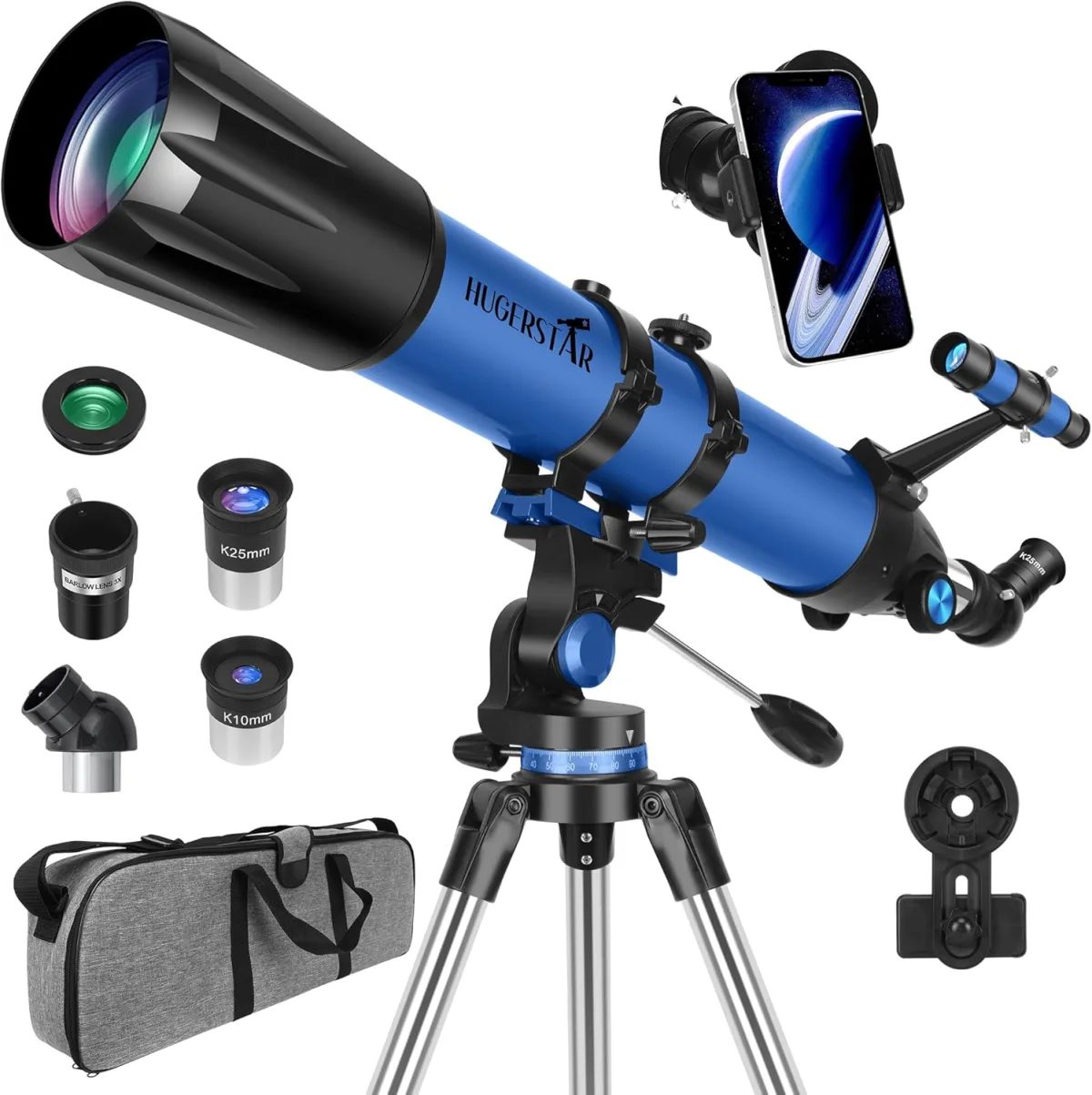
My First Impressions of the 90mm Refractor
As someone who's always been fascinated by the night sky but intimidated by the complex world of telescopes, I finally decided to take the plunge. I wanted something that wouldn't require a physics degree to operate, offered decent views, and wouldn't empty my wallet. That's how I stumbled upon this 90mm aperture 800mm professional refractor telescope on Amazon. The promise of "high powered" and "for adults astronomy beginners" sounded exactly like what I needed.
When the box arrived, I was pretty excited. Everything was well-packaged, and it felt like a proper piece of equipment, not some flimsy toy. Assembly was surprisingly straightforward, even for a complete novice like me. The instructions were clear enough, and I had it set up in about 15-20 minutes, which was a huge relief. I really appreciate when a product doesn't make you jump through hoops just to get started.
Unboxing, Setup, and Build Quality
The telescope itself felt pretty solid. The main tube is metal, and the stainless steel tripod, while not observatory-grade, felt robust enough to hold the telescope steady for casual viewing. It’s an Alt-Azimuth (AZ) mount, which means it moves up/down and left/right – very intuitive for beginners. I didn't want anything with a complex equatorial mount just yet, so this was perfect.
It comes with a carry bag, which is a nice touch. It's not a heavy-duty padded case, but it's good enough for transporting the scope to a backyard or a local park without worrying too much about dings and scratches. The included accessories are what you'd expect: two eyepieces (K25mm and K10mm), a 3x Barlow lens, and a moon filter. More on those later.
Performance: What Can You Actually See?
This is where the rubber meets the road, right? My first target was, naturally, the Moon. And let me tell you, I was genuinely blown away. Even with the K25mm eyepiece, the craters and mare were incredibly clear and detailed. The included moon filter is a must-have; without it, the Moon is almost too bright to look at comfortably for extended periods. With the filter, it’s a stunning, crisp view.
Next, I tried the K10mm eyepiece, and the magnification jumped up, bringing even more lunar detail into view. Adding the 3x Barlow lens to either eyepiece pushes the magnification further, but I noticed the image started to get a bit dimmer and a little less sharp at the highest magnifications, especially with the K10mm + Barlow combo. That's pretty normal for telescopes in this price range, so I wasn't too surprised.
I also managed to spot Jupiter and its four Galilean moons on a clear night. They looked like tiny, distinct dots orbiting a small, bright disc. Don't expect Hubble-like images of Jupiter's Great Red Spot with this scope, but seeing those moons for the first time with my own eyes was truly magical. Saturn's rings were also just barely discernible as a separate "handle" feature, not a distinct ring system, but again, for a beginner scope, it was enough to spark that wonder.
For brighter deep-sky objects like the Orion Nebula, I could discern a faint fuzzy patch with some hints of nebulosity. Again, this isn't a deep-sky imaging powerhouse, but it definitely gives you a taste of what's out there.
Mount, Tripod, and Accessories – The Good and The Not-So-Good
The AZ mount is easy to use for pointing, but tracking objects as they move across the sky can be a bit jerky. It's fine for the Moon, which moves relatively slowly across the field of view, but for planets, you'll be nudging it quite often. The stainless steel tripod is stable enough for calm conditions, but a strong gust of wind can introduce a bit of wobble. It's not a dealbreaker, but something to be aware of.
The finderscope is a 5x24 optical finder, and it took a little patience to align it with the main telescope. Once aligned, it does its job, helping you zero in on objects before switching to the main view. The included eyepieces are decent for beginners, but if you get serious, you'll likely want to upgrade them down the line for wider fields of view and better eye relief. The 3x Barlow is fun for pushing magnification, but use it sparingly, as explained above.
Overall, for the price, the accessories are functional and get you started. If you're serious about getting into astronomy, you can pick one up here and see for yourself.
Pros and Cons
Pros:
- Excellent Lunar Views: The Moon looks fantastic, especially with the included filter.
- Easy Setup: Very quick and intuitive to assemble, great for absolute beginners.
- Solid Optics for the Price: 90mm aperture provides clear images of brighter objects.
- Intuitive AZ Mount: Simple up/down and left/right movement.
- Portable: The carry bag makes it easy to take to darker locations.
- Good Value: A lot of bang for your buck if you're just starting out.
Cons:
- Jerky Tracking: The AZ mount isn't the smoothest for tracking planets at higher magnifications.
- Tripod Stability: Adequate, but can be a bit wobbly in windy conditions.
- Chromatic Aberration: You'll notice some purple fringing around very bright objects (like the Moon's limb) at high magnification, typical of achromatic refractors.
- Basic Eyepieces: Functional, but serious stargazers will want to upgrade eventually.
- Finderscope Alignment: Can be a bit fiddly to align initially.
- Limited Deep-Sky: While it can show some bright nebulae/clusters, don't expect stunning deep-sky views.
Who Should Buy This Telescope?
This telescope is absolutely perfect for:
- First-time astronomy enthusiasts: If you’ve never owned a telescope and want to dip your toes in.
- Parents looking for an educational gift: It’s a great way to introduce kids (and adults!) to the wonders of space.
- Casual stargazers: Someone who wants to enjoy clear views of the Moon, Jupiter, and Saturn without a big investment or complex setup.
- Urban or suburban observers: It performs well on brighter objects even with some light pollution.
Who Should Skip It?
This might not be the right fit if:
- You're an experienced astronomer: You'll likely find it too basic and might want more aperture or a computerized mount.
- You primarily want to view faint deep-sky objects: Galaxies and faint nebulae require larger aperture scopes.
- You plan on astrophotography: This isn't designed for serious imaging (though you could probably snap some quick moon shots with a phone adapter).
- You need perfectly smooth tracking: For buttery-smooth planetary tracking, you'd need a more advanced mount.
My Final Thoughts
After several weeks of using this telescope, I can honestly say I'm really happy with my purchase. It delivered exactly what I hoped for: an accessible, enjoyable entry into stargazing. The views of the Moon alone are worth the price of admission. It’s not a professional observatory instrument, and it doesn't pretend to be. What it is, however, is a fantastic stepping stone for anyone curious about the cosmos.
If you're looking for an affordable, easy-to-use telescope that delivers genuinely impressive views of the Moon and provides a peek at the planets, then I highly recommend giving this one a try. It’s a solid choice for adults just starting their astronomy journey. Go check today's price; you might be surprised at the value!