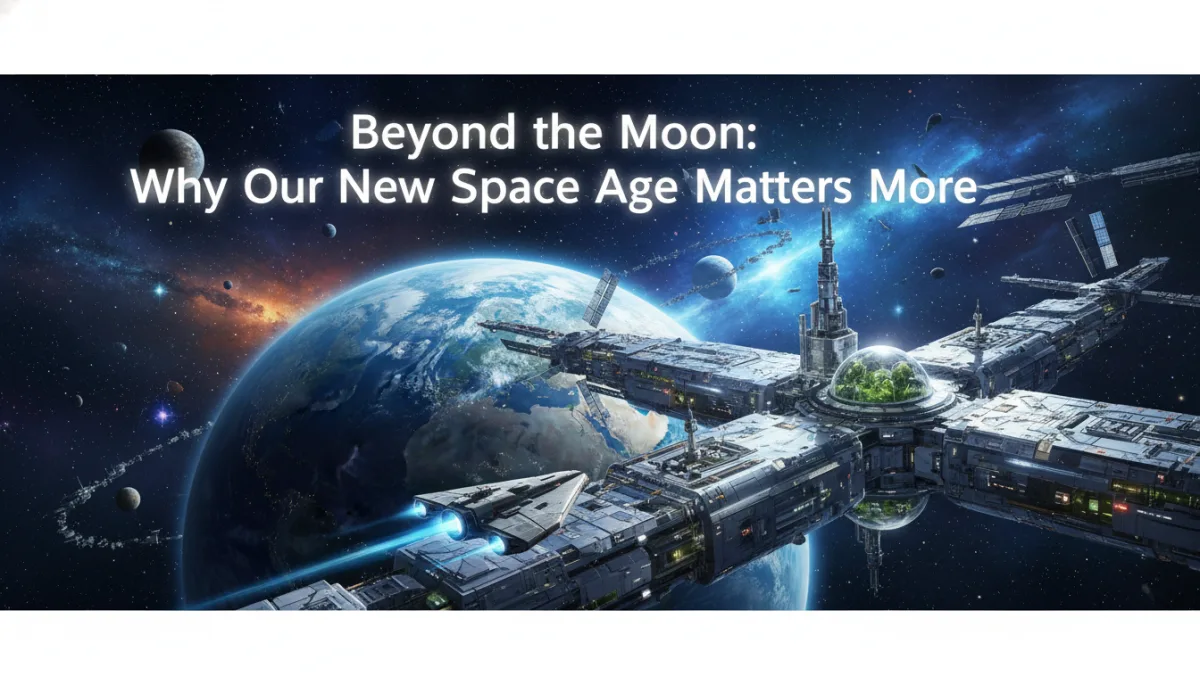
Space Exploration: More Than Just Giant Leaps
Remember that iconic grainy footage of Neil Armstrong's "one small step"? It’s etched into our collective memory, a defining moment of human ambition. For decades, space exploration often felt like a grand, government-funded spectacle, a Cold War chess match played out among the stars. Flags, footprints, and the occasional dazzling satellite launch defined the narrative. But if you're still viewing space exploration through that lens, you're missing the most profound transformation in generations. We’re not just replaying the past; we're writing an entirely new chapter, one that's far more complex, ambitious, and, frankly, vital to our future here on Earth.
The space race of yesteryear was about proving a point. Today’s space endeavors? They’re about proving humanity’s resilience, ingenuity, and capacity for long-term vision. This isn't merely about planting another flag on a celestial body; it's about establishing a persistent presence, unlocking new resources, and fundamentally expanding our understanding of the universe and our place within it. And it's happening at a pace and scale that would make the architects of Apollo blink.
The Dawn of a Collaborative Cosmos
One of the most striking shifts in recent years has been the democratization of space. While NASA, ESA, JAXA, and other national agencies continue to lead groundbreaking scientific missions, the private sector has exploded onto the scene, bringing with it an unprecedented level of innovation, efficiency, and a healthy dose of competition. Companies like SpaceX, Blue Origin, and Rocket Lab aren't just building rockets; they're fundamentally reshaping how we access and utilize space. They've driven down launch costs, accelerated development cycles, and opened doors to ventures once considered pure science fiction.
Consider the International Space Station (ISS). For over two decades, it’s been a beacon of international cooperation, a living laboratory orbiting our planet. Astronauts from diverse nations have conducted thousands of experiments, pushing the boundaries of material science, biology, and human physiology in microgravity. It’s a testament to what we can achieve when we work together, a tangible milestone showing that despite earthly squabbles, humanity can unite for a common, lofty goal. The ISS isn't just a structure; it's a blueprint for our future in space.
Webb, Artemis, and the Next Frontier
The scientific returns from our orbital observatories are nothing short of breathtaking. The Hubble Space Telescope, a venerable workhorse, delivered images that profoundly reshaped cosmology. Now, the James Webb Space Telescope (JWST) is taking us even further. Its stunning initial images, from the "Cosmic Cliffs" of the Carina Nebula to the deepest infrared view of the universe ever captured, didn't just break scientific records; they captivated the world, sparking a renewed sense of wonder and curiosity about our origins. Webb isn't just observing; it's revealing the universe as we've never seen it, hinting at untold discoveries about exoplanets, galaxy formation, and the very fabric of spacetime.
Then there's the Artemis program, NASA’s ambitious plan to return humans to the Moon. But this isn't just Apollo 2.0. Artemis aims for a sustainable lunar presence, establishing a base, utilizing lunar resources (like water ice for fuel and life support), and preparing for the ultimate human journey: Mars. We’re not just visiting; we’re learning to live and work off-world, building the infrastructure for a multi-planetary future. This endeavor pushes technological boundaries in propulsion, life support, robotics, and advanced materials – innovations that inevitably find their way back to Earth.
Why Does It Matter Here on Earth?
Critics often ask, "Why spend billions in space when we have so many problems on Earth?" It’s a valid question, and one we shouldn't shy away from. But the answer isn’t simple; it’s profound. Space exploration isn't a luxury; it’s an engine of innovation, a catalyst for economic growth, and an indispensable tool for understanding and protecting our home planet.
Let's talk about the tangible benefits. You use them every day, likely without a second thought. Global Positioning System (GPS), for instance. It didn't just revolutionize navigation; it underpins modern logistics, agriculture, emergency services, and even the timing of financial transactions. That's a direct spin-off from space technology. Weather forecasting and climate monitoring? Our satellite networks are literally our eyes in the sky, predicting hurricanes, tracking droughts, and providing critical data to understand and combat climate change. Without them, our ability to prepare for natural disasters would be crippled.
Beyond the obvious, the space industry itself is a rapidly expanding economic powerhouse. Morgan Stanley projects the global space economy could exceed $1 trillion by 2040. That's jobs, innovation, and entirely new sectors emerging from the drive to explore. The material science advancements, the miniaturization of electronics, the improvements in medical imaging – countless technologies we now take for granted trace their origins back to the demands of space travel. Space exploration forces us to solve incredibly complex problems, and those solutions frequently cascade into terrestrial applications, improving our quality of life in myriad ways.
A Vision for Humanity's Future
Ultimately, space exploration speaks to something fundamental within us: curiosity. It’s the drive to know what's beyond the next horizon, to understand our origins, and to ponder our destiny. It’s about building a future where humanity isn't confined to a single planet, vulnerable to a single catastrophic event. The threat of asteroid impacts, for example, is a very real one, and our nascent planetary defense capabilities are a direct product of our spacefaring efforts.
The milestones we’re witnessing today – the reusable rockets, the deep-space telescopes, the plans for lunar bases – aren't just engineering marvels. They are bold declarations of intent, proof that humanity, when it sets its mind to it, can overcome immense challenges. This new space age isn't just about escaping Earth; it's about enriching it, inspiring its inhabitants, and securing a future for generations to come. It’s an investment in our collective intelligence, our survival, and our boundless potential. And that, I’d argue, is a giant leap worth making.