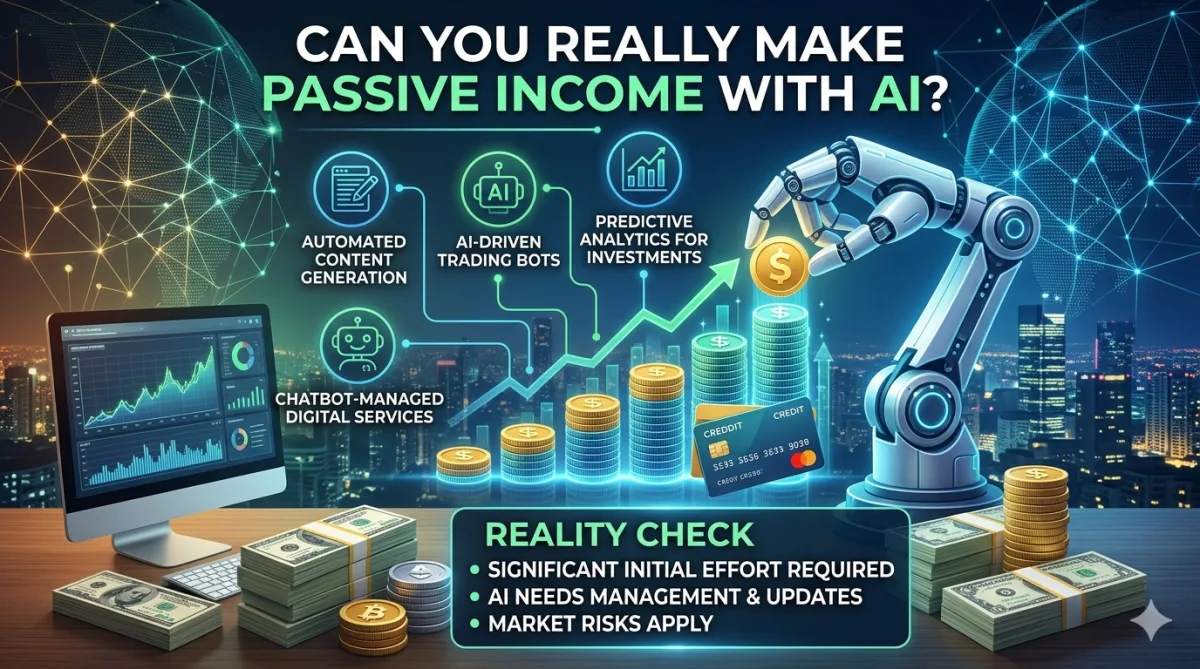
The allure of passive income is undeniable. Imagine earning money while you sleep, travel, or simply enjoy your life. Now, inject the transformative power of artificial intelligence into that vision, and you've got a potent combination that's sparking countless conversations across the business world. But can you really make passive income with AI, or is it just another overhyped trend?
The short answer is yes, but it’s far more nuanced than many online gurus suggest. Leveraging AI for passive income isn't about magical "money-making bots"; it's about strategic implementation, initial effort, and smart automation. It requires understanding what AI excels at and how to integrate those capabilities into a viable business model that generates revenue over time with minimal ongoing intervention.
Deconstructing Passive Income in the Age of AI
True passive income means you do the work once, or set up a system, and it continues to generate revenue with little to no active management. Think royalties from a book, rental income from a property, or dividends from investments. AI doesn't create passive income out of thin air; it acts as a powerful accelerant and enabler for existing passive income strategies.
It's a tool that can automate tasks, generate content, analyze data, and even interact with customers, drastically reducing the active input required after the initial setup. The global AI market, for instance, is projected to grow from $387.45 billion in 2022 to a staggering $1,394.30 billion by 2029, according to Fortune Business Insights. This growth underscores AI's expanding capabilities and its potential to reshape how we approach business and wealth generation.
AI for Automated Content Creation and Monetization
One of the most accessible pathways to making passive income with AI involves content creation. AI tools can generate text, images, audio, and even video almost instantly. This capability opens doors for entrepreneurs to scale content production far beyond what was previously possible.
Consider the potential:
- Blogging and Niche Websites: AI can help draft articles, generate topic ideas, optimize for SEO, and even create social media posts to promote your content. Once published and ranked, these articles can earn through affiliate marketing, advertising, or digital product sales, passively.
- Stock Assets: Artists and designers are using AI to generate unique images, vectors, and even music. These can be uploaded to stock photography or audio sites, earning royalties every time they're downloaded. It's a scalable model where each new asset is a potential income stream.
- YouTube Channels: AI can assist in scriptwriting, video editing (identifying key moments, creating summaries), and even generating voiceovers. Niche channels focusing on educational content, relaxation videos, or explainers can become passive income generators through ad revenue and sponsorships once they gain traction.
AI Tools That Power Passive Content Streams
The market is flooded with AI tools, but a few stand out for their ability to facilitate passive income generation:
- Text Generators: Platforms like Jasper, Copy.ai, or Writesonic can produce blog posts, product descriptions, marketing copy, and even entire e-books. You'll still need to edit and refine, but the heavy lifting of drafting is automated.
- Image Generators: Tools such as Midjourney, DALL-E 3, or Stable Diffusion allow you to create unique visuals from text prompts. These are invaluable for stock photography, website graphics, or even print-on-demand products.
- Audio and Voice Generators: Services like ElevenLabs or Play.ht can create realistic voiceovers, perfect for audiobooks, podcasts, or YouTube videos, eliminating the need for expensive voice actors or your own recording studio.
The key here isn't just generating content; it's creating *valuable* content that attracts an audience and then strategically monetizing it. AI simply makes the creation process faster and more efficient.
AI-Powered Automation for E-commerce and Services
Beyond content, AI is revolutionizing automation in direct sales and service industries. This is where AI truly shines in reducing ongoing operational effort.
- Dropshipping and E-commerce: AI can write compelling product descriptions, generate marketing copy for ads, and even personalize email campaigns based on customer behavior. Chatbots can handle customer inquiries 24/7, reducing manual support needs. The initial product sourcing and store setup require significant effort, but AI automates many of the post-launch tasks.
- Automated Consulting or Service Delivery: Imagine an AI-powered chatbot that can answer common client questions, qualify leads, or even deliver basic consultation based on a pre-programmed knowledge base. While not entirely passive, it drastically minimizes the active time a human consultant needs to spend on repetitive tasks.
- Data Analysis and Reporting: Businesses that sell reports or data insights can use AI to automate the collection, analysis, and presentation of data. Once the AI model is trained, it can generate updated reports periodically, which can be sold on a subscription basis.
These models transform active businesses into semi-passive ones by offloading labor-intensive functions to intelligent systems.
The Reality Check: Making Passive Income with AI Requires Strategy
Here's the crucial part: there's no magic "easy button" for passive income with AI. The term "passive" often misleads people into thinking it means "no effort." That's simply not true. You'll need significant upfront effort and ongoing strategic oversight.
Consider these essential factors:
- Initial Setup is Intensive: Building an AI-driven system, whether it's a content farm, an e-commerce store with AI tools, or an automated service, demands considerable time, learning, and investment. You need to understand the tools, design the workflow, and train the AI where necessary.
- Quality Control is Key: AI-generated content or automated responses aren't always perfect. Human oversight is essential for maintaining quality, brand voice, and accuracy. Without it, your "passive" income stream could quickly erode customer trust and revenue.
- Competition is Fierce: As AI tools become more accessible, the barrier to entry for many online businesses lowers. Standing out requires unique angles, superior quality, and effective marketing – areas where AI can assist, but not entirely replace human ingenuity.
- Maintenance and Adaptation: AI models evolve, algorithms change, and market trends shift. Passive income streams aren't truly "set it and forget it"; they require periodic monitoring, updates, and adaptation to remain profitable.
So, while AI offers unprecedented opportunities for automation, it doesn't eliminate the need for entrepreneurial spirit, strategic planning, and a commitment to quality. It's a powerful lever, not a magic wand.
What This Means for You
If you're looking to generate passive income with AI, your approach needs to be strategic and realistic. Don't chase the dream of zero effort; instead, focus on leveraging AI to automate the *repetitive, time-consuming parts* of a business model you understand and can execute well.
Start by identifying a niche where AI can significantly reduce manual labor. Perhaps it's creating highly specific educational content, generating unique digital art, or automating customer support for a small service business. Invest time in learning the specific AI tools relevant to your chosen path and, crucially, understand how to integrate them into a cohesive system. Your role transitions from doing every task to designing, overseeing, and refining the automated processes. This is where the true power of AI lies for the modern entrepreneur.
The vision of making passive income with AI isn't science fiction; it's a tangible reality for those willing to put in the foundational work. AI won't hand you a check, but it will empower you to build sophisticated, automated systems that can generate significant revenue over time. It's a journey that demands creativity, technical curiosity, and a strategic mindset, but for the savvy entrepreneur, the rewards can be substantial and, yes, wonderfully passive once established.