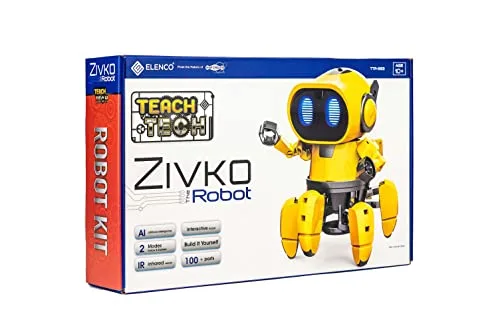
My Honest Take on the Elenco Interactive Infrared Robot
As someone who loves a good DIY project, especially one that promises a bit of learning along the way, I was pretty excited to get my hands on the Elenco Interactive Infrared Robot kit. I’m always on the lookout for engaging STEM toys that actually teach something, not just entertain for five minutes, and this robot seemed to fit the bill. I decided to tackle it myself first to see if it was something I'd recommend for a curious youngster or if it was more suited for an adult hobbyist. After spending a good afternoon building and then playing around with it, I have some solid opinions.
Unboxing and First Impressions
When the box arrived, I was pleased to see Elenco’s usual clear branding. Inside, everything was neatly organized in bags, which always gets a thumbs-up from me. There were a good number of parts – circuit board, motors, wheels, gears, plastic chassis pieces, and a bunch of tiny screws. The instruction manual looked comprehensive, with diagrams that seemed easy enough to follow. No immediate red flags, which is a great start for any kit. I quickly scanned through the components, noting that it didn't require any soldering, which makes it much more accessible for younger builders or those without specialized tools. You’ll just need a small Phillips head screwdriver and a pair of flush cutters for the plastic parts.
The Build Process: Rewarding, with a Couple of Hiccups
The assembly process is where the real fun (and occasional frustration) begins. I found the instructions to be generally very good. They break down the build into manageable steps, each with clear illustrations. I started with the chassis, attaching the motors and gearboxes. This part was straightforward, though some of the screws are quite small, so a magnetic screwdriver tip would have been a godsend. My fingers are average-sized, and even I had a moment or two fumbling with a screw.
Wiring the motors to the main circuit board was simple enough, involving screw terminals, which is a nice touch for ease of assembly. The infrared sensors, which are the "eyes" of the robot, were also easy to install. The most time-consuming part for me was probably attaching all the small plastic clips and ensuring the wires were neatly tucked away so they wouldn't interfere with the wheels or moving parts. I took my time, probably about 2.5 to 3 hours total, including a coffee break. An experienced builder might do it quicker, but someone new to kits, especially a child with adult supervision, might take longer. There was one step where a diagram could have been slightly clearer regarding the orientation of a specific plastic bracket, but I figured it out after a minute of head-scratching. That's part of the learning experience, right?
Features and Performance: More Than Just a Toy
Once built, the robot requires two AA batteries (not included, so grab those ahead of time!). Flipped the switch, and voilà! It whirred to life. The Elenco robot has a few modes, primarily obstacle avoidance and line tracing. I tested the obstacle avoidance first. I placed it on my kitchen floor and watched it navigate around chair legs and even my cat (who was surprisingly tolerant). It uses its IR sensors to detect objects and then changes direction. It worked pretty well! It wasn't super speedy or agile, but it consistently avoided collisions, which is the main goal.
The line tracing feature was also impressive. I drew a thick black line on a large piece of poster board, and the robot followed it diligently. It uses downward-facing IR sensors to detect the line. It wobbled a bit on sharper curves, sometimes losing the line momentarily before correcting itself, but for a kit in this price range, I was genuinely impressed with its ability. It's not going to win any robot races, but it reliably demonstrates the principles of sensor-based navigation. I enjoyed seeing how the programming and hardware came together to create intelligent movement. If you're looking to grab it on Amazon, make sure you have those batteries ready!
Pros:
- Excellent Educational Value: Truly teaches basic robotics, electronics, and mechanical assembly. It’s hands-on learning at its best.
- Engaging Build: The process is challenging enough to be rewarding but not so difficult that it’s frustrating (mostly!).
- Clear Instructions: For the most part, the manual is well-written with good diagrams.
- Solderless Assembly: A huge plus for accessibility, making it suitable for younger users (with supervision).
- Satisfying Performance: Both obstacle avoidance and line tracing work reasonably well, providing that "it actually works!" moment.
- Durable Enough: Once assembled, the plastic chassis feels sturdy enough for regular play and minor bumps.
Cons:
- Tiny Screws: Some screws are very small and can be a bit fiddly, especially for larger hands or those lacking fine motor skills.
- Battery Requirement: Doesn't come with the two AA batteries needed, which is a minor inconvenience if you forget.
- Limited Advanced Functionality: Once built, the robot only performs its pre-programmed tasks. There's no further programming or customization without significant modification, which might disappoint truly advanced hobbyists.
- Patience Required: Not a quick build, so impatient kids (or adults!) might need encouragement.
Who Should Buy This:
This robot kit is perfect for kids aged 10 and up who have an interest in how things work, electronics, or robotics. It’s also great for parents looking for a quality STEM project to do with their children. If you enjoy following instructions, working with your hands, and seeing a project come to life, you’ll find this very satisfying. It makes an excellent gift for a budding engineer or scientist. You can check today's price if you're thinking about picking one up.
Who Should Skip It:
If you're looking for a robot that's ready to play right out of the box, this isn't it. This is a kit, and assembly is a significant part of the experience. Also, if you're an advanced hobbyist hoping for a platform to program and customize extensively, you might find its fixed functionality limiting. While it's great for learning basic principles, it doesn't offer the flexibility of more open-ended robotics platforms. Finally, if you (or the recipient) lack patience for detailed assembly, this might lead to more frustration than fun.
Final Thoughts
Overall, I'm really happy with the Elenco Interactive Infrared Robot. It delivers on its promise of being an engaging, educational build that works as advertised. It's not flashy or overly complex, and that's precisely its strength. It focuses on the fundamentals, providing a solid introduction to robotics and electronics in a hands-on way. The satisfaction of seeing something you built come to life and perform tasks is a unique joy, and this kit offers that in spades. If you're in the market for a meaningful gift or a fun learning project, I'd definitely recommend giving it a look.