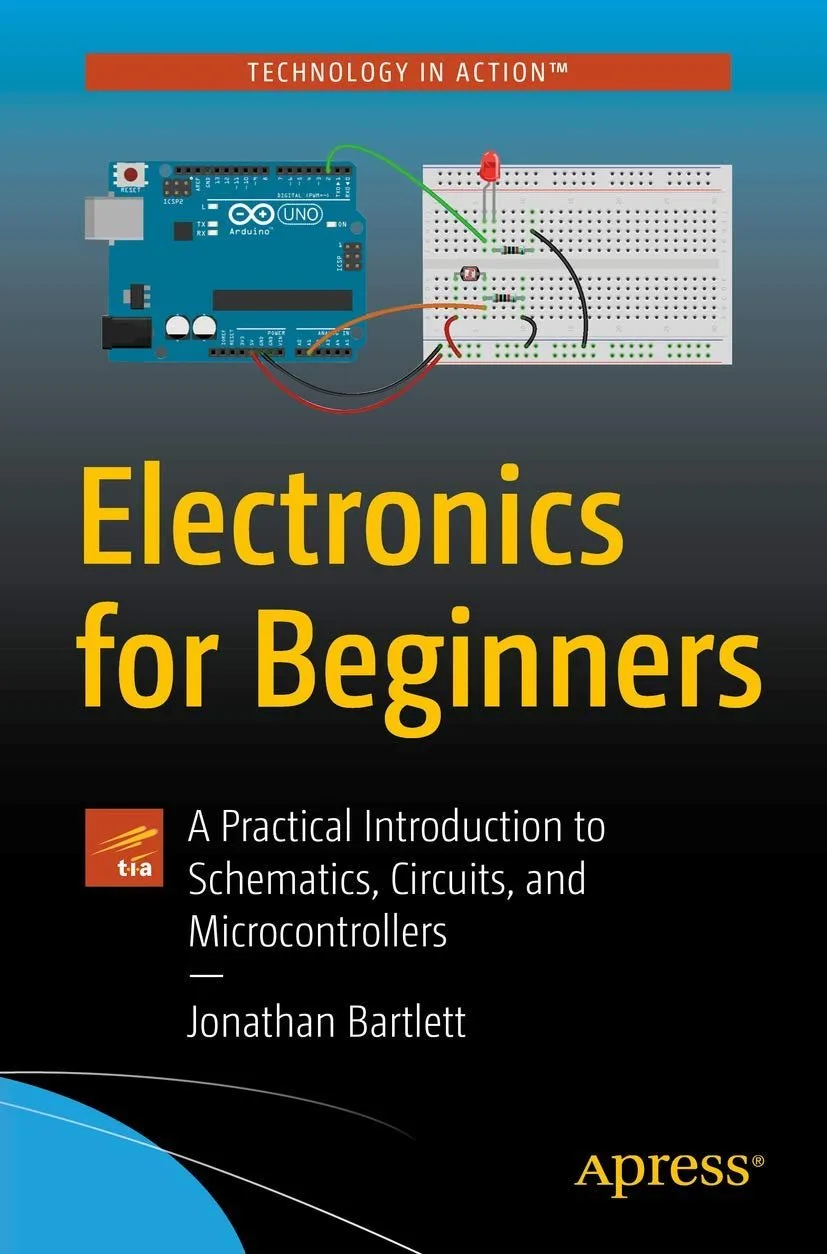
I’ve always been that person who buys Arduino starter kits, blindly plugs jumper wires into a breadboard following a colorful diagram, and crosses my fingers hoping nothing catches fire. I could make an LED blink, but I didn't actually understand what I was doing or why it worked. That’s exactly why I picked up Jonathan Bartlett’s Electronics for Beginners: A Practical Introduction to Schematics, Circuits, and Microcontrollers.
I wanted to look at a real schematic without feeling like I was deciphering ancient hieroglyphs. I’ve spent the last month working through this book on my workbench, and I have a lot of thoughts. If you're in a hurry and just want the bottom line, you can check today's price, but I highly recommend sticking around for my full experience because this guide definitely has a few quirks you should know about.
First Impressions and Pacing
Right out of the box, it's a pretty hefty book at over 400 pages. The tone right out of the gate is super approachable. Bartlett writes like a patient teacher who knows you are probably terrified of complex math. He doesn't just throw equations at you; he explains the why behind them before doing the calculations.
The pacing in the first few chapters is fantastic. It starts with the absolute basics—what is voltage, what is current, and how does Ohm's law actually apply to the real world. I've watched dozens of YouTube videos on Ohm's law, but the way it's laid out here finally made it click in my brain.
What I Absolutely Loved
Translating Schematics to Breadboards
This is where the book shines. Instead of just showing you a picture of a fully wired breadboard, the author forces you to look at the schematic, understand the standard symbols, and translate that to the physical board yourself. After a few weeks of working through these exercises, I was able to look at random circuits online and actually understand the flow of current. It felt like learning a new language and finally being able to read a full sentence.
Mastering the Multimeter
I also loved the practical multimeter usage. I've owned a cheap multimeter for years and only ever used it to check if AA batteries were dead. The book walks you through testing voltage drops, measuring resistance, and checking continuity like a pro. It gave me a lot of confidence to troubleshoot my own messy wiring when things inevitably didn't turn on.
What Annoyed Me
Here's where I have to be brutally honest. While the instruction is top-notch, the physical formatting of the book drove me a little crazy. The pictures and diagrams are printed in black and white. When you are trying to learn how to read resistor color bands (which rely entirely on distinguishing red from brown or orange), a grayscale photo is completely useless. I had to keep my phone handy to Google resistor color charts constantly.
The other thing that caught me off guard was the hidden cost. The book itself is reasonably priced, but you need to buy a lot of components to follow along. Resistors, capacitors, LEDs, switches, 555 timers, a multimeter, an Arduino... the list goes on. I really wish there was an official companion kit you could just buy in one click. Sourcing all the individual parts from various vendors took me an entire afternoon and cost me more than the book itself. If you already have a big bin of spare parts, you'll be fine, but total newbies should budget for the extra hardware. If you're willing to make that investment, you can grab it on Amazon and start building.
The Microcontroller Section
The last third of the book transitions from analog components and basic digital logic into microcontrollers, specifically the Arduino. It's a solid, gentle introduction. However, if you only care about coding and Arduino projects, there are better, more specific books out there for that. This book's true superpower is teaching pure hardware, analog circuits, and logic gates.
Who Should Buy This
- Frustrated Hobbyists: If you are tired of just copying tutorials and want to know why your circuit works.
- Visual Learners: Anyone who wants to finally learn how to read actual schematics instead of relying on breadboard pictures.
- Math-Phobic Makers: People who are intimidated by the heavy calculus usually found in university engineering textbooks.
Who Should Skip It
- Advanced Tinkerers: People looking for an advanced engineering textbook. This is strictly for beginners.
- Budget-Conscious Buyers: Those on a super tight budget who can't afford to buy extra loose components to follow the exercises.
- Software-First People: Programmers who only want to learn C++ for Arduino and don't care about hardware fundamentals.
Final Verdict
Overall, I'm really glad I bought Electronics for Beginners. It sits permanently on my workbench now as a reference guide. The grayscale photos are definitely a bummer, and tracking down all the little parts was a bit of a chore, but the actual knowledge I gained was totally worth the struggle. My electronics projects finally make sense, and I haven't let the magic smoke out of a component in over a month. If you're ready to stop guessing and actually learn how circuits work, see what others paid and pick up a copy for yourself.