My Quest for a Faster, Simpler 3D Printer
As someone who's spent countless hours tweaking settings and battling finicky machines, I was on the hunt for a 3D printer that could deliver speed without sacrificing ease of use or quality. My previous printers, while capable, often felt like a part-time job just to get a decent print. I’d heard a lot of buzz about the Flashforge Adventurer 5M, especially its speed, and decided it was time to give it a whirl. If you're curious about the current pricing or want to check today's price, I recommend heading over to Amazon.
Unboxing & First Impressions: Surprisingly Simple
The Adventurer 5M arrived well-packaged, and getting it out of the box was straightforward. What really surprised me was the minimal setup required. I'm used to spending an hour or more assembling parts and running initial calibrations. With the 5M, it was practically plug-and-play. I attached the filament holder, loaded up some PLA, and within about 15 minutes, I was ready for my first print. The auto-leveling feature is a godsend; it just works, which immediately put a smile on my face. No more fiddling with feeler gauges or worrying about first-layer adhesion.
Performance: Speed Demon with a Gentle Touch
Blazing Fast Printing
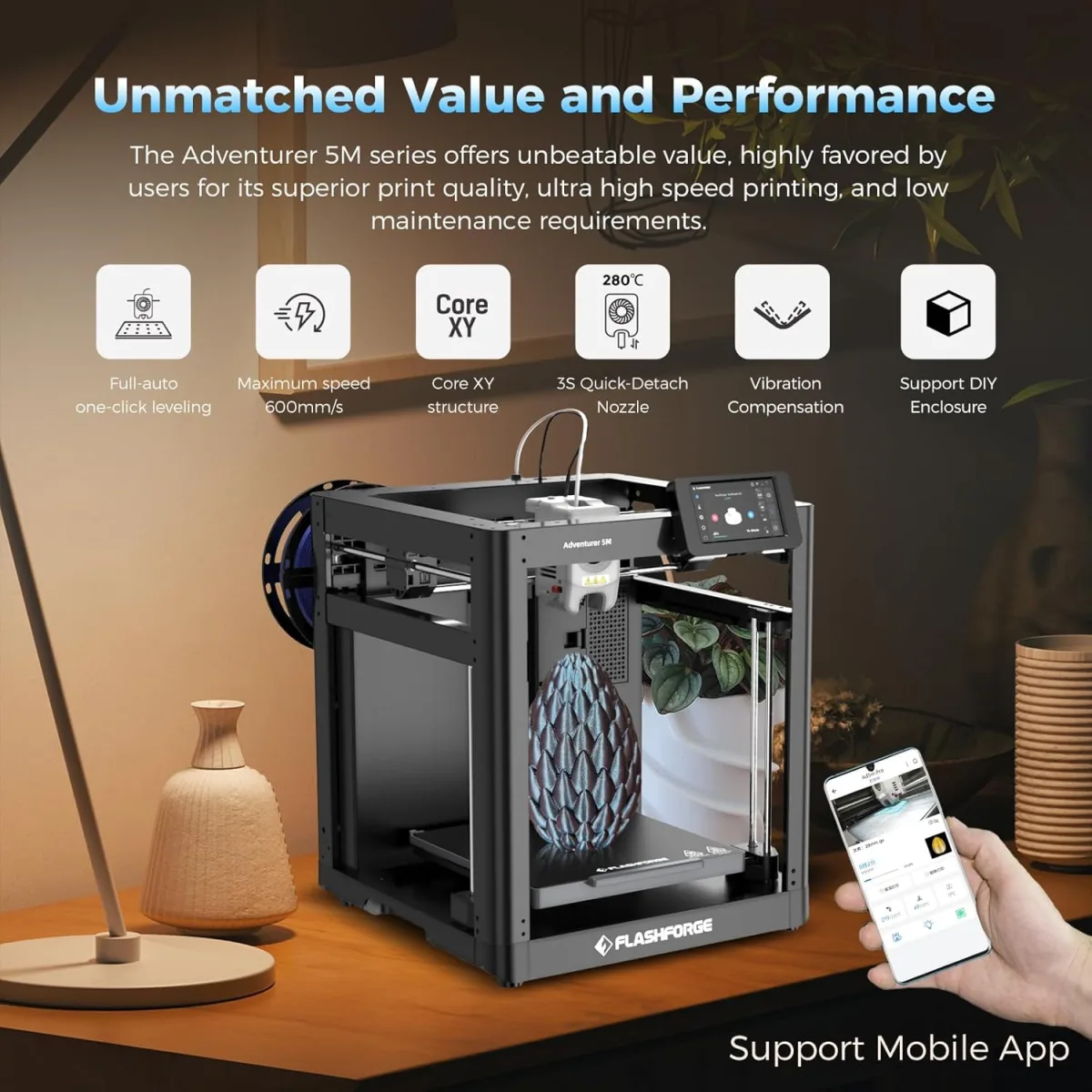
The biggest selling point for the Adventurer 5M is its speed, and let me tell you, it delivers. Prints that used to take hours on my older machines were completed in a fraction of the time. I'm talking about a noticeable, jaw-dropping difference. This isn't just marketing hype; it genuinely prints fast. This speed doesn't seem to come at the expense of quality either, which was a huge relief.
Print Quality & Materials
I primarily print with PLA and PETG, and the results have been consistently good. Layers are smooth, details are crisp, and I haven't run into any significant issues with stringing or warping with standard settings. The direct drive extruder handles flexible filaments pretty well too, though I haven't done extensive testing with them yet. For most hobbyist and prototyping needs, the quality is more than adequate. I've printed everything from functional parts for around the house to detailed miniatures, and it's handled them all like a champ.
User Experience & Interface
The touchscreen interface is intuitive and responsive. Navigating menus, starting prints, and changing settings is a breeze. FlashPrint, their slicing software, is decent. It's not as feature-rich as some third-party slicers, but it's very user-friendly and gets the job done for most models. I appreciate how seamlessly it integrates with the printer.
Noise Levels
Now, let's talk about the elephant in the room for many fast printers: noise. The Adventurer 5M is not silent. When it's really pushing those speeds, you'll hear it. The fans and stepper motors are definitely audible. It’s not scream-loud, but it’s certainly not something you’d want right next to you while trying to concentrate in a quiet office. If you have a dedicated print area or a garage, it's fine, but if it's going to be in your living space, be prepared for some background hum.
Features I Loved
- Detachable Nozzle: This is a game-changer! Swapping nozzles is incredibly easy and quick. No more wrestling with wrenches and hot components. It’s a simple twist-and-pull system that makes maintenance or material changes a joy.
- Automatic Bed Leveling: As mentioned, this works flawlessly. It takes the guesswork and frustration out of getting that perfect first layer.
- Flexible PEI Build Plate: Prints adhere well when hot and pop right off once cooled, making print removal effortless. I've had zero issues with adhesion, which is a common headache on other machines.
- Open Frame Design: While some might see this as a con (more on that below), I found it great for accessibility. It's easy to see what's happening, troubleshoot, and reach into the print area.
- Quick Heating: The bed and hotend heat up remarkably fast, getting you printing sooner.
A Few Annoyances (The Cons)
- Noise: Again, it's not a deal-breaker for me, but it's something to be aware of. If silence is golden, this isn't your printer.
- Open Frame for Certain Materials: While I like the accessibility, the open frame means printing with materials like ABS or ASA, which are very sensitive to drafts and temperature fluctuations, can be challenging without an external enclosure. For PLA and PETG, it's perfectly fine.
- FlashPrint Software: While user-friendly, it lacks some of the advanced features and customization options that experienced users might be accustomed to with Cura or PrusaSlicer. You can use other slicers, but FlashPrint is designed to integrate best.
- Build Volume: The 220x220x220mm build volume is standard, but for really large projects, you'll still need to break them into smaller parts. It's not a huge negative, but something to consider if you dream of printing giant helmets in one go.
After spending significant time with it, if you're leaning towards a speedy and reliable machine that won't break the bank, you can grab it on Amazon and see the speed for yourself.
Who Should Buy This?
- Beginners: If you're new to 3D printing and want a machine that's easy to set up, reliable, and relatively forgiving, this is an excellent starting point.
- Hobbyists & Makers: For those who enjoy printing various models, prototypes, or functional parts and value speed and convenience.
- Educators: Its ease of use makes it a good option for classrooms or workshops where quick, reliable prints are needed without extensive troubleshooting.
- Anyone on a Budget for Speed: If you want high-speed printing without diving into the significantly more expensive professional-grade machines, the 5M offers fantastic value.
Who Should Skip It?
- Users Needing Absolute Silence: If your printer needs to operate in a very quiet environment (e.g., a bedroom office), the noise might be an issue.
- Professionals Requiring Specific Features: Those needing highly specialized material support (like high-temp engineering plastics that require an enclosed, heated chamber) or extremely large build volumes might find it limiting.
- Hardcore Tinkers: If you love to modify, upgrade, and customize every single aspect of your printer, the "just works" nature might feel a bit restrictive, though it's still an open-source friendly machine.
Final Thoughts
The Flashforge Adventurer 5M has genuinely impressed me. It's a breath of fresh air in a market often dominated by machines that demand a lot of time and expertise. It delivers on its promise of speed and simplicity without compromising on print quality for common materials. For the price, it’s hard to beat the combination of features, performance, and user-friendliness you get. It’s significantly reduced my print times and, more importantly, my frustration levels.
Overall, the Adventurer 5M is a solid investment for many. If you're ready to jump in or upgrade to a faster, more reliable machine that lets you focus on creating rather than troubleshooting, pick one up here and start printing faster than ever before!