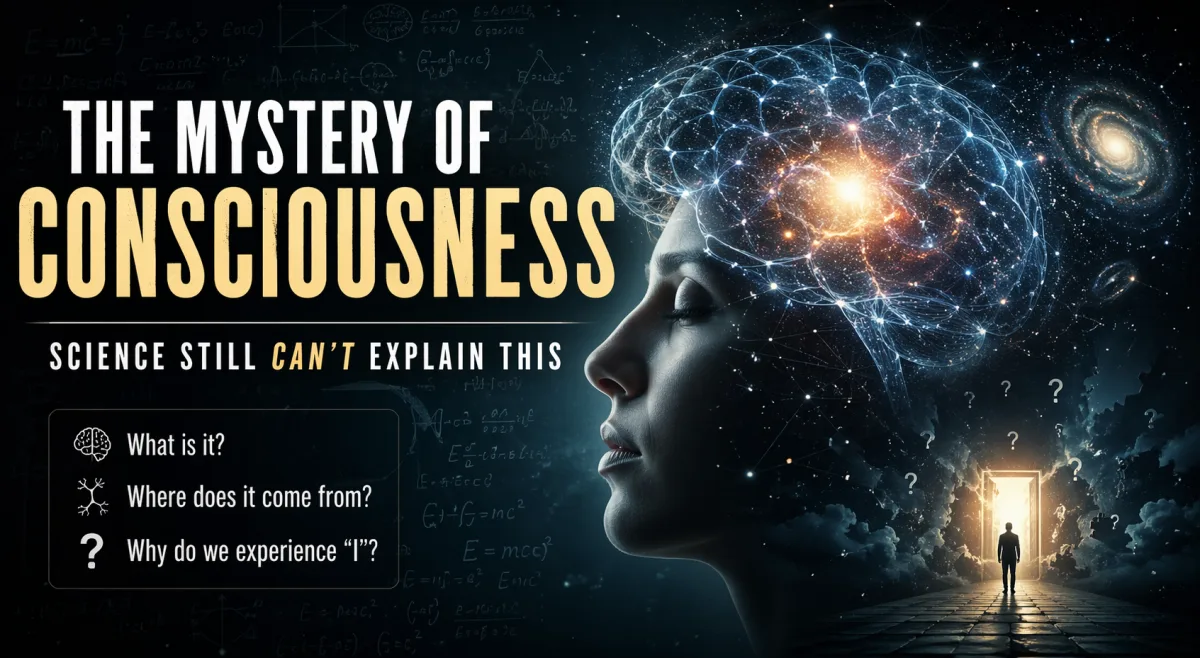
You’re reading these words. You’re processing their meaning, perhaps feeling a sense of curiosity, or even a slight headache from staring at a screen too long. That entire experience – the perception, the thought, the feeling, the sheer "you-ness" of it all – is consciousness. It’s the very foundation of our existence, yet for all our scientific prowess, for all our technological marvels, the mystery of consciousness: science still can’t explain this. We can map the brain, decode genomes, and even send probes to distant galaxies, but we haven't cracked the code of why we feel like *we* exist.
Defining Consciousness: The Elusive "I" at the Heart of the Mystery
Before we can explain consciousness, we first need to define it. That’s where the first hurdle appears. Is it simply awareness? Is it self-awareness? Does a dog have it? What about a highly sophisticated AI? Philosophers and scientists have grappled with this for centuries. The term itself can encompass everything from basic sentience (the capacity to feel) to complex self-reflection and the experience of qualia – the subjective, qualitative properties of experiences, like the "redness" of red or the "painfulness" of pain.
Perhaps the most famous articulation of this challenge comes from philosopher David Chalmers, who coined the term "the hard problem of consciousness." He distinguishes it from the "easy problems," which involve identifying the neural correlates of consciousness (NCCs) – the brain activities that correspond with conscious experiences. The hard problem isn't about *what* happens in the brain when we're conscious; it's about *why* any of that physical activity should give rise to subjective experience at all. Why isn't it all just unconscious information processing? We don't have a good answer.
Mapping Consciousness: The Brain's Enigmatic Symphony
Neuroscience has made incredible strides in understanding the brain's mechanics. We know that consciousness is intimately linked to brain activity. Damage to certain areas can alter or extinguish consciousness, and specific neural patterns correlate with particular conscious states. For instance, studies using fMRI and EEG show heightened activity in the thalamocortical system – a network connecting the thalamus to the cerebral cortex – during conscious wakefulness.
Researchers have identified various potential NCCs. One fascinating example involves the claustrum, a thin, sheet-like structure deep within the brain. In a 2014 study published in *Epilepsia*, neurosurgeon Mohamad Koubeissi and his team temporarily turned off a patient's consciousness by electrically stimulating her claustrum. When stimulation stopped, she immediately regained full awareness. While this suggests the claustrum plays a crucial role, it doesn't tell us *how* it generates subjective experience, only that its function is necessary for it.
The challenge isn't just pinpointing where consciousness happens, but how billions of neurons firing electrochemical signals translate into the rich, unified, subjective world we inhabit. It's like having every single component of a television laid out, understanding how they connect and what each does, but still not grasping *how* that arrangement produces the image and sound you perceive.
Leading Theories: Grappling with the Mystery of Consciousness
Without a definitive explanation, scientists and philosophers have proposed a range of theories, each attempting to bridge the explanatory gap. None have achieved widespread consensus, and all face significant critiques.
Integrated Information Theory (IIT): A Mathematical Approach
One of the most prominent theories is Integrated Information Theory (IIT), championed by neuroscientist Giulio Tononi. IIT proposes that consciousness is a fundamental property of systems that possess a high degree of integrated information – meaning they have many parts that interact in a complex, irreducible way. The theory uses a mathematical measure called "phi" (Φ) to quantify this integration. A system with high phi, like the human brain, is theorized to be conscious.
IIT suggests that consciousness isn't just about information, but about information that is unified and differentiated. It can explain why a camera isn't conscious (its parts are separable, not integrated in the same way) and why a single neuron isn't (too simple). However, IIT has been criticized for its panpsychist implications – suggesting that even very simple systems could have a tiny bit of consciousness – and for the difficulty in empirically testing its core postulates.
Other theories offer different perspectives:
- Global Workspace Theory (GWT): Developed by Bernard Baars, GWT posits that consciousness arises from a "global workspace" in the brain, a kind of central broadcasting system that makes information available to various unconscious processors. It explains how different sensory inputs and memories come together into a unified conscious experience, but critics argue it primarily addresses "access consciousness" (what we can report and act upon) rather than "phenomenal consciousness" (the subjective feeling itself).
- Orchestrated Objective Reduction (Orch OR) Theory: Proposed by physicist Roger Penrose and anesthesiologist Stuart Hameroff, Orch OR suggests consciousness originates from quantum processes within microtubules – protein structures inside neurons. This theory is highly speculative and faces significant skepticism from mainstream neuroscience, as the brain is generally considered too "warm, wet, and noisy" for quantum coherence to be sustained long enough to play a role in consciousness.
The Hard Problem: Why Science Still Can't Fully Explain It
The persistence of the "hard problem" isn't a failure of science, but rather an indication of the unique nature of consciousness itself. Science, by its very methodology, excels at studying objective, third-person phenomena. It measures, quantifies, and models the external world and the physical processes within our bodies. But consciousness is fundamentally a first-person, subjective experience. How do you objectively measure the "taste" of chocolate or the "feeling" of love?
This inherent subjectivity creates an explanatory gap that traditional scientific methods struggle to cross. We can correlate brain states with subjective reports, but we can't observe the subjective experience itself. It's a bit like trying to understand what it's like to be a bat solely by studying bat biology and flight mechanics; you'll learn a lot *about* the bat, but you won't grasp its unique echolocation experience.
This isn't to say science won't make progress. Continued research into neural correlates, altered states of consciousness, and the development of new theoretical frameworks will undoubtedly deepen our understanding. But the leap from objective brain activity to subjective experience remains the grandest challenge.
What This Means For You: Living with the Profound Unexplained
So, what does it mean that science can't fully explain the very essence of your being? For one, it highlights the incredible wonder and mystery of existence. Your conscious experience isn't just a byproduct of a complex machine; it's a profound, irreducible phenomenon that continues to baffle the brightest minds.
This understanding can foster a deeper appreciation for your own subjective world and the unique inner lives of others. It underscores the limitations of purely mechanistic views of humanity and encourages humility in the face of the unknown. It also has profound implications for fields like artificial intelligence: can a machine ever truly be conscious, or will it merely simulate consciousness without ever having an inner life? The answer hinges on whether consciousness is purely computational or something more.
For individuals facing medical conditions that impact consciousness – like coma, persistent vegetative states, or locked-in syndrome – the ongoing scientific quest to understand consciousness is critically important. It drives research into better diagnostic tools and potential therapies, offering hope for clearer communication and improved quality of life.
The mystery of consciousness isn't just an abstract academic puzzle; it's the most intimate question we can ask about ourselves. It reminds us that despite our impressive scientific achievements, the universe, and indeed our own minds, hold secrets far grander than we can currently grasp. We're on a journey of discovery, and while we might be mapping the terrain, the ultimate destination – a complete explanation of consciousness – still feels a universe away. And perhaps, in that enduring mystery, lies a beauty all its own.