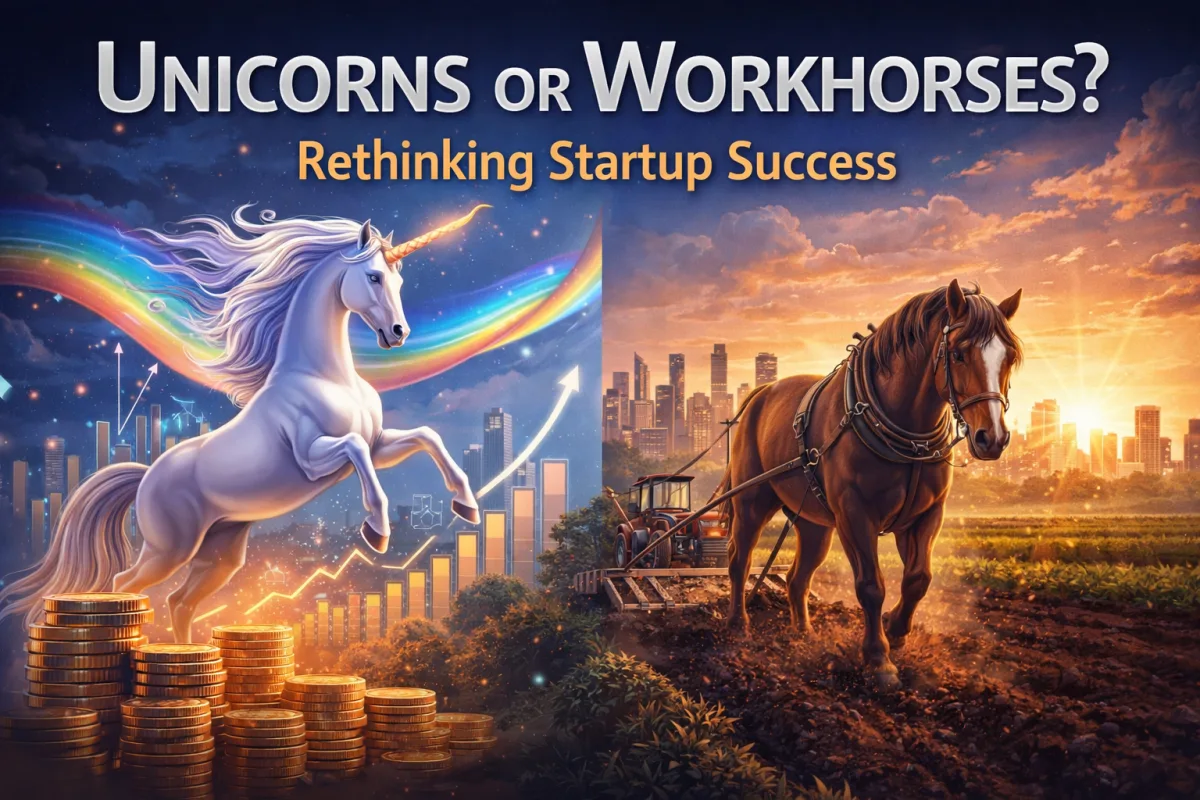
The Siren Song of the Unicorn
You've heard the stories. They're everywhere, splashed across headlines and whispered in co-working spaces: the plucky founder, the brilliant idea, the sleepless nights, and then – *poof!* – a billion-dollar valuation. A "unicorn" is born. This narrative, potent and endlessly alluring, dominates our understanding of startup success. It’s a tale of rapid growth, dizzying venture capital rounds, and the ultimate payout. It tells us that true entrepreneurial triumph is measured in exits, IPOs, and a valuation that would make Midas blush. But I'm here to tell you, that's only part of the story, and frankly, it's a dangerously narrow one.
We've become fixated on these outliers, the statistical anomalies that capture our imaginations. We celebrate the Facebooks, the Ubers, the Airbnbs, and we frame their trajectory as the gold standard. But what about the countless other ventures, the ones that don't make it to the cover of a glossy business magazine, yet build genuine value, create lasting jobs, and solve tangible problems? Are they failures simply because they didn't hit a magical nine-figure benchmark?
Beyond the Bling: What We're Missing
Let's be blunt: the obsession with unicorns distorts our perception of what it takes to build a successful business. It prioritizes speculative growth over sustainable profit, often at the expense of ethics, employee well-being, and even the product itself. When the primary goal is to "disrupt" and "scale fast" to attract the next round of funding, long-term vision can quickly become secondary to short-term metrics. It's a high-stakes game of musical chairs, and when the music stops, a lot of people get hurt.
Consider the stark reality: a vast majority of venture-backed startups fail. Studies consistently show that less than 1% of startups ever achieve unicorn status, and a significant percentage of those that raise substantial capital still don't make it to a profitable exit. For every celebrated IPO, there are dozens, if not hundreds, of companies that quietly fold, their innovative ideas and dedicated teams dissolved. We don't hear their stories as often, do we? Their struggles don't make for clickbait headlines, but their lessons are arguably more valuable.
The Unsung Heroes: Real-World Resilience
True success, I'd argue, often looks a lot less like a rocket ship and a lot more like a well-built, sturdy bridge. It's the local software company that's been profitably serving its niche for two decades, providing stable, fulfilling careers for its employees. It's the sustainable agriculture startup that slowly but surely transforms local food systems, even if its valuation never hits the stratosphere. It's the bootstrapped e-commerce brand that consistently delivers quality products and builds a loyal customer base, one sale at a time.
Take, for instance, a company like Mailchimp before its acquisition. For years, they resisted outside investment, meticulously building a profitable, customer-centric business. They focused on their users, iterated their product, and grew organically. They weren't chasing the next funding round; they were chasing customer satisfaction and sustainable revenue. When Intuit acquired them for $12 billion, it wasn't a sudden, out-of-nowhere unicorn moment; it was the culmination of two decades of diligent, unglamorous, yet incredibly effective work. That's a success story we should champion.
What about the smaller victories? The startup that creates 50 high-paying jobs in a struggling community? The one that develops a critical piece of medical technology that saves lives, even if its market isn't "massive" enough for VCs? These aren't just businesses; they're engines of economic development, sources of innovation, and pillars of community. Their impact is profound, yet the prevailing narrative often overlooks them because they don't fit the 'hyper-growth' mold.
Redefining Our Metrics
If we're serious about fostering a healthy entrepreneurial ecosystem, we need to broaden our definition of success. Here's what we should value:
- Profitability & Sustainability: Can the business stand on its own two feet without a constant infusion of external capital? Is it generating real revenue and profit?
- Impact & Value Creation: Is the company solving a genuine problem? Is it making a positive contribution to its industry, its customers, or society at large?
- Employee Well-being: Does the company foster a healthy, supportive work environment? Are its employees thriving, not just burning out in pursuit of a distant payout?
- Resilience: Can the business weather economic downturns, market shifts, and unforeseen challenges? Is it built to last, not just to scale?
- Customer Loyalty: Does it have a dedicated customer base that trusts its product or service?
These are the hallmarks of businesses that truly contribute, that build lasting legacies, and that, frankly, make the world a better place. They might not generate the same breathless headlines as a new unicorn, but their quiet, consistent success is far more common and, I'd argue, far more meaningful.
The Road Ahead: A Call for Realism
Don't get me wrong; there's nothing inherently wrong with aiming for the stars. Innovation and ambitious growth are vital. But let's temper the hype with a healthy dose of realism. Let's celebrate the grit, the perseverance, and the often-mundane work that underpins *all* successful ventures, not just the ones that hit the jackpot. Let's recognize that building a sustainable, profitable business that genuinely serves its customers and treats its employees well is a monumental achievement in itself.
It's time we stop telling founders that the only path to glory is a breakneck race to a billion-dollar valuation. We need to empower them to build businesses that are not just fast, but strong; not just flashy, but foundational. Because when we broaden our definition of success, we unlock a richer, more diverse, and ultimately more impactful future for entrepreneurship.