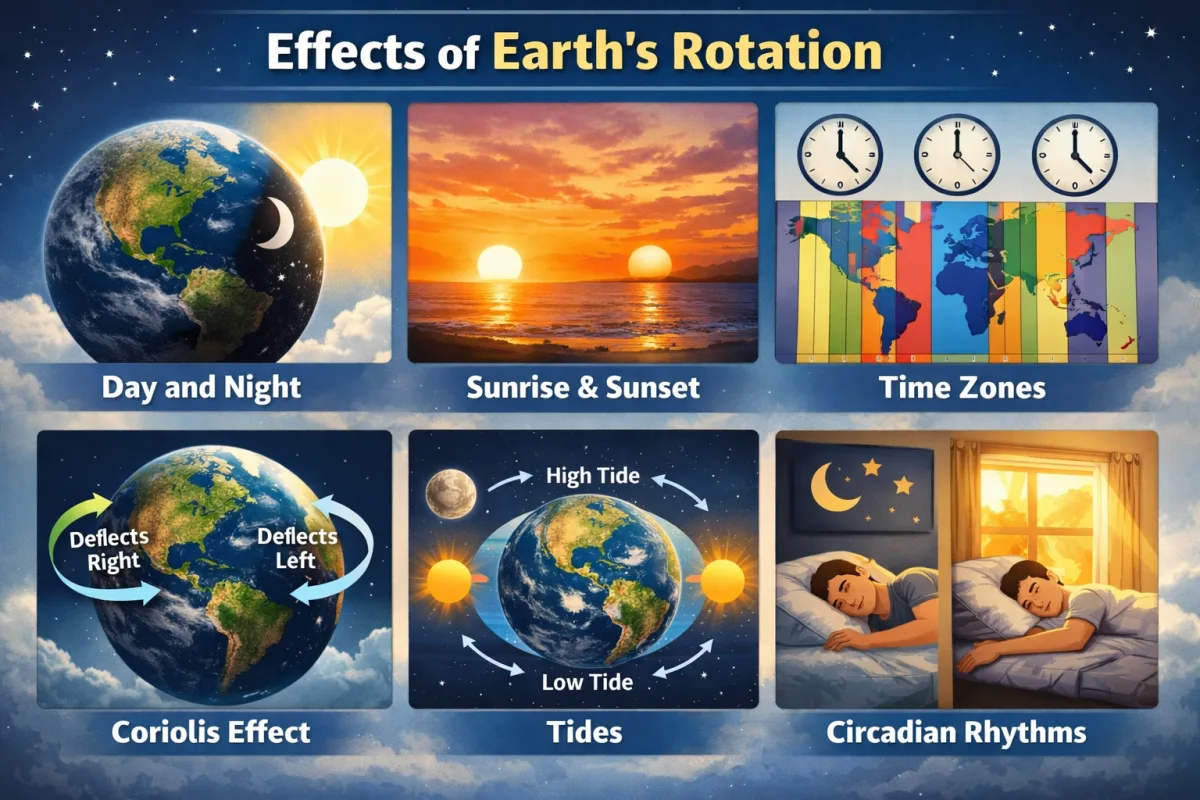
We live on a magnificent, dynamic sphere, constantly spinning. While we don't feel it, our planet's rotation at approximately 1,670 kilometers per hour (1,037 mph) at the equator is one of the most fundamental forces shaping our existence. It's not just a background hum; this ceaseless motion orchestrates a complex symphony of phenomena we often take for granted. Understanding what are the 6 effects of rotation reveals a deeper appreciation for the intricate mechanics of our home.
From the rhythm of our days to the shape of our continents and the very currents that drive our weather, Earth's spin is a master puppeteer. Let's delve into the six profound impacts this daily pirouette has on our world.
The Rhythmic Dance: Day and Night Cycles
Perhaps the most immediate and universally recognized effect of rotation is the cycle of day and night. As Earth spins on its axis, different parts of its surface are alternately exposed to the sun's light and then turned away into shadow. This continuous shift creates the regular rhythm that dictates biological processes, human activity, and even global energy patterns.
Without rotation, one side of Earth would perpetually bake under the sun, while the other would remain frozen in eternal darkness. This wouldn't just be inconvenient; it would render the planet largely uninhabitable. The constant turnover allows for a relatively even distribution of solar energy over a 24-hour period, preventing extreme temperature differentials that would otherwise sterilize our world. It's the most primal clock we know.
Deflecting Forces: The Coriolis Effect
One of the most profound, yet often misunderstood, effects of rotation is the Coriolis effect. This isn't a force in the traditional sense, but rather an apparent deflection of moving objects when viewed from a rotating frame of reference – like our spinning Earth. Imagine throwing a ball directly across a spinning merry-go-round; from the perspective of someone on the merry-go-round, the ball appears to curve.
On Earth, the Coriolis effect deflects moving air and water currents to the right in the Northern Hemisphere and to the left in the Southern Hemisphere. This invisible hand is incredibly powerful, shaping global wind patterns, ocean currents, and even the paths of rockets and long-range artillery shells. It's why hurricanes spin counter-clockwise north of the equator and clockwise to the south, and why ocean gyres create massive circular current systems that redistribute heat around the globe.
Impact on Weather and Ocean Currents
The Coriolis effect is a cornerstone of meteorology and oceanography. It's directly responsible for the formation of trade winds, westerlies, and polar easterlies, which are essential for distributing heat and moisture globally. Without it, winds would simply blow directly from high to low pressure, creating far less complex and less effective atmospheric circulation.
Similarly, vast ocean currents like the Gulf Stream or the Kuroshio Current are steered by this rotational influence. These currents act as planetary conveyors, transporting warm water towards the poles and cold water towards the equator, significantly moderating coastal climates. The effect is also why pilots and navigators must account for Earth's rotation when plotting long-distance routes; ignoring it could lead to significant deviations from a planned trajectory.
Shaping Our World: Earth's Oblate Spheroid
While often depicted as a perfect sphere, Earth isn't quite round. Our planet's rotation causes it to bulge at the equator and flatten at the poles, creating an "oblate spheroid" shape. This is a direct consequence of centrifugal force, which pushes matter outwards from the center of rotation.
Think about spinning a ball of soft clay; it flattens at the top and bottom and widens around the middle. Earth's equatorial diameter is approximately 43 kilometers (27 miles) greater than its polar diameter. This subtle but significant difference means that Mount Everest, while the highest peak above sea level, isn't actually the point furthest from Earth's center. That distinction belongs to Mount Chimborazo in Ecuador, which sits closer to the equatorial bulge.
Navigating Time: The Genesis of Time Zones
Since the sun illuminates only one side of Earth at any given moment, the concept of "noon" — when the sun is highest in the sky — occurs at different times as our planet rotates. This continuous progression necessitates a system to standardize time across different longitudes. Enter time zones, another direct effect of Earth's rotation.
In the 19th century, as railroads and global communication expanded, the need for standardized time became paramount. The world was eventually divided into 24 primary time zones, each roughly 15 degrees of longitude wide, corresponding to one hour of Earth's 360-degree rotation. This ingenious system allows us to synchronize activities globally, ensuring that 9 AM in New York isn't also 9 AM in Beijing, which would be in the middle of their night.
Cosmic Illusions: Apparent Celestial Motion
When you look up at the sky, you see the sun "rising" in the east and "setting" in the west. At night, stars appear to slowly arc across the heavens. This isn't because the sun and stars are moving around us; it's an illusion created by Earth's rotation. Our perspective from a spinning platform makes it seem as though the entire celestial sphere is revolving around us.
This apparent motion is fundamental to how we perceive our place in the cosmos. Ancient civilizations developed sophisticated calendars and navigation techniques based on these perceived movements. The North Star, Polaris, appears relatively stationary in the Northern Hemisphere sky because it's almost directly aligned with Earth's rotational axis, making it a crucial navigational beacon for millennia.
Gravity's Subtle Shift: Understanding Rotational Effects
The centrifugal force caused by Earth's rotation doesn't just create an equatorial bulge; it also subtly affects the pull of gravity we experience. Gravity is technically weaker at the equator than at the poles. There are two main reasons for this.
Firstly, the equatorial bulge means that locations at the equator are further from Earth's center of mass. Since gravitational force decreases with distance, this slightly reduces the gravitational pull. Secondly, the outward-pushing centrifugal force directly counteracts the inward pull of gravity at the equator. While small – roughly 0.5% weaker at the equator compared to the poles – this difference is measurable and has implications for precise scientific measurements, satellite orbits, and even the weight of objects.
What This Means for You
The effects of Earth's rotation aren't just abstract scientific concepts; they're woven into the fabric of our daily lives and our planet's very existence. You rely on the day-night cycle for your sleep patterns and work schedules. Weather forecasts, essential for travel and agriculture, are built upon an understanding of the Coriolis effect. The time on your watch, whether you're calling a loved one across the globe or catching a flight, is managed by time zones. Even your weight is fractionally different depending on your latitude, a testament to the planet's spin.
Understanding these rotational phenomena helps us predict weather, navigate oceans and skies, launch satellites accurately, and appreciate the delicate balance that makes Earth a habitable world. It underscores how deeply interconnected all aspects of our planet are, all orchestrated by that silent, persistent spin.
From the grand sweep of global climate to the subtle shift in gravity beneath your feet, Earth's rotation is an omnipresent force. It’s a constant, silent engine driving many of the natural processes that define our experience. Recognizing these six effects isn't just about scientific curiosity; it's about appreciating the profound and beautiful mechanics of the world we call home.