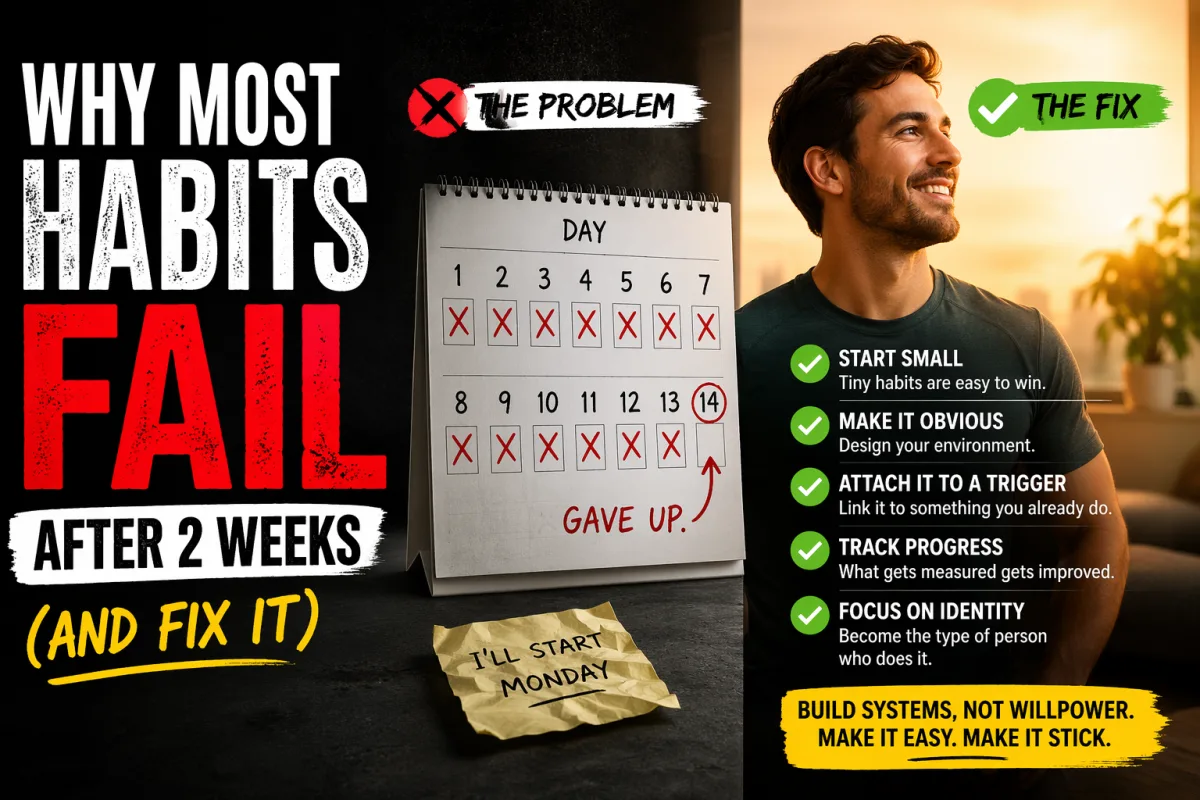
You’ve felt that surge of motivation. The fresh start, the new commitment. Whether it’s daily meditation, an early morning run, or finally learning that language, you dive in with enthusiasm. For a few days, maybe even a week or two, you’re crushing it. Then, almost imperceptibly, the consistency wavers. A missed day turns into two, then three, and before you know it, that promising new habit has vanished. If you’re wondering “Why most habits fail after 2 weeks,” you’re experiencing a widely shared frustration, and it’s not a personal failing. It’s a systemic issue with how we approach change.
The truth is, your initial burst of willpower simply isn’t enough for sustained habit formation. Most people approach new routines with a flawed understanding of human psychology, setting themselves up for inevitable collapse. We often aim too big, too fast, and neglect the critical underlying mechanisms that truly embed a behavior into our daily lives. Let’s unravel the common pitfalls and, more importantly, equip you with the strategies to build habits that actually stick.
The Illusion of Motivation: Why Initial Spark Isn't Enough
That initial rush of motivation feels powerful, doesn’t it? It propels you forward, makes you believe anything is possible. But here’s the stark reality: motivation is fleeting. It’s an emotion, and like all emotions, it ebbs and flows. Relying solely on motivation to drive your new habit is like fueling a cross-country trip with a single tank of gas. You’ll get started, but you won’t make it to your destination.
This reliance on an emotional high is a primary reason why most habits fail after 2 weeks. Research often points to this honeymoon period. A well-known statistic from Strava, the social fitness network, even pinpointed January 19th as "Quitters' Day" for New Year's resolutions, a mere 19 days into the year. That’s precisely when the initial enthusiasm wanes, and the real work begins. We often overestimate our future selves' willpower and underestimate the friction of daily life.
Think about it. On day one, you’re excited. By day fifteen, you’re tired, stressed, or simply bored. If your system relies on you feeling "up for it," you're in trouble. Successful habit-builders understand they need to create systems that function even when motivation is absent. They remove the need for constant decision-making and willpower, automating the process as much as possible.
The Goal-Oriented Trap: Why Focusing on Outcomes Undermines Habit Formation
We're conditioned to set big, audacious goals: "Lose 20 pounds," "Write a novel," "Run a marathon." While admirable, an exclusive focus on these outcomes can actually sabotage your habit-building efforts. When the goal feels distant or overwhelming, and you don't see immediate results, it's incredibly easy to get discouraged. Your brain interprets the lack of instant gratification as a sign to quit.
The problem isn't the goal itself, but rather prioritizing the goal over the process. True habit formation isn't about achieving a single outcome; it’s about becoming the kind of person who consistently takes action. James Clear, author of "Atomic Habits," articulates this beautifully with the concept of identity-based habits. You shouldn't just aim to "read more books"; you should aim to become "a reader."
Shifting to Identity-Based Habits
This subtle shift changes everything. Instead of focusing on the result ("I want to lose weight"), you focus on the identity ("I am a healthy person"). When faced with a choice, a healthy person asks, "What would a healthy person do?" They choose the salad, they go for the walk, they prioritize sleep. This internal shift provides a much more robust framework for decision-making and long-term adherence than simply chasing a number on a scale.
When you adopt an identity, the actions become less about willpower and more about affirming who you are. This makes the habit feel less like a chore and more like a natural extension of your self-concept. It's a powerful psychological lever to prevent new routines from failing after a couple of weeks.
Environment as Architect: Designing Your World for Success
We significantly underestimate the power of our environment in shaping our choices. Your surroundings are constantly nudging you towards certain behaviors, whether you realize it or not. If your goal is to eat healthier, but your kitchen counter is piled with cookies, you’re fighting an uphill battle every single day. If you want to exercise, but your gym clothes are buried in the back of your closet, the friction to start is high.
Successful habit-builders are environmental architects. They proactively design their physical and digital spaces to make desired habits easy and undesired habits difficult. This isn't about superhuman discipline; it's about reducing friction for good behaviors and increasing it for bad ones.
Consider these simple environmental adjustments:
- Make it obvious: Lay out your running shoes and workout clothes the night before. Keep your meditation cushion visible. Place your vitamins next to your coffee maker.
- Make it attractive: Buy a water bottle you love to encourage hydration. Find a workout playlist that genuinely energizes you.
- Make it easy: Pre-chop vegetables for healthy meals. Keep your book on your nightstand. Set up your workspace to minimize distractions.
- Make it difficult (for bad habits): Unsubscribe from tempting email lists. Move unhealthy snacks to a high, out-of-sight shelf, or better yet, don't buy them. Put your phone in another room when you need to focus.
These small, intentional changes stack up. They transform your environment from a source of resistance into a powerful ally, significantly increasing the likelihood your habits will stick beyond the initial two weeks.
The Micro-Habit Revolution: Starting So Small You Can’t Fail
One of the biggest reasons most habits fail after 2 weeks is simply biting off too much. We get excited and commit to an hour of gym time, 30 minutes of journaling, or two chapters of a book every single day. This creates immense pressure and makes the habit feel like a monumental task, especially on days when motivation is low.
The solution? The micro-habit. This strategy involves starting with an absurdly small version of your desired behavior – so small, in fact, that it feels almost ridiculous not to do it. Think one push-up a day, flossing one tooth, reading one sentence, or meditating for 60 seconds. The goal isn't to achieve significant results immediately, but to build consistency and reinforce the identity associated with the habit.
BJ Fogg, a Stanford researcher and author of "Tiny Habits," champions this approach. He argues that consistency trumps intensity, especially in the early stages. The objective is to get repetitions in, to prove to yourself that you can show up, even for a tiny fraction of the desired behavior. Once you’ve consistently performed the micro-habit for a few weeks, you can gradually increase the intensity. That single push-up becomes two, then five, then a full set. This gentle progression prevents burnout and builds confidence, ensuring your habits don't crumble prematurely.
Bouncing Back: The Critical Role of Self-Compassion and Recovery
Let’s be honest: you will miss a day. Or two. Life happens. Sickness, travel, unexpected emergencies – they all disrupt routines. How you respond to these inevitable setbacks determines whether your habit dies or thrives. This is where many people falter, abandoning their new routine entirely because they perceive a single slip-up as total failure.
This all-or-nothing mindset is a major culprit for why most habits fail. Instead of chastising yourself, practice self-compassion. Understand that perfection isn't the goal; consistency over time is. The "never miss twice" rule is incredibly powerful here. If you miss a day, make it your absolute priority to get back on track the very next day. Don’t let one missed day snowball into a week of abandonment.
View setbacks as data points, not declarations of defeat. What made you miss that day? Was your goal too ambitious? Was your environment not supportive? Use the information to adjust your strategy, not to beat yourself up. Recovery is part of the process. It builds resilience and teaches you how to adapt, making your habit-building journey much more sustainable in the long run.
What This Means For You: Building Habits That Last
You now understand that the initial two-week wall isn't a sign of personal weakness, but a predictable hurdle in the habit formation journey. To fix it, you need to shift your approach from relying on fleeting motivation to building robust systems.
Here’s your action plan:
- Start ridiculously small: Choose a micro-habit you can perform in under two minutes, every single day. Make it so easy you can’t say no.
- Anchor your habits: Attach your new micro-habit to an existing, consistent routine. For example, "After I brew my coffee, I will do one push-up."
- Design your environment: Make the desired behavior obvious and easy to perform. Remove temptations for undesired behaviors.
- Focus on identity: Instead of just doing the habit, actively reinforce the identity associated with it. "I am a runner," not "I run."
- Embrace imperfection: When you miss a day (and you will), forgive yourself and get back on track immediately. Never miss twice.
- Track your progress: Use a simple habit tracker (digital or physical) to visually see your consistency. This provides motivation and a sense of accomplishment.
Building lasting habits isn't about grand gestures or superhuman willpower. It's about consistent, small actions, smart environmental design, and a compassionate understanding of your own psychology. Stop blaming yourself for past failures; instead, empower yourself with a system that makes success inevitable. You have the power to create the life you want, one tiny, consistent habit at a time. This isn’t just about sticking to a new routine; it’s about becoming the person you aspire to be.