My Honest Take on the Woehrsh 40X-5000X Microscope
I’ve always been fascinated by the unseen world, and after years of wanting to dip my toes back into microscopy, I finally decided to pick one up here. The Woehrsh microscope caught my eye with its impressive magnification claims and a price point that felt accessible for a beginner. I’ve spent a few weeks putting it through its paces, looking at everything from onion skin to pond water, and I’m ready to share my honest thoughts.
First Impressions & Setup
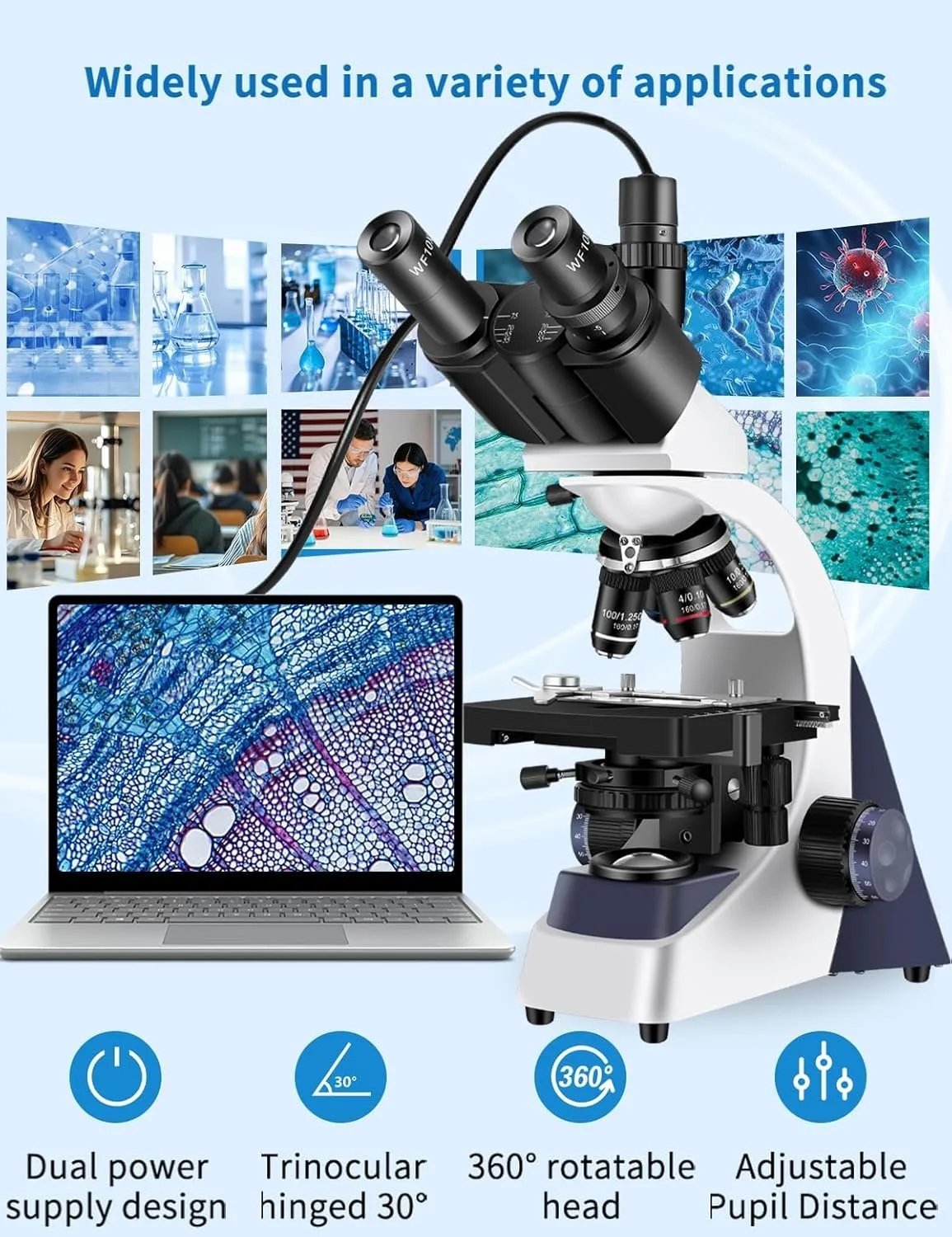
Unboxing the Woehrsh, I was pleasantly surprised by the overall build. It’s not feather-light, which is good; it gives it a stable feel on the desk. The main body felt like sturdy metal, though some components like the eyepiece housings and stage clips are plastic. Setup was straightforward. I just had to attach the eyepieces and plug it in. The dual LED illumination (top and bottom) was a welcome feature, allowing for both transmitted and reflected light, which is crucial for viewing different types of specimens.
Magnification & Image Quality: The Reality of 5000X
Let's address the elephant in the room: the "40X-5000X Magnification" claim. For an optical microscope in this price range, 5000X is usually a theoretical maximum achieved by combining high-power eyepieces with high-power objectives, often pushing the limits of useful magnification. In practice, I found the optical clarity to be excellent up to about 1000X-1250X with the included eyepieces. Beyond that, you start to hit the diffraction limit, and the image gets dimmer and less sharp, even if it's technically "bigger."
However, this isn't a knock on the microscope itself, but rather a common expectation management point for entry-level scopes. At 40X, 100X, 400X, and even 1000X, the views were surprisingly clear and bright. I examined:
- Prepared slides: Onion epidermis, blood smears, plant cross-sections – all showed good detail. The colors were true, and chromatic aberration was minimal at lower to mid-range powers.
- Pond water: This is where the fun really began! I spent hours watching paramecium, hydra, and various algae. The fine focus knob allowed me to track these tiny creatures with reasonable precision.
- Small insects/leaves (using top light): The top LED helped illuminate opaque objects, revealing textures on insect wings and leaf surfaces that are invisible to the naked eye.
The revolving nosepiece clicked firmly into place for each objective, which is a small but important detail for consistent viewing. The overall image quality at useful magnifications impressed me for a product in this category. If you're looking for extreme detail at the very highest theoretical magnifications, you'd need to invest significantly more, but for learning and exploration, this one performs admirably.
Build Quality & Features
The mechanical stage is a huge plus. It’s smooth and allows for precise movement of the slide in both X and Y directions. This is far superior to clip-only stages found on cheaper models, especially when you're trying to follow a moving organism or scan a large area of a slide. The coarse and fine focus knobs are well-calibrated; the coarse knob makes big adjustments quickly, and the fine knob allows for minute, sharp focusing, which is crucial at higher magnifications.
The dual LED illumination is bright and adjustable. I liked having independent controls for both transmitted (bottom) and reflected (top) light. It runs on AC power, which is typical. It also came with a few prepared slides and some blank ones, which was nice to get started right away. No fancy camera attachments or digital eyepieces, but for pure viewing, it’s solid.
What I Loved (Pros)
- Solid Build: Feels substantial and stable, not flimsy.
- Excellent Mechanical Stage: Smooth and precise, a must-have feature for serious viewing.
- Clear Optics (at useful magnifications): Don't expect perfect 5000X, but up to 1000X, the views are surprisingly crisp and bright.
- Dual LED Illumination: Flexible lighting for transparent and opaque specimens, with adjustable brightness.
- Fine Focus Knob: Essential for achieving sharp images, especially at higher powers.
- Good Value: For what you get, the price feels fair. You can check today's price and you'll see what I mean.
What Annoyed Me (Cons)
- The 5000X Marketing: While technically achievable, it sets an unrealistic expectation for optical clarity at that power. Most users will find practical limits around 1000X-1250X.
- Eyepiece Comfort: The eyepieces are decent, but after long viewing sessions, I found them a bit less comfortable than higher-end models. No eye guards were included.
- Limited Accessories: It comes with a basic set of slides, but for a true deep dive, you'll need to invest in a more comprehensive slide kit and tools.
- No Carrying Case: While sturdy, a proper case for storage and transport would have been a nice addition.
Who Should Buy This
This microscope is perfect for:
- Students: Especially middle school to high school, or even early college, for biology classes and science fair projects. It provides a real hands-on learning experience.
- Hobbyists: Anyone with a casual interest in microscopy who wants to explore the unseen world without breaking the bank. Great for examining plants, insects, pond life, or even textile fibers.
- Parents looking for an educational gift: It's robust enough to withstand regular use and provides genuine scientific exploration.
Who Should Skip It
You might want to pass on this if:
- You're a professional researcher: This isn't a lab-grade instrument. You'll need something with higher numerical aperture objectives, better optics, and more advanced features.
- You need a portable microscope: This is a desk-bound unit and not designed for fieldwork.
- You expect crystal clear, high-resolution images at 5000X: As mentioned, the practical optical limit is lower, and if your primary goal is extreme magnification, you'll be disappointed.
Final Thoughts & Recommendation
Overall, the Woehrsh 40X-5000X Microscope is a solid performer for its intended audience. It's a well-built, capable instrument that provides genuine insight into the microscopic world. It balances features, performance, and price very well. I've had a lot of fun using it, and it's certainly rekindled my interest in microscopy. If you're a student, a curious hobbyist, or just looking for an engaging educational tool, I think you'll be quite happy with this. Considering the features and performance, I think it's a solid buy for hobbyists. You can grab it on Amazon.