Astrophysics
16 articles on this topic
How Gravity Affects Small vs Large Objects
Think gravity treats all masses equally? Not quite. While acceleration is uniform, the *observable impact* of gravity dramatically changes with scale, often masked by forces we ignore.
What Happens When Two Forces Collide
Beyond destruction, collisions forge new realities. Discover the hidden science of emergence when powerful forces clash, reshaping everything from atoms to galaxies.
Why Do Some Stars Appear Brighter Than Others?
It's not just distance or size. Hidden cosmic dust and Earth's own air dramatically skew how we perceive stellar brilliance, making some giants fade and dwarfs dazzle.
Why Do Planets Orbit in the Same Direction?
Our solar system's orderly planetary ballet hides a turbulent past. While most orbit uniformly, it's the chaotic exceptions that unlock the universe's true formation secrets.
Why Nothing Can Escape Extreme Gravity
Gravity’s grip is powerful, but at its extremes, it becomes an inescapable prison. Explore the mind-bending physics behind why even light can't break free from cosmic behemoths.
The Mystery of Fast Radio Bursts Finally Explained
For years, these sudden, powerful cosmic flashes stumped astronomers. Now, we finally have a definitive answer to their perplexing origin.
The Most Extreme Planets Ever Discovered
Forget everything you thought you knew about planets. Beyond our cozy solar system, worlds exist where the laws of physics seem to bend, pushing the boundaries of what's possible.
How Stars Are Born and How They Die
Witness the incredible cosmic drama of stellar evolution. From swirling gas clouds to explosive deaths, stars fuel the universe's grandest cycles.
The Largest Explosion Ever Recorded in Space Explained
Imagine an explosion so powerful it carved a crater into the cosmos. We’re talking about an event that makes supernovas look like firecrackers.
 Science
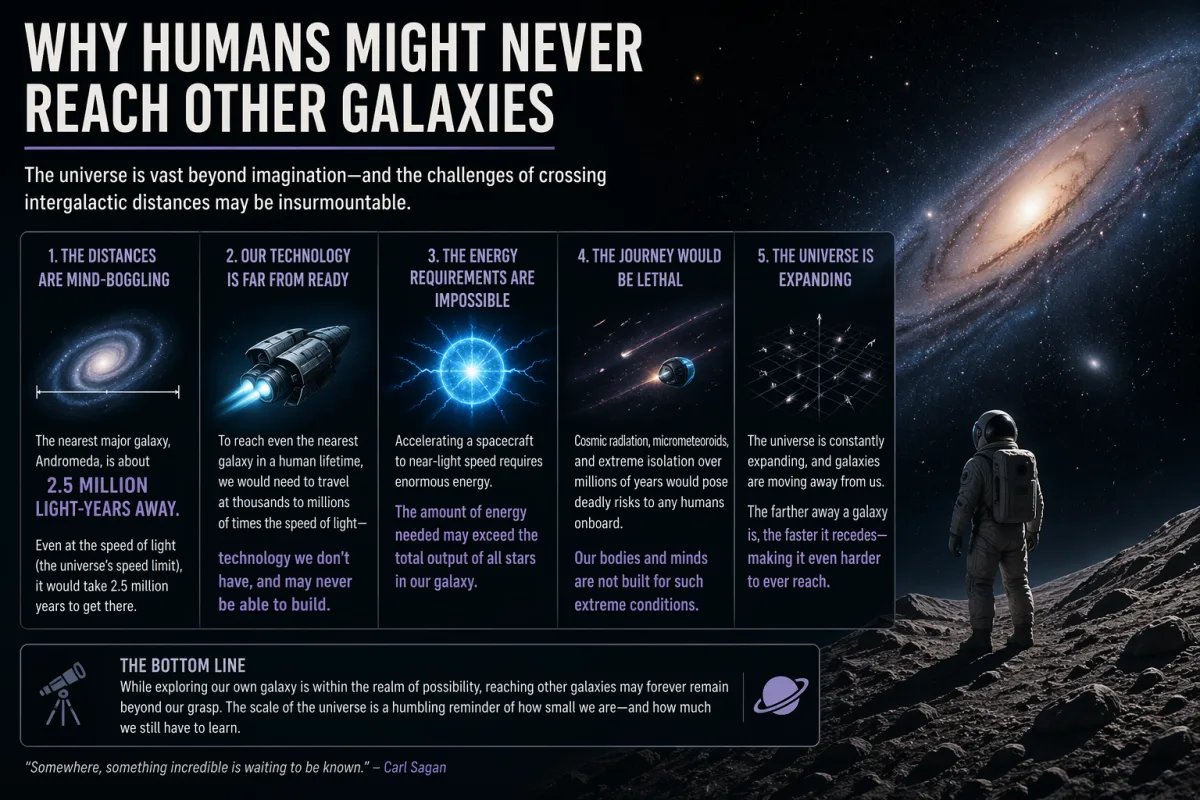
Why Humans Might Never Reach Other Galaxies
The dream of intergalactic exploration burns bright, but the cold, hard realities of physics and biology present an almost insurmountable barrier. We might be forever bound to our own cosmic neighborhood.
A New Discovery in Space Could Rewrite Astronomy
A cosmic observation just rattled the foundations of astrophysics. Prepare for a universe far stranger and more complex than we ever imagined.
What If the Sun Suddenly Disappeared for 1 Second?
Imagine our star simply vanishing. While the light takes minutes to reach us, a 1-second solar disappearance would unleash a sudden, invisible gravitational shockwave.