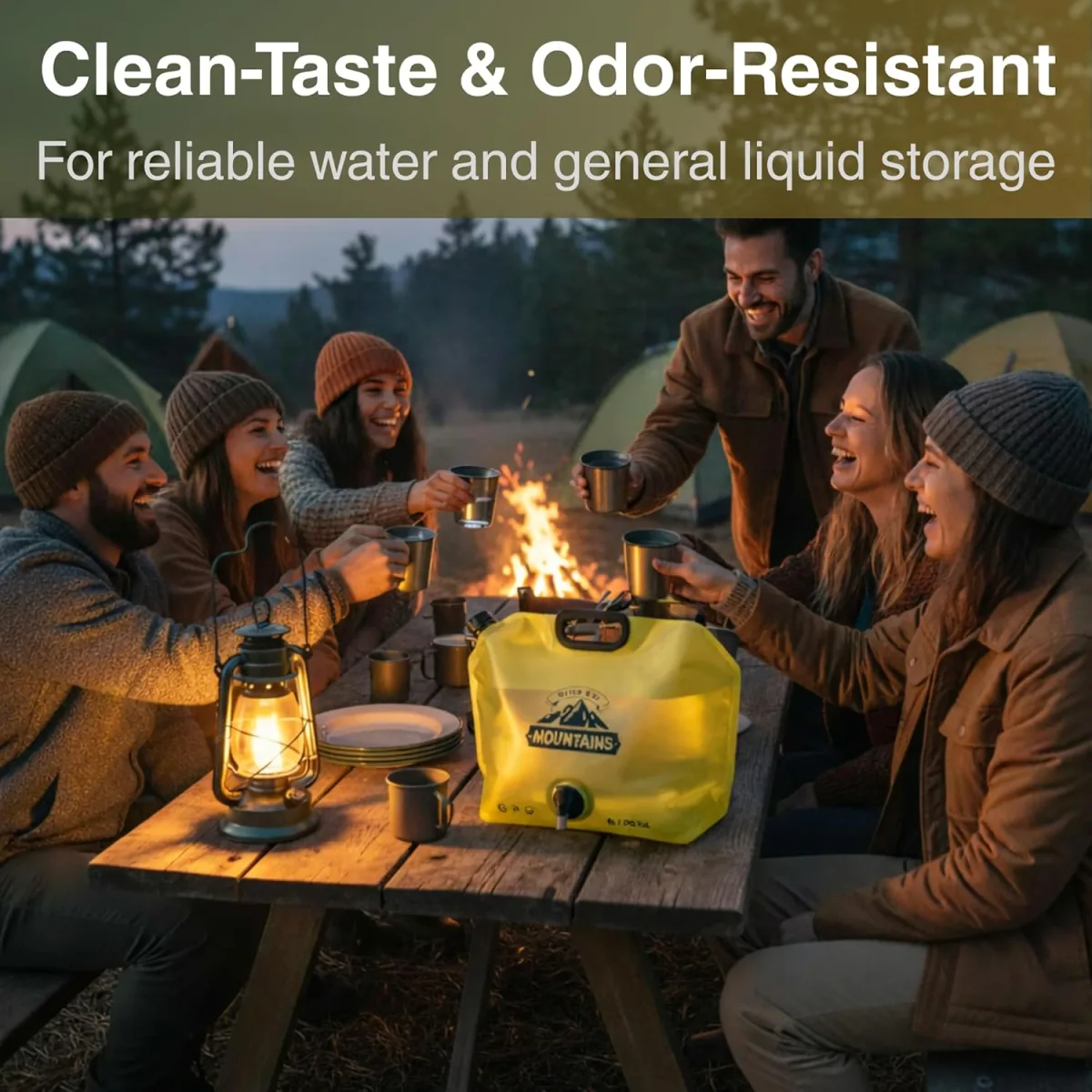
When the CoreMuse 2-Gallon Collapsible Water Jug arrived, I wasn't entirely sure what to expect. The package was surprisingly small and light, just a simple plastic bag containing the folded-up jug. My first impression was how thin the plastic felt, almost like a heavy-duty freezer bag, but with a definite structure when you tried to open it up. There was a faint, distinct "new plastic" smell when I uncrumpled it, which is something I always check for with food-grade containers. My initial thought after giving it a good rinse and filling it with tap water was that it felt a lot less rigid than I'd imagined. As the water filled it, the jug swelled into its rough rectangular shape, but it still wobbled and slumped on my counter. That was the moment I knew this wasn't going to be a sturdy, set-it-and-forget-it kind of container; it was going to require some careful handling.
- Who this is best for: Backpackers needing ultra-lightweight, occasional use water storage, or anyone building an emergency prep kit for static storage.
- Standout feature: Its exceptional collapsibility; it genuinely folds down to almost nothing, which is fantastic for saving space.
- The single biggest limitation or frustration: The inherent floppiness and slow, awkward pouring experience, especially when it's not completely full.
- Value assessment: It's worth the price for its specific niche (lightweight portability and static emergency storage), but don't expect the robustness or ease of use of a rigid jug. It's a budget-friendly compromise.
First Impressions and Build Quality
Out of the package, the CoreMuse Camping Water Container feels like a heavy-gauge, clear plastic, specifically a BPA-free polyethylene. It's pliable, almost like a very thick, clear plastic bag, but it has enough integrity to hold its form when completely filled. When empty, it literally weighs less than 4 ounces, which is incredibly light. This featherlight aspect is definitely one of its most appealing features. The finish is smooth, and the plastic itself is transparent, allowing you to easily see the water level inside, which is a practical touch for monitoring your supply. The packaging was as basic as it gets – just a simple plastic bag, no frills, which probably contributes to its lower price point. I unfolded it, and the creases from being collapsed were quite prominent, though they softened slightly once filled with water.
The jug features a simple screw-on cap over a push/pull spout, similar to what you'd find on a bicycle water bottle, but scaled up a bit. The cap feels secure, and I appreciate that it's tethered to the spout assembly, so you're less likely to lose it in the wilderness. The seams where the plastic panels are fused together are the parts I scrutinized most closely. They appear to be heat-sealed and fairly robust, but they're obviously the weakest structural points. Any significant pressure or abrasion on these seams could potentially lead to a leak down the line. The integrated handle is a simple molded loop of the same plastic, positioned on the top. It feels adequate for carrying the jug when full, but I wouldn't trust it for any kind of rough handling or swinging. It's meant for transportation, not for providing leverage during pouring, which I'd soon discover was a significant distinction.
Overall, what tells me it's "well-made" for its intended purpose is its simplicity and the fact that it holds water without leaking, at least initially. It's not a rugged piece of expedition gear, and it doesn't pretend to be. It's a functional, budget-friendly collapsible container. Its quality is proportionate to its price – it's not premium, but it's not flimsy either. It feels like it's built to perform its basic function without unnecessary complexity or bulk, making it a viable option for those who prioritize lightweight and compact storage above all else. If you're looking for something that can take a beating, you'll likely need to spend a lot more money for a different type of material or design.
Key Features Worth Knowing
I spent a good three weeks putting this CoreMuse jug through its paces, and here's my honest take on its advertised features:
- Collapsible Design: This is, without a doubt, its strongest selling point. When empty, it truly flattens down to a minimal footprint, perhaps an inch thick. This is incredibly practical for packing into a backpack, an emergency kit, or even just stashing in the car without taking up valuable space. I've got a small camping bin, and this jug just slid right in alongside other gear without a fuss. It's far superior in space-saving to any rigid jug I own.
- 2-Gallon Capacity: Two gallons (about 7.5 liters) is a really useful amount. It's enough for a day or two of drinking water for one person, or for cooking and some light washing on a short camping trip. It's a good balance between capacity and manageable weight when full; at 16 pounds, it's heavy but still liftable. I found it perfect for refilling smaller water bottles rather than carrying one large, heavy jug everywhere.
- Integrated Spout: The pull-out spout is a double-edged sword. On one hand, it's convenient that it's built-in and doesn't require separate pieces. On the other, the flow rate is quite slow. It's fine for filling a cup or a small bottle, but trying to fill a cooking pot or a larger reservoir can feel like it takes forever. It's not designed for high-volume pouring, and the small opening means it can get easily clogged by any tiny particles if you're filling from a natural source without a filter.
- Sturdy Carry Handle: The handle is indeed sturdy enough for carrying the full two gallons. I didn't feel like it was going to tear or break, even with the weight. However, it's important to differentiate between "carry" and "control." While I could carry it from the water source back to camp, using that same handle to accurately pour was another story entirely due to the jug's flexibility.
- BPA-Free Material: This is a non-negotiable for me with any water storage container. Knowing it's BPA-free gives me peace of mind about drinking from it, even if the initial plastic taste was a minor concern. It's an important health and safety feature that I expect from any modern food-grade plastic product.
- Surprise Feature (Negative): The Floppiness: What truly surprised me – and not in a good way – was just how incredibly floppy the jug becomes once it’s less than about three-quarters full. When it’s completely full, the water provides enough internal pressure to give it some structure, allowing it to stand on its own, albeit with a slight wobble. But as soon as you've used a liter or two, it starts to lose its shape dramatically. It slumps, bows, and struggles to stand upright without external support. This floppiness makes pouring progressively more difficult and messy, requiring two hands and careful balancing, which really limits its practicality in many situations. I truly expected it to retain some more rigid structure, even when partially empty, but that's just not the case with this particular design.
Real-World Performance
Living with the CoreMuse 2-gallon jug for three weeks gave me a very clear picture of its strengths and, more importantly, its weaknesses. I wasn't just testing it; I was relying on it for various water needs around the house and during a weekend camping trip. This wasn't a gentle lab test; it was real life.
Camping Scenario: Weekend Trip
My first true test was a two-night car camping trip. I brought the jug primarily for handwashing and for replenishing our smaller drinking bottles. Filling it at the campsite's communal spigot was straightforward, though its floppiness meant I had to hold it upright with one hand while filling with the other. Once full, the 2-gallon jug felt heavy but manageable to carry back to our site, roughly 50 yards, by the top handle. It weighed about 16 pounds, which is a good workout.
The real challenge came when trying to use the spout. When I used it for washing hands, the slow flow rate was actually okay, but it required a steady hand. My frustration really started when I tried to fill our kettle for morning coffee. The jug, being full, was heavy and wanted to distort. I had to hold the handle with one hand and support the bottom with the other, trying to aim the slow stream into the kettle's narrow opening. Despite my best efforts, water inevitably sloshed onto the picnic table. It's just not designed for precision pouring, especially with a full, heavy, flexible container. As it emptied, the floppiness increased, making two-handed pouring a must, and even then, it felt like I was wrestling an angry water balloon. For cooking, I ended up just unscrewing the entire spout assembly and pouring from the wider mouth, which was faster but even messier.
Emergency Home Storage: Pantry Test
After the camping trip, I cleaned the jug and filled it for emergency water storage in our pantry. This is where its collapsibility truly shines. I filled it completely, secured the cap, and tucked it into a corner. It sat there for over a week without any issues. No leaks, no sweating, just static storage. The clear plastic allowed me to easily see that the water level hadn't dropped, confirming its integrity for this purpose. If you're buying this primarily to stash away for a "just in case" scenario, where it won't be moved or jostled often, it performs admirably. It's a good way to have a few extra gallons of water on hand without dedicating space to bulky, rigid containers. Retrieving it and pouring from it after a week was still the same awkward experience, reinforcing that this isn't its strong suit.
Day Hike & Backpacking Simulation
I also tried a "day hike simulation" by filling it halfway and putting it in my backpack. This was a poor experience. The partially filled jug sloshed around significantly, its floppiness translating into an unbalanced weight distribution that shifted with every step. The handle isn't really designed for strapping onto the outside of a pack, and putting it inside meant I had to be very careful to avoid puncturing it with other gear. If you're truly backpacking, you're better off with a more rigid, purpose-built bladder or bottle system that integrates better with pack design and offers more protection.
Cleaning and Maintenance
Cleaning this jug is a chore. The opening for the spout is too small to get your hand inside, so you're reliant on bottle brushes. Even with a good brush, it's hard to reach all the corners and ensure it's completely scrubbed clean, especially with the way it collapses. Drying is an even bigger headache. Because it's so flexible and wants to fold in on itself, air circulation inside is minimal. I had to prop it open with a small towel and hang it upside down for over 24 hours to ensure it was completely dry, otherwise, I'd worry about mildew or funky smells developing. This is a significant drawback for regular use.
The plastic taste, which I mentioned earlier, was present for the first two fills, even after multiple rinses. It wasn't overpowering, but it was noticeable enough to detract from the freshness of the water. After about a week of use and refills, it seemed to diminish, but never entirely disappeared for me. If you're sensitive to plastic tastes, this is definitely something to consider.
| Feature | Camping Water Container 2 Gallon Collapsible Water Jug with Spout - Reusable Plastic Flasks, Foldable Empty Gallon Jug for Water Storage, Water Bag for Outdoor Hiking Emergency Prep (1 Pack) | Competitor A: Reliance Aqua-Tainer 2 Gallon Rigid Water Container | Competitor B: Platypus 2.0L (approx. 0.5 Gallon) Foldable SoftBottle |
|---|---|---|---|
| Material | BPA-Free PE (Polyethylene) - flexible, clear | BPA-Free HDPE (High-Density Polyethylene) - rigid, opaque | BPA/BPS/Phthalate-Free PE/PU - highly flexible, transparent |
| Capacity | 2 Gallons (approx. 7.5 Liters) | 2 Gallons (approx. 7.5 Liters) | 2 Liters (approx. 0.5 Gallons) - note smaller capacity for comparison |
| Spout Type | Push/Pull Spout with Screw Cap | Spigot/Faucet (often with vent cap) | Standard Screw Cap (no integrated spout) |
| Empty Weight | ~4 oz (extremely light) | ~1.5 lbs (significantly heavier) | ~0.8 oz (ultra-light, for smaller capacity) |
| Collapsibility | Excellent, folds almost flat | None, rigid structure | Excellent, rolls or flattens completely |
| Price Range | Low ($) | Medium ($$) | Medium-High ($$$ for comparable volume, but typically sold in smaller sizes) |
| Durability | Good for light/static use, potential for punctures/seam issues with rough handling | Very high, resistant to punctures/drops, long-lasting | High for its material type, designed for rugged use, but can be punctured |
| Ease of Pouring | Challenging and slow, especially when partially full; requires two hands | Easy and controlled with integrated spigot, often one-handed operation | Requires unscrewing cap; generally easy for smaller volumes, but no spout |
| Ease of Cleaning | Difficult due to narrow opening and floppiness; hard to dry completely | Easier with wider opening, though spigot can be tricky; good airflow for drying | Moderately easy, wider opening, dries quickly if propped open |
| Ideal Use Case | Emergency prep, lightweight car camping, occasional backup | Basecamp, car camping, long-term storage, rugged use | Backpacking, ultralight travel, daily hydration |
Pros and Cons
After weeks of testing, here's my balanced list of what I loved and what genuinely frustrated me about this jug.
Pros:
- Ultra-Lightweight When Empty: This is a huge plus. At just a few ounces, it adds virtually no weight to your pack or emergency kit, which is fantastic for minimalist setups.
- Exceptional Collapsibility: It folds down flatter than a pancake. This is its standout feature, making it incredibly easy to store in tight spaces or pack away when not in use.
- BPA-Free Material: I always appreciate knowing that my water containers are made from safe, food-grade materials. It's a basic expectation, but one that this jug meets.
- Transparent Design: Being able to see the water level at a glance is more convenient than you might think. It helps you monitor your supply without guessing.
- Budget-Friendly Price Point: For what it offers in terms of capacity and collapsibility, it's a very affordable option, especially compared to more robust or rigid alternatives. You can check today's price and you'll see it's quite accessible.
- Adequate for Static Storage: If you're just filling it and leaving it in a pantry or car for emergency purposes, it holds water without issues.
- Integrated Handle: The handle is sturdy enough to carry a full 2 gallons without feeling like it's going to rip, which is essential.
Cons:
- Awkward and Slow Pouring: This is my biggest gripe. The spout's flow rate is too slow for anything beyond filling a small cup, and the jug's inherent floppiness makes precise pouring a two-handed, often messy, operation.
- Poor Structural Rigidity (Especially When Partial): When not completely full, it loses all structural integrity, slumping and making it impossible to stand on its own without support. This greatly impacts usability.
- Challenging to Clean and Dry: The narrow opening combined with its flexibility makes internal cleaning a real chore. Getting it completely dry to prevent mildew is even harder.
- Initial Plastic Taste: For the first few uses, the water had a noticeable plastic taste. While it faded, it was never entirely absent for me, which can be off-putting for pure drinking water.
- Durability Concerns for Rugged Use: While it held up during my tests, I wouldn't trust it for anything but very gentle outdoor use. It feels susceptible to punctures or seam leaks if dropped or scraped against rough surfaces.
- Difficult to Fill from Natural Sources: Its lack of rigidity makes it collapse on itself when trying to scoop water from a stream or pond, often requiring two hands and considerable effort to keep it open.
Diving into other Amazon reviews for the CoreMuse 2-Gallon Collapsible Water Jug, I noticed a few recurring themes that largely align with my experience. Many buyers praise its primary benefit: the incredible space-saving collapsibility, often highlighting its usefulness for emergency kits, car camping, or as a lightweight backup. They frequently mention the convenience of being able to store 2 gallons of water without taking up significant space. The affordability is another common positive, with many feeling it offers good value for its price. However, the recurring complaints are also very consistent. The most frequent frustration centers around the difficulty of pouring, often described as slow, messy, or requiring two hands, especially as the jug empties and becomes floppy. Users also often mention an initial plastic taste, echoing my own experience, and some express concerns about its long-term durability, with a few reviews mentioning seam leaks or punctures after minimal use. It seems the general consensus is that it's great for static storage or occasional, gentle use, but falls short for demanding, active scenarios.
Who Should Buy This — And Who Should Skip It
Buy this if…
- You need ultra-lightweight, compact water storage for occasional use: If space and weight are your absolute top priorities, and you're not planning on roughing it too hard, this jug is excellent. It folds down to almost nothing.
- You're building an emergency kit and need static water storage: For tucking away in a closet, car trunk, or bug-out bag where it won't be moved frequently, its collapsibility and capacity make it a smart choice. It's a cheap way to store a decent amount of water.
- Your primary use is car camping where it won't be jostled much: If you're setting up a base camp and simply need to transport water from a spigot to your campsite for refilling smaller bottles, it's perfectly adequate. Just be prepared for less-than-elegant pouring.
- You're on a tight budget and need a temporary water solution: For its price, it offers a lot of capacity. If you need a few gallons of water storage without breaking the bank, this is a solid, economical option. You can view on Amazon and see what others paid, it's quite competitive.
Skip this if…
- You need a robust, durable jug for rugged backpacking or frequent, heavy-duty outdoor use: This jug isn't built for abuse. It's not going to withstand drops, scrapes, or being jammed against sharp objects in a pack. Look for something like a MSR Dromedary or a rigid container instead.
- You require fast, precise pouring for cooking or multiple people: The slow, awkward spout and the jug's floppiness make it ill-suited for any situation where you need quick, controlled dispensing of water. It's too frustrating for frequent cooking tasks.
- You prioritize ease of cleaning and completely taste-free water from the first use: If you're particular about taste or need a container that's super easy to sanitize and dry thoroughly, this isn't it. The cleaning process is cumbersome.
- You need a container that stands rigidly on its own, even when partially full: If you envision setting a partially filled jug on a table and easily pouring from it, you'll be disappointed. It collapses into a shapeless blob, requiring constant support.
Final Verdict
After three weeks of living with the CoreMuse 2-Gallon Collapsible Water Jug, I'd give it an honest 3.5 out of 5 stars. It excels in its core promise of being lightweight and incredibly collapsible, which makes it a fantastic option for space-constrained situations like emergency kits or minimalist car camping. It does hold 2 gallons of water, and it does so without leaking in static conditions. However, its significant drawbacks in terms of pouring difficulty, cleaning, and overall floppiness once partially emptied prevent it from being a truly versatile or enjoyable everyday outdoor companion.
Its best use case is undoubtedly as a backup water source for emergency preparedness or for very light-duty car camping where you're primarily just transporting water to a base camp. Would I buy it again? For my specific needs, which often involve more rugged camping and easier dispensing, probably not as my primary water jug. I'd invest in something more rigid or with a better spigot. But, if I needed a super affordable, compact, and lightweight container for an emergency kit, or a very occasional, gentle use, I'd consider it again. It's a product that delivers on its most advertised features, but with notable compromises in user experience that potential buyers should be fully aware of before they decide to pick one up here.
Frequently Asked Questions
Is it truly leak-proof during transport or storage?
When the cap is securely tightened and the spout is pushed fully in, I found the jug to be leak-proof during static storage in my pantry. During transport on my camping trip, I didn't experience any leaks while it was upright in the car. However, due to its flexible nature, I'd be cautious about tossing it around or subjecting it to significant pressure, as that could potentially stress the seams or the spout assembly over time.
How hard is it to clean inside the jug?
It's quite challenging, to be honest. The opening for the spout is too narrow for an adult hand, so you'll definitely need a long bottle brush to reach the bottom and sides. Even with a brush, getting into all the creases and corners can be difficult, and the jug's floppiness makes it hard to hold it open and scrub effectively. Thoroughly drying it afterwards is also a hassle, requiring it to be propped open and hung upside down for a long time to prevent mildew.
Does the water taste plasticky from this jug?
Yes, for the first few fills, I definitely noticed a distinct plastic taste in the water. I rinsed it thoroughly multiple times before first use, but the taste still lingered. It seemed to fade somewhat after about a week of regular use and refills, but I never found the water to be entirely taste-free, which is a common complaint with many plastic water containers. If you're very sensitive to plastic flavors, this might be an issue for you.
Can this jug stand up on its own when it's not completely full?
Not really, and this was one of my biggest frustrations. When the jug is completely full, the water provides enough internal pressure to give it a somewhat stable, albeit slightly wobbly, base. However, as soon as you've used a liter or two, it loses that structure and becomes very floppy. It will slump and fall over if not supported, making it quite awkward to handle and pour from when it's partially empty.