When the little brown box arrived on my doorstep, I wasn't expecting fireworks. My goal was simple: bring an old, dusty OptiPlex 7010 SFF back to life with multi-monitor support, and maybe, just maybe, handle some light 1080p video playback without a hitch. Integrated graphics just weren't cutting it anymore. Unboxing the Glorto GeForce GT 730 4G Low Profile Graphics Card, the first thing I noticed was how incredibly compact it was. It felt almost toy-like, weighing hardly anything at all, maybe around 200 grams if I had to guess. The fan, a small, unassuming 40mm or 50mm affair, looked ready to spin into action. There was that faint, distinctive smell of new electronics, a mix of plastic and circuit board, that always signals a fresh gadget. My first thought was, "This is either going to be a perfect fit for my tiny case, or it's going to be completely underpowered." The moment of truth would come with the installation, but even before that, I knew this wasn't a powerhouse; it was a specialist.
- Who this is best for — Users with older PCs (pre-2015), SFF/HTPC builds, or those needing basic multi-monitor support (3+ displays) for productivity, not gaming.
- Standout feature in one concrete sentence — Its comprehensive array of display outputs (2x HDMI, DP, VGA) in a single-slot, low-profile design is genuinely impressive for legacy and modern setups.
- The single biggest limitation or frustration — Gaming performance is virtually non-existent for anything beyond very old or extremely undemanding titles, despite the 4GB VRAM.
- Value assessment — It's worth the price if you absolutely need its specific combination of low-profile, multi-output, and low-power features for non-gaming tasks, but often feels a bit overpriced compared to slightly newer used cards that offer better performance.
First Impressions and Build Quality
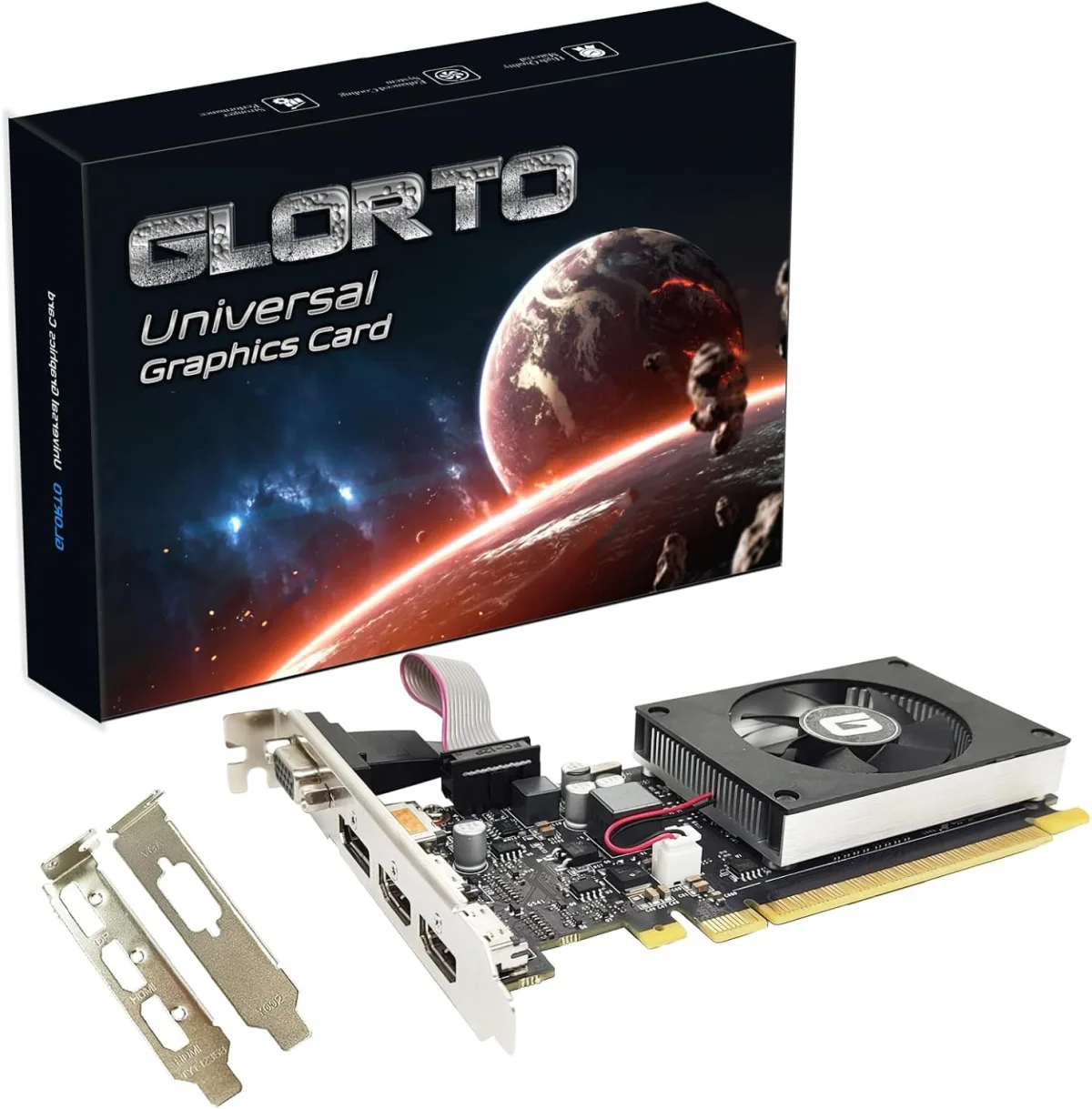
From the moment I pulled it out of its anti-static bag, the Glorto GT 730 exuded a sense of utilitarian design. It's not flashy, it's not a showpiece, and it doesn't try to be. The card itself is remarkably short, making it ideal for the cramped confines of a Small Form Factor (SFF) PC case, like the Dell OptiPlex I was installing it in. The PCB is a standard green, and the cooler is a simple aluminum heatsink with that small, single fan mounted directly on top. It's a single-slot design, which is another huge plus for those restrictive cases where every millimeter counts. Glorto includes both a full-height and a low-profile bracket in the box, which was a thoughtful touch and saved me the hassle of finding a separate one. Swapping the bracket was straightforward, requiring just a few small screws.
The materials felt adequate for the price point. The metal of the brackets was sturdy enough, and the fan housing felt like standard injection-molded plastic. There were no sharp edges or shoddy soldering that I could spot, which is always a relief with budget-friendly components. The ports – two HDMI, one DisplayPort, and one VGA – were all neatly aligned and felt secure. This card isn't built to be admired through a tempered glass side panel; it's built to sit quietly in a small, unassuming case and just do its job. It doesn't require any external power connectors, drawing all its juice directly from the PCIe slot, which is fantastic for older power supplies that might lack modern connectors, or for users who simply want to keep cable management minimal. Overall, it tells me it's built to a budget, but with a clear understanding of its target niche. It’s not luxurious, but it’s functional and compact, which, for many buyers, is exactly what they need.
Key Features Worth Knowing
This little card packs a few features that, depending on your needs, can be a lifesaver or a complete waste. Here's what I found most noteworthy after living with it for a few weeks:
- GeForce GT 730 GPU with 4GB DDR3 VRAM: Let's be brutally honest here. The GT 730 is an ancient GPU architecture, released back in 2014. The 4GB of DDR3 VRAM is almost entirely marketing fluff. For a GPU of this caliber, 4GB of *slow* DDR3 memory provides virtually no performance benefit over 1GB or 2GB. It's not going to make a game playable that wasn't already playable with less VRAM, nor will it significantly speed up video processing. It's there, but don't let the "4G" number fool you into thinking it's a gaming card. It's primarily useful for storing textures for multiple displays, not for high-resolution gaming.
- Low Profile, Single Slot Design: This is, without a doubt, the card's strongest suit. If you have a Small Form Factor (SFF) PC, a slim desktop, or an old workstation with limited space, this card is designed to fit. Its single-slot width means it won't block adjacent PCIe slots, which can be crucial in tight builds. It slipped into my OptiPlex 7010 with room to spare, which was a huge relief.
- Multiple Display Outputs (2x HDMI, 1x DP, 1x VGA): This was the main reason I bought it, and it delivered. I was genuinely impressed by the versatility. Having two HDMI ports, a DisplayPort, and a legacy VGA port means you can connect almost any monitor, old or new, without needing an adapter. I successfully ran three monitors simultaneously – one via HDMI, one via DisplayPort, and an older secondary monitor via VGA – for an extended desktop setup. This is where the card truly shines for productivity users or those building an HTPC that needs to connect to various displays.
- PCI Express 2.0 x8 Interface: Another nod to its older architecture. While modern cards use PCIe 3.0 or 4.0 (or even 5.0) with x16 lanes, the 2.0 x8 interface is perfectly adequate for the GT 730's limited bandwidth needs. It means it's compatible with a vast range of older motherboards, which is exactly the kind of system this card is designed to upgrade. It won't bottleneck this GPU's performance in any meaningful way.
- Windows 11 Compatibility: Despite its age, I was pleasantly surprised that Windows 11 detected it immediately and installed a generic driver. A quick download of the latest NVIDIA drivers from their website (the ones for the GT 730 are still readily available) brought it fully up to speed. It’s good to know you won't be stuck on an older OS just to get display output.
- Surprise Feature: Passive Cooling (at idle) / Quiet Fan: While it has a fan, I was pleasantly surprised by how quiet it was during light use. For HTPC or office work where the GPU isn't under heavy load, the fan often spins at a very low RPM or even stops entirely, making it practically silent. When I pushed it a bit, the fan did spin up, but it wasn't overly loud or obnoxious. This was a welcome change from some other budget cards I've tried. If you're looking for a card that blends into the background noise, this one does a decent job, especially for the price. If you want to check today's price, you'll see it's positioned as a very affordable upgrade.
Real-World Performance
Living with the Glorto GT 730 for three weeks has been an exercise in managing expectations. It's not a wonder card, but it does exactly what it's supposed to do for its intended audience, with some clear limitations.
Scenario 1: HTPC and Video Playback (1080p Streaming)
My primary use case for the first week was turning my old OptiPlex into a dedicated HTPC. I hooked it up to my 1080p TV via HDMI, and then another 1080p monitor for browsing. Streaming Netflix, YouTube, and Disney+ in full 1080p was absolutely smooth. There was no stuttering, no dropped frames, and the picture quality was crisp. The GT 730 handles hardware-accelerated H.264 video decoding well, which is what most streaming services still rely on heavily. I even tried a few 4K YouTube videos. While it could play them, it leaned heavily on the CPU, and some very high bitrate 4K content occasionally showed minor hitches. But for standard 1080p streaming, it's a champ. The fan remained quiet throughout these tasks, which is crucial for an HTPC environment.
Scenario 2: Multi-Monitor Productivity
This is where the card truly excelled for me. I connected a 1080p monitor via HDMI, a 1440p monitor via DisplayPort, and an older 1280x1024 monitor via VGA. The Glorto GT 730 handled all three outputs simultaneously without a single hiccup. Running multiple browser tabs, Microsoft Office applications (Word, Excel, Outlook), Slack, and even a video conference call on one screen while having documents open on another was completely fluid. Windows 11's desktop environment was responsive, windows snapped quickly, and there was no noticeable lag when dragging applications between screens. For anyone needing to drive multiple displays on an older system for office work or light content creation, this card is a revelation compared to struggling with integrated graphics. It completely transformed my productivity setup on the old machine.
Scenario 3: Light Gaming (and Frustrations)
I had to try, didn't I? Despite knowing it wasn't a gaming card, I wanted to see its limits. I installed an older version of Minecraft. At 1080p with moderate settings, it was barely playable, maybe hitting 20-25 FPS in open areas, dipping lower when things got busy. Reducing the resolution to 720p and lowering all settings made it more tolerable, around 30-40 FPS. I also tried an older eSports title, League of Legends. At 1080p, lowest settings, it was somewhat playable, hovering around 40-50 FPS, but with noticeable frame drops in team fights. Anything more demanding, like CS:GO or Valorant, was a slideshow even at the lowest settings and 720p. The fan spun up quite audibly during these attempts, becoming a noticeable whir. My biggest frustration here is that the "4G" VRAM gives a false impression. It simply doesn't have the processing power to utilize that much memory for gaming. It’s not meant for gaming, and trying to force it into that role quickly exposes its severe limitations. After experiencing its limitations and strengths firsthand, I sometimes wonder if I should have just spent a bit more, but for what I needed, it delivered. You can grab it on Amazon if your needs align.
Scenario 4: SFF PC Compatibility and Power Draw
Fitting it into my SFF OptiPlex was a breeze, especially with the included low-profile bracket. The single-slot design meant I didn't have to worry about airflow or blocking other components. Power consumption is incredibly low, typically around 20-30W under load, well within the limits of even a basic 200-250W power supply often found in older SFF machines. This makes it a perfect drop-in solution for upgrading such systems without needing a PSU upgrade.
Comparison Table
To give you a better idea of where the Glorto GT 730 stands, here's how it stacks up against a couple of other entry-level low-profile options you might consider:
| Feature | Glorto GeForce GT 730 4G Low Profile Graphics Card, 2X HDMI, DP, VGA, DDR3, PCI Express 2.0 x8, Entry Level GPU for PC, SFF and HTPC, Compatible with Windows 11 | Competitor A (AMD Radeon R7 240 2GB GDDR5 Low Profile) | Competitor B (NVIDIA GeForce GT 1030 2GB GDDR5 Low Profile) |
|---|---|---|---|
| GPU Architecture | Kepler (2014) | GCN 1.0 (2013) | Pascal (2017) |
| VRAM | 4GB DDR3 | 2GB GDDR5 | 2GB GDDR5 |
| Memory Bus | 64-bit | 128-bit | 64-bit |
| Stream Processors / Cores | 384 CUDA Cores | 320 Stream Processors | 384 CUDA Cores |
| Display Outputs | 2x HDMI, 1x DP, 1x VGA | HDMI, DVI, VGA (typical, varies) | HDMI, DP (typical, varies) |
| PCIe Interface | 2.0 x8 | 3.0 x8 | 3.0 x4 |
| TDP (Typical) | 25W | 30W | 30W |
| Gaming Performance (Relative) | Very Low (Basic 720p) | Low (Basic 720p, slightly better than GT 730) | Entry-Level (720p/1080p Low, significantly better than GT 730) |
| Price (Approx. New) | ~$60-80 | ~$50-70 (often refurbished) | ~$90-120 |
As you can see, the Glorto GT 730 is firmly in the "very low" performance bracket. While it boasts 4GB of VRAM, the DDR3 memory type and older architecture severely limit its real-world performance compared to even a GT 1030 with just 2GB of GDDR5. The R7 240 is a closer competitor in terms of age and performance, though some versions might offer GDDR5 which is a small advantage. The Glorto's biggest differentiator here is its wide array of display outputs, especially the combination of modern (HDMI, DP) and legacy (VGA) ports. For a closer look at the specs and to see what others paid, the product page is quite informative.
Pros and Cons
After weeks of testing and daily use, here's my honest breakdown of what I liked and what frustrated me about this Glorto GT 730:
Pros:
- Exceptional Multi-Monitor Support: The combination of 2x HDMI, 1x DP, and 1x VGA in a single card is fantastic for productivity setups, allowing connection to almost any display.
- Perfect for SFF and HTPC Builds: Its low-profile, single-slot design and low power consumption make it an ideal upgrade for compact systems with limited space and weak power supplies.
- Low Power Consumption: Drawing all its power from the PCIe slot means no extra power connectors are needed, making it compatible with even the most basic PSUs.
- Quiet Operation (Idle/Light Load): The fan is surprisingly unobtrusive during everyday tasks like browsing, office work, and video streaming, often spinning silently.
- Plug-and-Play with Modern OS: Windows 11 detected and installed basic drivers immediately, and NVIDIA's official drivers are still readily available and work perfectly.
- Includes Both Brackets: The thoughtful inclusion of both full-height and low-profile brackets adds versatility and saves you an extra purchase.
Cons:
- Extremely Poor Gaming Performance: Despite the 4GB VRAM, this is not a gaming card. Even older games struggle at 1080p, and anything modern is unplayable.
- DDR3 VRAM is a Major Bottleneck: The slow DDR3 memory severely limits the card's potential, making the 4GB capacity largely irrelevant for performance.
- Outdated Architecture: The Kepler architecture is nearly a decade old, meaning it lacks modern features and efficiency found in newer GPUs.
- Can Be Overpriced: Depending on market fluctuations, its price can sometimes creep into territory where slightly newer, significantly more powerful used cards (like a GT 1030 GDDR5) become a more sensible option.
- Fan Noise Under Load: While quiet at idle, the small fan can become noticeably whiny when the card is under even moderate load (e.g., trying to play a low-demand game).
Looking through other Amazon reviews, I've noticed a strong pattern that echoes my own experience. Many buyers praise this card for its ability to breathe new life into older PCs, especially those with integrated graphics that struggled with basic tasks or multi-monitor setups. Phrases like "perfect for my old Dell OptiPlex" or "great for my HTPC" pop up frequently. Users consistently highlight its low-profile form factor and the wide range of display outputs as major positives for their specific needs, particularly when replacing a dead or insufficient integrated GPU. The ease of installation and low power draw are also recurring themes of appreciation. However, the recurring complaint, almost universal, is about its gaming performance. People who bought it hoping for even casual modern gaming are consistently disappointed, underscoring that it's simply not designed for that. The "4GB" VRAM is often mentioned as misleading in the context of its actual gaming capabilities, leading to frustration for those who didn't research the GT 730's true performance tier beforehand.
Who Should Buy This — And Who Should Skip It
Buy this if…
- You have an older PC (pre-2015) with integrated graphics: This card is a significant upgrade over most integrated solutions from that era, providing smoother desktop performance and video playback.
- You need multi-monitor support for productivity: If you're running multiple displays for office work, web browsing, or light content creation on an older system, its varied outputs are a huge benefit.
- You're building an HTPC (Home Theater PC): For smooth 1080p video streaming and basic media consumption, it's a solid, low-power choice that won't make your living room noisy.
- You have a Small Form Factor (SFF) PC: Its low-profile, single-slot design is perfect for cramped cases that can't accommodate larger, more powerful GPUs.
- You need a cheap, reliable display output for a server or diagnostic rig: For systems where you just need to see a GUI but don't need any processing power, it's a cost-effective solution.
Skip this if…
- You're a gamer (even casual): Seriously, don't buy this for gaming. Even for older or very light eSports titles, there are much better (though slightly pricier) options like a GT 1030 GDDR5.
- You do any kind of video editing, rendering, or graphic design: This card lacks the horsepower for GPU-accelerated tasks in demanding creative applications.
- You have a modern CPU with good integrated graphics (e.g., AMD Ryzen with Vega, Intel 11th Gen or newer with Iris Xe): Your integrated graphics might already be as good or even better than this GT 730.
- You're looking for a future-proof upgrade: This card is based on an old architecture and offers no room for growth in terms of performance. It's a stop-gap or a very niche solution.
Final Verdict
After living with the Glorto GeForce GT 730 4G Low Profile Graphics Card for several weeks, my honest rating is a solid 3 out of 5 stars. It's not a bad product, but it's a highly specialized one, and you need to go into it with eyes wide open about its limitations. Its greatest strengths lie in its ability to provide flexible multi-monitor support, its low-profile design, and its low power consumption, making it an excellent choice for breathing new life into old SFF PCs or building a dedicated HTPC. For those specific use cases, it performs admirably, handling 1080p video playback and desktop productivity with ease. However, don't let the "4G" VRAM fool you; this is absolutely not a gaming card, and attempting to use it as such will lead to significant disappointment. If you're in that specific group – an owner of an older PC needing more display outputs or a basic HTPC solution – I'd say give it a shot. You can pick one up here and give your old PC a new lease on life, or at least a few more display outputs. Knowing its role, I would buy it again for the exact purpose I used it for.
Frequently Asked Questions
Can the Glorto GT 730 run modern games like Fortnite or Call of Duty?
No, absolutely not. The GT 730 is an incredibly old and low-power GPU. It lacks the processing power and modern architecture required for even basic modern gaming. You'd experience unplayable slideshows, even at the lowest settings and resolutions.
Is this card good for 4K video playback?
For standard 4K video playback (like YouTube or Netflix, depending on codec), it can sometimes manage, but it relies heavily on your CPU. It doesn't have efficient hardware decoding for modern 4K codecs like HEVC or VP9 at high bitrates, so it's best suited for 1080p content.
Will this graphics card fit in my small form factor (SFF) PC?
Yes, very likely! Its key design feature is its low-profile, single-slot form factor. It comes with both full-height and low-profile brackets, making it highly compatible with most SFF cases that have limited space.
Does the Glorto GT 730 require any additional power connectors from my power supply?
No, it doesn't. This card is designed to draw all the power it needs directly from the PCIe slot on your motherboard. This makes it ideal for older or smaller power supplies that might not have extra PCIe power cables.