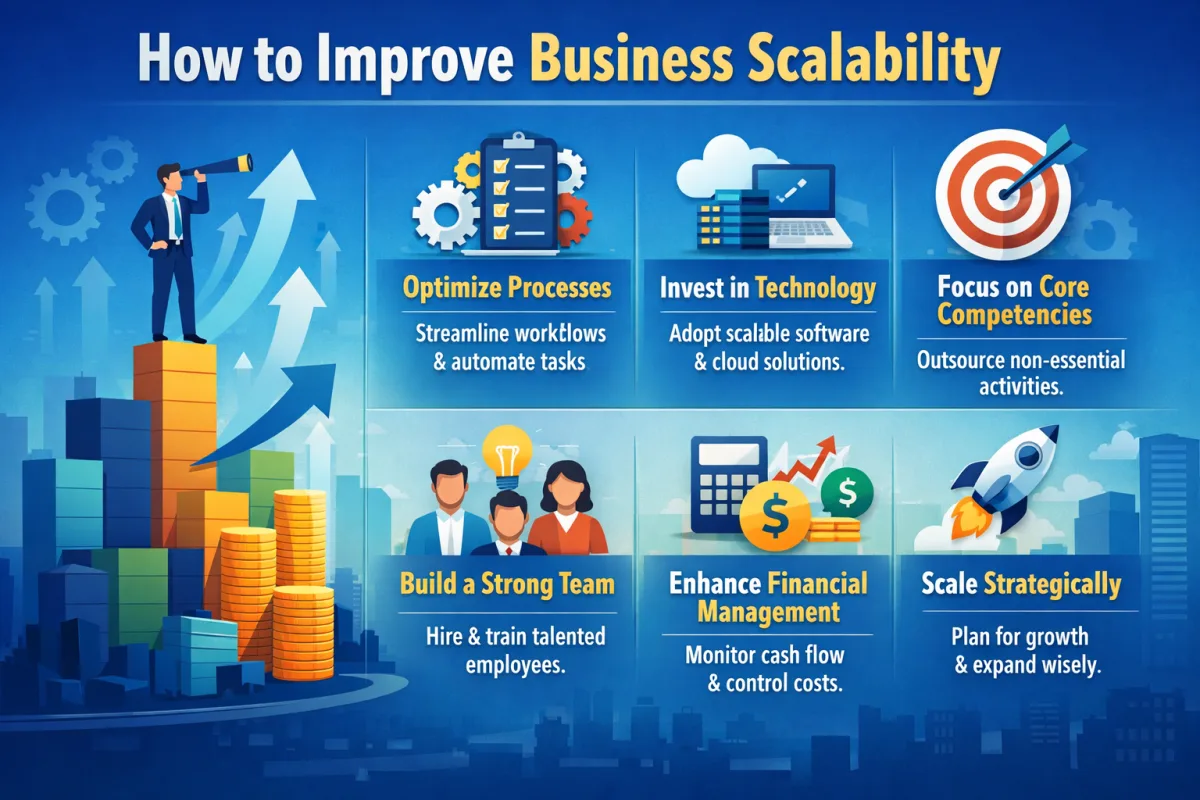
Rapid growth feels exhilarating, but unmanaged expansion can quickly become a business's undoing. It's a common trap: chasing market share while your internal systems groan under the strain. That's where understanding how to improve business scalability becomes not just an advantage, but a necessity. It’s about building a framework that allows you to multiply your output without proportionally increasing your input of resources, time, or headaches. We're talking about smart growth, resilient growth, the kind that doesn't just add customers but enhances profitability and operational strength.
Build a Robust Foundation: Streamline Processes and Infrastructure
You can't build a skyscraper on a shaky foundation, and you certainly can't scale a business effectively without solid internal processes. Many businesses stumble when growth outpaces their operational maturity. This often manifests as bottlenecks, inconsistencies, and a constant feeling of firefighting.
Start by auditing your core operations. What are the repetitive tasks? Where do errors frequently occur? Documenting every key process, from sales onboarding to customer support, is crucial. This isn't just about creating a manual; it's about identifying inefficiencies and standardizing best practices. Standardized processes mean new hires become productive faster, quality remains consistent, and you can delegate tasks confidently. It frees up your key people to focus on strategic initiatives, not daily minutiae.
Think about your infrastructure as well. Is your current setup—whether it's your office space, supply chain, or data storage—designed to handle double or triple your current volume? Often, businesses wait until they hit a wall before addressing these issues, which is a reactive and expensive approach. Proactive planning here makes all the difference.
Leverage Technology as Your Growth Multiplier
In today's landscape, technology isn't just a cost center; it's the most powerful lever you have to improve business scalability. The right tools automate repetitive tasks, provide critical data insights, and connect disparate parts of your organization. Ignoring this fact is like trying to build a modern city with only hand tools.
Consider the power of a robust Customer Relationship Management (CRM) system. It centralizes customer data, automates sales and marketing tasks, and provides a unified view of every customer interaction. This doesn't just make sales teams more efficient; it ensures consistent customer experience even as your customer base explodes. Similarly, Enterprise Resource Planning (ERP) systems integrate critical business functions like finance, HR, and inventory management, offering a holistic view that's indispensable for strategic decision-making at scale.
A study by McKinsey & Company found that companies that effectively use data and analytics improve their operational efficiency by 15-20%. That's a significant boost when you're aiming for exponential growth without exponential costs.
Harnessing Cloud Power and Automation
Cloud-based solutions are non-negotiable for modern scalability. They offer flexibility, cost-efficiency, and accessibility that on-premise solutions simply can't match. You can scale computing resources up or down as needed, paying only for what you use. This elasticity is vital for handling peak loads without over-investing in hardware during quieter periods.
Automation takes this a step further. Robotic Process Automation (RPA) can handle routine, rule-based tasks across various systems, from data entry to invoice processing. This frees human employees from tedious work, allowing them to focus on complex problem-solving and customer engagement. Imagine the time savings when your order fulfillment, customer support routing, or marketing email sequences run on autopilot. This isn't about replacing people; it's about empowering them to do higher-value work, directly contributing to improving business scalability.
Optimize Your Workforce for Agile Expansion
Your people are your most valuable asset, but an unoptimized workforce can become a scalability bottleneck. Scaling effectively means building a team that's not just growing in numbers, but growing in capability and efficiency.
Firstly, focus on smart hiring. Look for individuals with a growth mindset, who are adaptable and eager to learn. As you scale, you'll need people who can take on new responsibilities and thrive in an evolving environment. Don't just hire for immediate needs; anticipate future roles and skills gaps. Implement robust onboarding and training programs. A well-trained employee becomes productive faster and makes fewer errors, directly impacting your operational efficiency.
Secondly, empower your existing team. Delegate effectively, trusting your managers and employees with more autonomy. This requires clear communication of goals and expectations, but it prevents leadership from becoming the sole decision-makers, which is a guaranteed scalability killer. Consider adopting remote or hybrid work models; they can broaden your talent pool, reduce overhead costs, and offer employees greater flexibility, all of which support growth.
Finally, cultivate a culture of continuous improvement. Encourage feedback, celebrate successes, and learn from failures. A strong culture fosters loyalty and innovation, essential ingredients for navigating the challenges of rapid expansion.
Strategic Financial Management for Sustainable Growth
Growing too fast without proper financial oversight is a recipe for disaster. Scalability isn't just about revenue; it's about profitable revenue and healthy cash flow. Many businesses discover, too late, that their growth is actually costing them money because their unit economics aren't right.
You need to understand your Cost of Goods Sold (COGS), Customer Acquisition Cost (CAC), and Lifetime Value (LTV) inside out. Are you acquiring customers profitably? Can you increase your LTV through better retention or upsells? As you scale, these metrics become even more critical. Regularly review your pricing strategy; can you increase prices without losing significant market share, thereby improving your margins?
Cash flow management is paramount. Growth often requires significant investment in inventory, staff, or technology before the returns materialize. A solid financial plan includes detailed budgeting, forecasting, and contingency planning. Don't be afraid to seek external funding when appropriate, but ensure you understand the terms and how that capital will directly contribute to scalable growth, not just cover existing inefficiencies.
What This Means For Your Business
Improving business scalability isn't a one-time project; it's an ongoing commitment to strategic evolution. It means shifting your mindset from simply 'doing more' to 'doing more efficiently and effectively.' For your business, this translates into actionable steps:
- **Audit and Document:** Map out your current processes. Identify bottlenecks and areas ripe for standardization.
- **Embrace Technology:** Invest in CRM, ERP, cloud solutions, and automation tools that align with your growth trajectory. Don't just buy software; integrate it thoughtfully.
- **Empower Your Team:** Develop clear roles, train effectively, and delegate responsibilities to build a self-sufficient, high-performing workforce.
- **Monitor Financial Health:** Keep a close eye on your unit economics, cash flow, and profitability margins. Growth without profit isn't sustainable.
- **Plan for the Future:** Always think two steps ahead. What will your business look like at 2x or 5x its current size? What infrastructure, processes, and people will you need then?
This proactive approach ensures that when opportunities for expansion arise, your business is ready to seize them without buckling under the pressure. Isn't it time your business stopped just growing and started scaling intelligently?
Ultimately, true business scalability comes from a holistic strategy that integrates optimized processes, cutting-edge technology, a skilled and empowered workforce, and robust financial management. It's about building a business that can not only withstand growth but thrive on it, expanding its reach and impact with resilience and unwavering efficiency. Prioritize these areas now, and you'll lay the groundwork for a future where your business doesn't just survive but truly flourishes at any size.