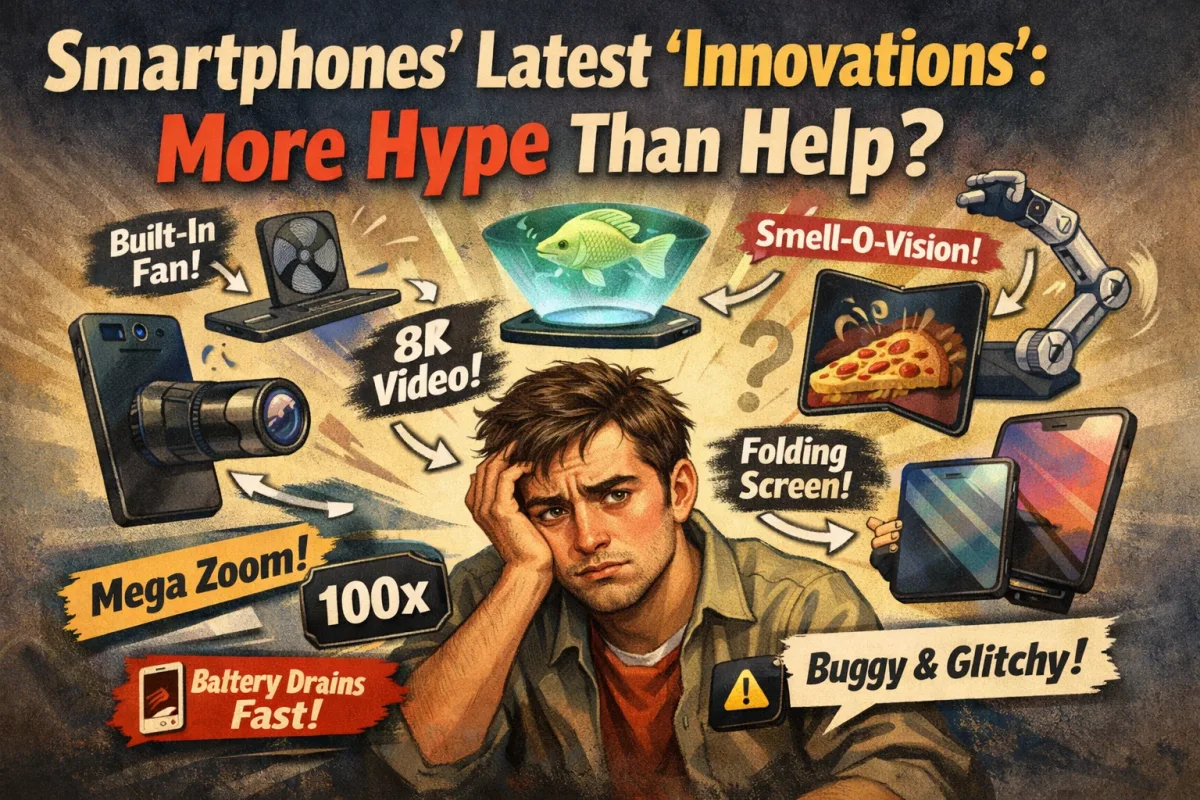
The Innovation Mirage: Are We Really Moving Forward?
It’s that time of year again. The tech giants roll out their shiny new flagships, each boasting a laundry list of "innovations" designed to make your current phone feel as ancient as a rotary dial. Faster chips, brighter screens, more lenses than a professional photographer’s kit bag – the marketing blitz tells us we’re witnessing the future. But let's be honest, as a seasoned observer of this annual spectacle, I can't help but feel a pervasive sense of déjà vu. Are we truly seeing groundbreaking innovation, or just a sophisticated exercise in incrementalism, dressed up in dazzling PR?
For years, we’ve been chasing the dragon of revolutionary change, spurred on by the industry’s relentless upgrade cycle. Yet, for many of us, the core smartphone experience hasn't fundamentally shifted in ages. We’re still scrolling, tapping, and snapping pictures. The real question isn't whether phones are getting 'better' – they objectively are, in terms of raw specs – but whether these improvements translate into a genuinely better, more meaningful experience for the average user. I’d argue that for a significant chunk of the population, the answer is a resounding 'not really.'
Foldables: A Glimpse of the Future, or a Niche Novelty?
Take foldables, for instance. They’re undeniably cool. The first time you snap a Samsung Galaxy Z Flip closed or unfold a Z Fold into a tablet-sized canvas, there’s a genuine "wow" factor. It feels futuristic, a tactile response to years of slab-phone monotony. But after the initial honeymoon phase, what’s left? Is the ability to fold a phone truly solving a widespread problem, or is it creating new ones?
The durability concerns, while improving, haven't entirely vanished. The crease, while less noticeable, is still there. And let’s talk about the price tag – often pushing well over a thousand dollars, sometimes closer to two. For that kind of money, you could buy a top-tier traditional phone and a decent tablet separately, likely with better battery life and less anxiety about dropping it. For a select few, perhaps creators or those who genuinely benefit from a larger screen on the go, they make sense. But for the vast majority who just want to check Instagram and answer emails, it’s a solution in search of a problem, wrapped in an exquisite, expensive package.
The Camera Wars: More Lenses, More Problems?
Then there’s the relentless escalation of the smartphone camera. Remember when one good lens was enough? Now, you’ll find triple, quadruple, even quintuple camera arrays on the backs of our phones. We’ve got ultrawide, telephoto, macro, depth sensors, periscopes – the list goes on. Megapixels have ballooned to numbers that would make professional DSLRs blush, with some phones boasting 108MP or even 200MP sensors. But does anyone, outside of professional photographers or extreme enthusiasts, truly *need* that level of fidelity from a device they primarily use to share blurry pet photos on social media?
The truth is, for most users, the photographic capabilities peaked a few generations ago. The difference between a photo taken on a top-tier phone from 2021 and one from 2024 is often imperceptible to the untrained eye, especially once compressed for online sharing. The real magic in smartphone photography now lies less in the hardware and more in the computational wizardry happening behind the scenes. It's software doing the heavy lifting, cleaning up images, boosting colors, and simulating bokeh. The innovation here isn’t in the optics themselves, but in the algorithms that make mediocre hardware look great.
Power and Performance: Overkill for the Everyday
Every year, we hear about the new chip that’s "X% faster" and "Y% more efficient." More RAM, more storage, benchmark scores that climb ever higher. These are undoubtedly engineering marvels. But ask yourself: when was the last time your smartphone felt genuinely slow doing everyday tasks? Browsing the web, checking email, watching YouTube, even casual gaming – modern chipsets from years ago handle these with aplomb. Unless you’re editing 4K video on your phone or running console-level games for hours, you’re likely never pushing your device anywhere near its limits.
What consumers *do* still complain about, consistently, is battery life. Despite the efficiency gains, our phones still struggle to last a full day for heavy users, especially as screens get brighter and apps more demanding. And while "super-fast charging" is touted as an innovation, it often comes with trade-offs in battery longevity and requires proprietary chargers. It feels less like true innovation and more like a band-aid solution to an underlying problem that nobody seems to have truly cracked.
Niche Features and Lengthening Upgrade Cycles
We’re also seeing interesting, albeit niche, innovations like satellite connectivity for emergency situations. It’s a fantastic safety net, a potentially life-saving feature, but it's not something you’ll use daily, or even yearly, for most people. It’s a testament to engineering prowess, but it doesn't redefine the daily smartphone experience.
The truth is, consumers are wising up. It wasn't long ago that a two-year upgrade cycle was the norm. Now, reports from industry analysts like Counterpoint Research consistently show consumers holding onto their devices for three, even four years. Why? Because the older phones still work perfectly well, and the "innovations" offered by new models just don’t justify the hefty price tag. We’ve reached a point of diminishing returns, where the leap from one generation to the next feels more like a hop.
What Would True Innovation Look Like?
Perhaps true innovation isn’t about adding another camera or boosting a benchmark score. Maybe it’s about a phone that genuinely lasts three days on a single charge. Or a screen that's truly unbreakable, eliminating the constant anxiety of a drop. What about modular phones, where you could swap out components to upgrade only what you need, reducing waste and cost? Or perhaps a device that seamlessly integrates into our lives without constantly demanding our attention?
Until then, let’s approach the latest smartphone releases with a healthy dose of skepticism. Enjoy the spectacle, appreciate the engineering, but don't feel pressured to upgrade just because a new model promises the moon. Your current phone is probably doing just fine, and its 'lack' of the latest incremental 'innovation' might just be its biggest strength.