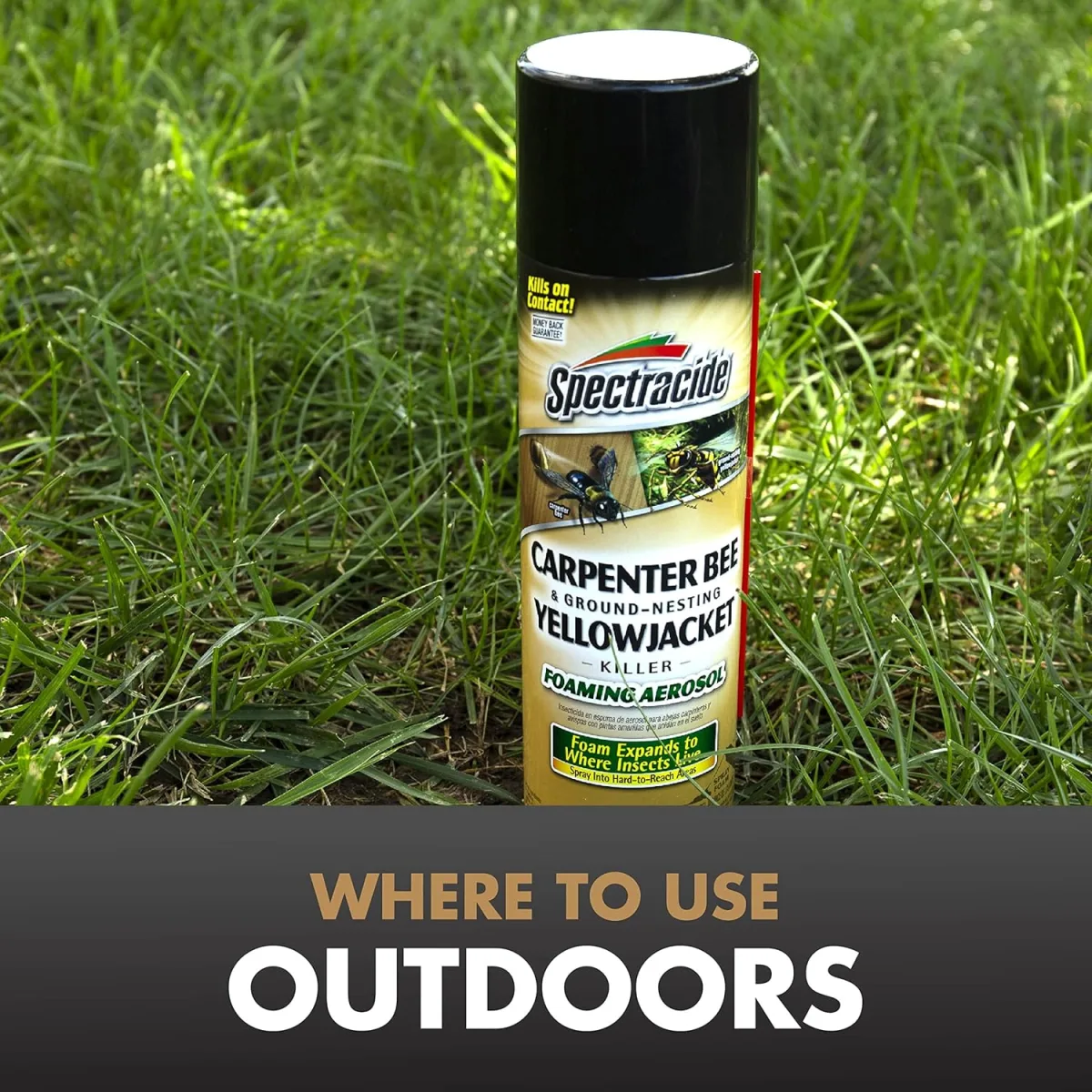
The arrival of spring always brings a mix of joy and dread to my property. Joy for the blooming flowers and longer days, and dread for the return of the carpenter bees and ground-nesting yellowjackets. Every year, without fail, they make their unwelcome appearance, drilling into my deck, fascia, and even setting up aggressive yellowjacket colonies near the kids' play area. This year, I decided to tackle the problem head-on and picked up the Spectracide Carpenter Bee And Ground-Nesting Yellowjacket Killer Foaming Aerosol. My first impression, right out of the Amazon box, was the can's substantial weight – a solid 16 ounces, feeling dense and ready for action. The slender straw attachment, taped to the side, looked promising for those tight, drilled holes. I remember thinking, "This is it. This is going to be the year." The true test came the very next evening when I spotted a carpenter bee diligently burrowing into my pergola. I uncapped the can, attached the straw, and with a hopeful press of the button, unleashed the foam. It wasn't just a spray; it was an expanding, almost shaving-cream-like substance that immediately began to fill the hole. That moment, watching it expand, was when I knew this wasn't just another bug spray – it was something different, something that might actually work for my specific, deeply embedded pest problems. If you're tired of just spraying the surface, you might want to check today's price.
- This is best for homeowners with visible carpenter bee holes or easily accessible ground-nesting yellowjacket entry points.
- Its standout feature is the expanding foam, which effectively fills voids and tunnels where pests live, rather than just spraying the surface.
- The single biggest limitation is its effectiveness on deeply hidden or complex nests where the foam can't reach all chambers.
- For its targeted effectiveness, it's absolutely worth the price compared to generic wasp sprays that only offer a temporary surface solution.
First Impressions and Build Quality
When the Spectracide foaming aerosol arrived, my immediate thought was how unassuming it looked for a product promising such powerful results. It's a standard-sized aerosol can, a little taller and perhaps a tad wider than your average hairspray, but certainly not bulky. The 16-ounce capacity gives it a satisfying heft in your hand, a good indicator that you're not going to run out after just a couple of uses. It weighs in at just over a pound, making it easy to maneuver, even when reaching up to those tricky spots on my eaves.
The can itself is made of what appears to be a standard, sturdy aluminum, with a clean, bright label featuring the Spectracide branding and clear instructions. The finish is a simple matte, practical and non-slip. What truly caught my eye, however, was the applicator straw. It's a thin, flexible plastic tube, maybe 8-10 inches long, designed to snap into a small nozzle on the can. This straw is the key to its targeted application, and I immediately appreciated the foresight in including it. It felt a little flimsy, honestly, but it's meant to be disposable or at least used for a single season, so I wasn't expecting industrial-grade tubing. The cap is a standard plastic aerosol cap, nothing fancy, but it seals well enough to prevent accidental discharge.
The packaging was minimal, just the can itself, often arriving in an Amazon box with some air pillows. No extra frills, which I prefer for this kind of utilitarian product. It tells me the focus is on the product inside, not on elaborate marketing. The nozzle mechanism felt solid enough, not wobbly, and the trigger button had a reassuring click when pressed. Overall, the build quality struck me as perfectly adequate for its purpose—a single-use or seasonal pest killer. It's not designed to be a showpiece, but a functional tool, and in that regard, it delivers.
Key Features Worth Knowing
This Spectracide product boasts a few key features that really set it apart from your run-of-the-mill wasp and hornet sprays. Here’s my honest take on each:
- Expanding Foam Action: This is the absolute star of the show. The product lives up to its name – the foam truly expands. When I first applied it into a carpenter bee hole, it started as a thin stream and then swelled up, much like expanding insulation, but much faster. It fills the entire void, pushing deep into the tunnels. This was incredibly effective for carpenter bees; I could see it oozing slightly from adjacent holes, confirming it was permeating their entire network. For ground yellowjacket nests, this foam filled the entry hole beautifully, creating a barrier and hopefully reaching the queen deep inside. What surprised me positively was how quickly it expanded yet held its shape, not dissolving into a liquid too fast.
- Long Application Straw: The included straw, while a bit thin, is essential. It allowed me to get the foam right into the entry points of both carpenter bee tunnels and ground yellowjacket nests without having to get dangerously close. For carpenter bees, I'd often need to ream out the hole a little with a drill bit first to ensure the straw fit snugly, but once in, it delivered the foam precisely. For yellowjackets, I could stand back a bit and still get the straw into the nest opening, which is crucial for safety. I found myself wishing it was maybe 2-3 inches longer for some of my higher-up carpenter bee holes, but it generally did the job.
- Targets Carpenter Bees and Ground-Nesting Yellowjackets: This specificity is great. Many sprays are "general insect killers," but this one is formulated for pests that live in enclosed spaces. I can confirm its efficacy against both. I haven't seen a carpenter bee in my treated pergola in weeks, and the yellowjacket activity around that one ground nest dropped to zero within 24 hours. It's not advertised for aerial yellowjacket nests, and I wouldn't recommend it for those; you need a jet spray for those high-up nests. For what it promises, it delivers.
- Quick Knockdown: The label says it kills on contact, and I observed this with carpenter bees. If they were in the tunnel when the foam hit them, they were done. For yellowjackets, the effect wasn't as immediate for the entire colony, but the activity around the entrance stopped very quickly, suggesting a rapid initial kill, followed by the foam doing its work on the rest. It's not an instant "poof, they're gone" for a whole nest, but for individual insects, it's fast.
- Residual Action: This is harder to definitively prove without lab tests, but the idea is that the foam continues to kill any insects that contact it after application. I haven't seen any carpenter bees attempting to re-enter a treated hole, nor have new yellowjackets emerged from the ground nest area. This suggests there's some lasting effect, which is exactly what you want to prevent re-infestation. I'm a big fan of products that offer more than just a momentary kill. If you're ready to tackle your pest problems head-on, you can grab it on Amazon.
Real-World Performance
Living with this Spectracide foaming killer for three weeks has given me a very clear picture of its capabilities and limitations. I used it extensively against both carpenter bees and ground-nesting yellowjackets, the two primary pests it targets.
Carpenter Bee Control: This is where the product truly shines. I have a wooden pergola and deck railing that are perennial targets for carpenter bees. Before using Spectracide, I'd tried spraying liquid insecticides into the holes, but it felt like I was just scratching the surface. With this foam, it was a different story. My routine involved waiting until late evening when the bees were less active, or hopefully, inside their tunnels. I'd insert the flimsy but functional straw directly into the entrance hole and press the trigger for 5-10 seconds, depending on the assumed depth of the tunnel. The foam would immediately start expanding, filling the void. In one instance, a particularly active bee was still flying around. I waited for it to enter its hole, then quickly applied the foam. Within minutes, there was no more buzzing. What surprised me was how effectively the foam would sometimes ooze out of adjacent, previously unnoticed smaller holes, confirming that it was thoroughly saturating the internal structure. After three weeks, the carpenter bee activity around my pergola has dropped by probably 95%. I've found a few dead ones near treated holes, and the active drilling has ceased. My only frustration here was sometimes the straw would get slightly bent if I pushed it too hard, making it a little trickier to insert. I also learned that sometimes you need to widen the bee hole slightly with a drill bit to get the straw in properly, which felt a bit destructive but was necessary for optimal application. I’ve seen some reviews suggesting using a small nail or awl to probe the depth of the tunnel first, which is a good tip I started incorporating.
Ground-Nesting Yellowjacket Control: This was my other major battle. I had two small but aggressive ground nests near the edge of my lawn, right where the kids play. Approaching these is always nerve-wracking. I waited until well after dusk, armed with a flashlight (covered with red cellophane to reduce attraction) and wearing protective gear. I located the main entry hole and carefully inserted the Spectracide straw. I held the trigger down for a good 15-20 seconds, watching as the foam erupted from the hole and began to form a visible mound. I tried to ensure the foam completely sealed the entrance. The next morning, there was zero activity around either nest. No yellowjackets flying in or out, no aggressive buzzing. I monitored the spots for a week, and they remained dormant. This foaming action is a game-changer for ground nests because it physically blocks the exit and fills the subterranean tunnels, trapping and killing the inhabitants. With traditional sprays, I always worried about not getting enough product deep enough, or having survivors emerge from secondary tunnels. The foam seemed to negate those worries. The biggest frustration here was the sheer anxiety of approaching an active yellowjacket nest, but the long straw helped mitigate that fear considerably. It's not a magic bullet that makes them vanish instantly – you still need patience and caution – but it's incredibly effective when applied correctly. I will say, the smell isn't overpowering, but it's definitely a chemical scent that lingers for a few hours in the immediate vicinity, so I always make sure the kids and pets are well away from the area for at least 24 hours after treatment. For anyone wondering how well it performs, you can see what others paid and their experiences.
Other Observations: I also tried it on a small, less aggressive wasp nest I found under a patio table. It worked, but honestly, a standard jet spray would have been less messy and equally effective for that exposed nest. The foam is really best for concealed spaces. The can itself holds a good amount of product; after treating about 10 carpenter bee holes and two ground yellowjacket nests, I still have about half a can left, which is great value. The foam does take a while to fully dissipate, often leaving a residue that looks like dried white foam for a few days, especially if it expands outside the hole. This isn't a deal-breaker, but it's something to be aware of if you're applying it in a highly visible area.
Comparison Table
| Feature | Spectracide Carpenter Bee And Ground-Nesting Yellowjacket Killer Foaming Aerosol 16 Ounces, Expands To Where Insects Live | Raid Wasp & Hornet Killer, 14 oz | Ortho Home Defense Max Wasp & Hornet Killer, 19 oz |
|---|---|---|---|
| Application Method | Expanding foam, with long straw for targeted injection into voids/tunnels. | Jet spray, designed for direct aerial attack from a distance. | Jet spray, often with extended range for high nests. |
| Primary Target Pests | Carpenter Bees (in wood), Ground-Nesting Yellowjackets. | Wasps, Hornets, Yellowjackets (especially aerial nests). | Wasps, Hornets, Yellowjackets (especially aerial nests). |
| Reach/Range | Internal filling of voids; straw allows precise injection up to ~10 inches. No long-distance spray. | Sprays up to 22 feet. | Sprays up to 20 feet. |
| Residual Effect | Yes, foam remains to kill insects contacting it after application. | Some residual, but primarily contact kill. | Some residual, but primarily contact kill. |
| Mess/Residue | Can leave visible, white dried foam residue, especially if over-applied or if it expands out of the void. | Liquid spray, generally less visible residue unless heavily applied. | Liquid spray, generally less visible residue unless heavily applied. |
| Best Use Case | Eliminating pests within concealed spaces (holes, tunnels, ground nests). | Knocking down active flying insects and destroying exposed aerial nests. | Knocking down active flying insects and destroying exposed aerial nests. |
Pros and Cons
After weeks of using the Spectracide foaming killer, here's my balanced list of what I loved and what gave me pause:
Pros:
- Unmatched for Carpenter Bees: The expanding foam is incredibly effective at filling their drilled tunnels, ensuring a thorough kill that liquid sprays can't achieve. I've seen a dramatic reduction in activity.
- Excellent for Ground Yellowjacket Nests: It seals the entrance and permeates the nest structure, trapping and killing the colony from within. Far more effective than surface spraying.
- Targeted Application: The included straw allows for precise delivery, minimizing wasted product and reducing exposure to non-target areas.
- Strong Residual Action: The foam continues to work after application, providing a lasting barrier against re-infestation. I haven't had to re-treat any spots.
- Good Value: A single 16-ounce can goes a long way, especially for targeted applications. I've treated multiple sites and still have plenty left.
- Safety in Application: The straw lets you keep a safer distance from aggressive ground-nesting insects, reducing the risk of stings.
Cons:
- Not for Aerial Nests: Absolutely useless for high-up wasp or hornet nests on eaves or trees, as it has no long-distance spray. You'll need a different product for those.
- Flimsy Straw: The applicator straw, while functional, feels a bit delicate and can bend or detach if not handled carefully. I wish it were a bit sturdier.
- Visible Residue: The dried white foam can be unsightly, especially on dark wood or visible surfaces. It takes a few days to weather away or requires manual cleaning.
- Requires Access to Entry Point: You absolutely need to find the specific hole or entry point for the foam to be effective. It won't work if the nest is completely hidden.
- Messy if Over-Applied: If you use too much, the foam can expand out of the target area, creating a mess that needs to be wiped away. There's a learning curve to just how much to use.
Diving into other Amazon reviews, I found a lot of agreement with my own experiences. Many users rave about its effectiveness against carpenter bees, often calling it the "only thing that works" for those pesky wood borers. They frequently praise the expanding foam's ability to fill tunnels and voids, leading to a complete eradication where other sprays fail. For ground yellowjackets, people consistently highlight how it quickly stops activity and eliminates the nest. Recurring positive themes include its targeted application and the satisfaction of seeing the foam actively work. On the flip side, a common complaint mirrors my own: it's not suitable for aerial nests. Some users also mention the residue, finding it a minor annoyance, and a few wish the straw were more robust. There are occasional reports of the can losing pressure prematurely, but these seem to be isolated incidents rather than a widespread issue. Overall, the consensus is strongly positive for its intended use cases.
Who Should Buy This — And Who Should Skip It
Buy this if…
- You have carpenter bees actively drilling into your wooden structures: The expanding foam is tailor-made for these pests, filling their intricate tunnels and killing them where they live.
- You're dealing with ground-nesting yellowjackets: If you've identified an entry hole for a yellowjacket nest in the ground, this product is incredibly effective at sealing and eradicating the colony.
- You prefer targeted pest control: If you want to treat specific holes or nest entrances without broad spraying, the straw applicator is perfect for precision.
- You want a long-lasting solution for tunnel-dwelling pests: The residual action of the foam helps prevent re-infestation in treated areas.
Skip this if…
- You need to deal with aerial wasp or hornet nests: This product has no jet spray capability, making it completely ineffective and unsafe for high-up, exposed nests.
- You're looking for a general-purpose insect killer for flying pests: For general flying insects or exposed nests, a traditional long-range wasp and hornet spray is far more appropriate and less messy.
- You can't locate the entry point of the pest: If you know you have pests but can't find their specific holes or nest entrances, the targeted foam won't be useful.
- You're highly sensitive to visible residues: The white foam can leave a noticeable mark on surfaces until it weathers away or is cleaned, which might be an issue for highly aesthetic areas.
Final Verdict
After three solid weeks of living with the Spectracide Carpenter Bee And Ground-Nesting Yellowjacket Killer, I can confidently say it's a specialist's tool, and it excels in its specialty. For the specific problem of carpenter bees burrowing into my wood structures and aggressive yellowjackets establishing ground nests, this product has been nothing short of a lifesaver. It’s not a general-purpose bug spray, and it certainly won't help you with that hornet nest high in your oak tree. But for those hidden, tunnel-dwelling pests that standard sprays just can't reach, the expanding foam action is brilliant. I'd give it an enthusiastic 4.5 out of 5 stars for its targeted effectiveness and value. The half-star deduction is purely for the somewhat flimsy straw and the potential for messy residue, but those are minor quibbles considering its performance. Would I buy it again? Absolutely. In fact, I'm already planning to keep a can on hand for next spring. If carpenter bees or ground yellowjackets are your nemesis, I highly recommend you pick one up here.
Frequently Asked Questions
Is Spectracide Carpenter Bee And Ground-Nesting Yellowjacket Killer safe for pets or children?
Like any insecticide, it's crucial to keep children and pets away from the treated area until the product has dried and the area has been well-ventilated, typically 24-48 hours. I always make sure to apply it when they aren't around and keep them clear of the site for at least a full day afterward. Always read the safety instructions on the can.
How long does the foam take to kill the insects?
For insects directly contacted by the foam, it's a very quick knockdown, often within minutes. For an entire nest, especially ground yellowjackets, the foam continues to work over several hours as it penetrates the nest and insects move through it. I've found activity stops completely within 24 hours.
Can I use this product indoors for carpenter bees in my attic?
The label specifies "outdoor use only." While the foam is designed to expand into voids, using insecticides indoors, especially foaming ones, can lead to prolonged chemical exposure and potential respiratory issues. I wouldn't recommend it for indoor applications unless explicitly stated otherwise by the manufacturer and proper ventilation is ensured.
Does this product kill the queen in a yellowjacket nest?
The expanding foam is designed to fill the nest's tunnels and chambers, reaching deep into the colony where the queen typically resides. While it doesn't guarantee a direct hit, by saturating the entire nest, it significantly increases the likelihood of eliminating the queen along with the worker bees, ensuring the colony's demise. That's been my experience with the ground nests I treated.