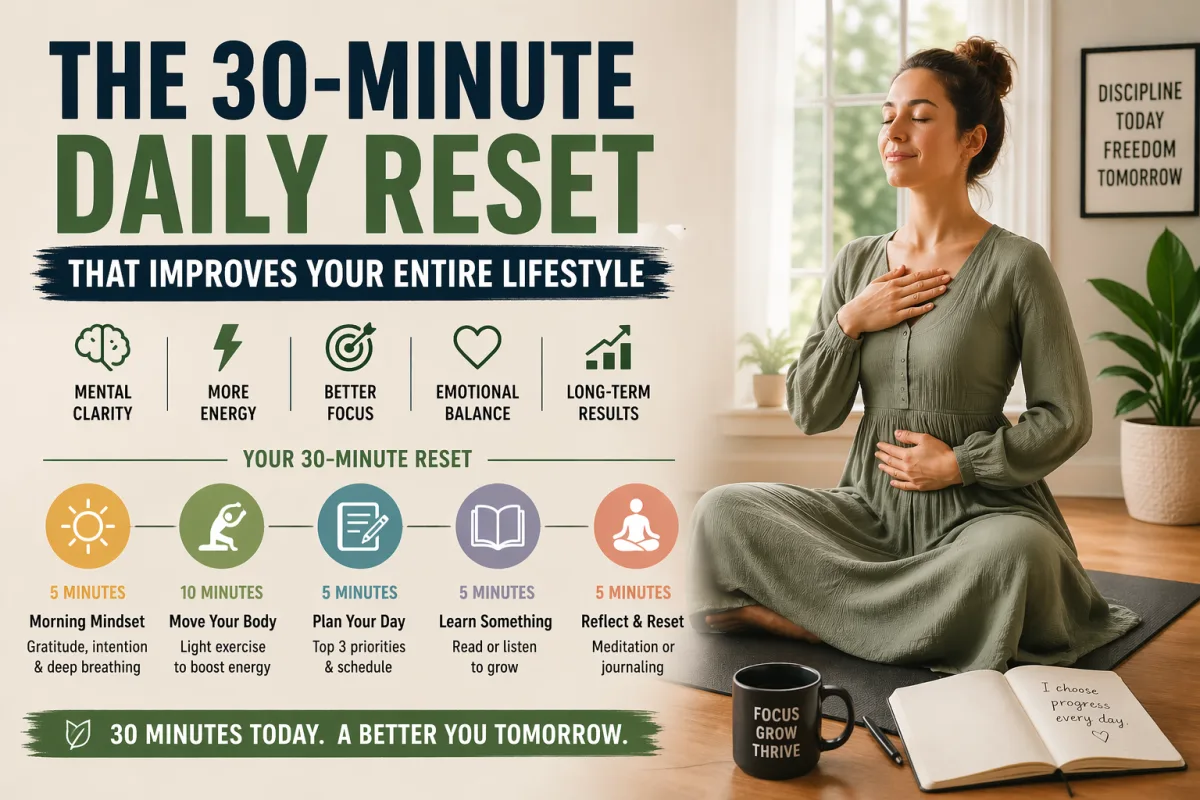
In a world where 60% of adults report experiencing stress regularly, according to the American Psychological Association's 2023 Stress in America survey, the idea of adding anything to our already overflowing plates feels like a cruel joke. We're perpetually chasing deadlines, juggling responsibilities, and often, by day's end, feeling more drained than accomplished. But what if I told you that just 30 minutes, strategically invested each day, isn't another task, but a powerful antidote to this chronic overwhelm? A deliberate, short pause that doesn't just offer temporary relief, but fundamentally shifts your entire lifestyle for the better.
- A 30-minute daily reset is a crucial investment, not an added burden, for holistic well-being.
- The routine combines mindful movement, focused reflection, and intentional preparation to maximize impact.
- Consistent, short resets can significantly reduce stress, boost cognitive function, and enhance productivity.
- Integrating this habit requires overcoming mental barriers and prioritizing self-care as a non-negotiable.
The Hidden Power of 30 Minutes: Why Less Is More for Your Lifestyle
Here's the thing. We often equate significant change with monumental effort. We tell ourselves we need hours at the gym, or an entire weekend retreat, to truly "reset." This all-or-nothing mindset becomes our biggest barrier. But the truth, as countless studies on habit formation reveal, is that small, consistent actions often yield the most profound, lasting results. A 30-minute daily reset isn't about escaping your life; it's about engaging with it more effectively. It's a deliberate pause designed to re-center your mind, re-energize your body, and re-focus your intentions, all within a timeframe so brief it’s nearly impossible to justify skipping.
Think about it: 30 minutes. That's a single episode of a sitcom, half a commute, or the time many people spend mindlessly scrolling social media. Reclaiming this sliver of your day for intentional self-care isn't about deprivation; it's about strategic reallocation. This isn't just fluffy wellness advice. Research from Stanford University's Center for Compassion and Altruism Research and Education (CCARE), for example, has shown that even short bursts of mindfulness meditation can alter brain structures related to attention, emotion regulation, and self-awareness. Imagine the cumulative effect of integrating such practices daily.
The beauty of the 30-minute framework lies in its accessibility and adaptability. It doesn't demand you become a yoga guru or a meditation master overnight. Instead, it invites you to curate a personalized sequence of activities that genuinely serve your immediate needs, whether that’s clearing mental fog, easing physical tension, or simply preparing for the hours ahead with a clearer head. This isn't just about feeling better in the moment; it's about building a robust foundation for improved decision-making, enhanced resilience, and a more fulfilling existence.
Crafting Your Personal 30-Minute Daily Reset Routine
The core of an effective 30-minute daily reset lies in its structure, yet its power comes from personalization. This isn't a rigid template you must follow, but a framework you adapt. The goal is to choose activities that provide a meaningful return on your time investment, focusing on mental clarity, physical well-being, and intentionality. We're looking for actions that don't just fill time but genuinely replenish your reserves and sharpen your focus for the day or evening ahead.
A successful reset often blends different types of activities to engage both mind and body. You might start with something physical to shake off inertia, transition to a mental exercise for clarity, and conclude with a preparatory action. The key is to make these choices deliberate and enjoyable, ensuring you look forward to this sacred window of time rather than dreading it. It's your personal sanctuary in the day, a moment carved out exclusively for your well-being.
Don't be afraid to experiment. Your ideal reset might shift with your daily demands, your energy levels, or even the seasons. The important part isn't rigid adherence to a single routine, but the consistent commitment to the act of resetting. What brings you peace? What helps you feel grounded? What prepares you to face challenges with calm competence? These are the questions that guide your choices.
Mindful Movement: Awakening Body and Mind
Allocate 10-15 minutes to gentle physical activity. This isn't about high-intensity cardio, but rather about waking up your muscles, improving circulation, and releasing any stored tension. Consider simple stretches, a short walk around the block, or a few sun salutations. Even just standing up and consciously moving your limbs can make a profound difference. This physical engagement acts as a powerful bridge, pulling you out of mental chatter and grounding you in your body. It signals to your system that it’s time to be present and active, rather than passively reacting to the day’s demands.
The benefits extend beyond the physical. Mindful movement, where you pay attention to the sensations in your body and your breath, can be a form of active meditation. It helps to quiet the mind, reduce anxiety, and improve focus. For instance, a brisk 10-minute walk can boost mood and energy, offering a quick physiological reset that primes you for better cognitive performance. This segment is your chance to literally move forward with renewed vigor.
Focused Reflection and Intentional Planning
Dedicate another 10-15 minutes to mental clarity and foresight. This could involve journaling about your thoughts and feelings, practicing gratitude, or a short guided meditation. Alternatively, use this time for The “Quiet Productivity” Method for Getting More Done Without Burnout, simply planning out your top 3 priorities for the day, or organizing your workspace. This structured thought helps to reduce decision fatigue later on and ensures you're working on what truly matters.
The power of reflection can't be overstated. Taking a few moments to acknowledge your emotions, process recent events, or articulate your goals can prevent rumination and bring a sense of control. This isn't about solving all your problems; it's about acknowledging them, then consciously choosing where to direct your energy. When you plan intentionally, even for a short period, you're not just organizing tasks; you're organizing your mind, creating a roadmap for your day that reduces stress and increases effectiveness.
Beyond the Moment: The Ripple Effect on Productivity and Well-being
The magic of the 30-minute daily reset isn’t confined to those specific minutes. Its effects ripple outward, transforming your entire day and, over time, your entire lifestyle. Imagine starting your day not in a scramble, but with a sense of calm readiness. Or concluding your workday by consciously shedding the stress, rather than carrying it into your evening. This consistent micro-investment pays dividends in ways you might not immediately anticipate.
On the productivity front, a clear mind is a focused mind. By taking the time to reset, you're reducing cognitive load, improving decision-making capabilities, and enhancing your ability to concentrate on demanding tasks. This isn't lost time; it's time redeemed. You'll find yourself less prone to distractions and better equipped to tackle complex problems. Furthermore, the practice of intentional planning during your reset instills a sense of purpose, ensuring your efforts are directed towards meaningful outcomes, not just busywork.
From a well-being perspective, the benefits are even more profound. Regular resets can significantly lower stress levels, improve sleep quality, and foster greater emotional resilience. You're creating a buffer against the daily grind, a protective layer that helps you bounce back from challenges rather than being overwhelmed by them. This isn't just about feeling good; it's about building mental fortitude and emotional intelligence, skills that are invaluable in every facet of life, from professional endeavors to personal relationships.
Dr. Jud Brewer, a neuroscientist and addiction psychiatrist at Brown University, highlights that "mindfulness practices, even brief ones, can effectively rewire the brain's reward system, helping us break cycles of anxiety and habit formation." His research, including studies published in JAMA Psychiatry (2018), shows that just 10 minutes of daily mindfulness meditation can significantly reduce cravings and anxiety by helping individuals become more aware of the habit loop.
Overcoming the 'No Time' Fallacy: Making Your Reset Non-Negotiable
The most common objection to any new positive habit is, "I don't have time." It’s a compelling narrative, especially in our hyper-connected, always-on culture. But let's be honest: we often find time for things we prioritize, even if subconsciously. We find time for social media, for TV, for complaining about how busy we are. The "no time" fallacy isn't about a lack of minutes in the day; it's about a lack of perceived importance for self-care. Here's how to reframe that.
First, recognize that this 30-minute daily reset isn't an optional luxury; it's a fundamental investment in your capacity to handle everything else. Without it, you're running on fumes, making poorer decisions, and experiencing higher stress. It's like arguing you don't have time to put gas in your car because you're too busy driving. The car will eventually stop. Your mental and emotional engine will, too. This 30 minutes is the fuel.
Second, be strategic about when you implement your reset. Could it be the first 30 minutes of your day, before the world wakes up? This is often the quietest time, free from interruptions. Or perhaps it's a mid-day break, a crucial pause to clear your head before the afternoon slump. For some, an evening reset, designed to decompress and transition from work to personal life, proves most effective. The key is to schedule it, literally put it in your calendar, and treat it with the same reverence you would a doctor's appointment or an important meeting. For more ideas on how to weave routines into your life, consider exploring How to Create a Morning Routine That Doesn’t Feel Forced.
Finally, start small and build consistency. If 30 minutes feels daunting, begin with 10. The goal is to build the habit, not to perfect it from day one. Once you experience the tangible benefits – the clearer thinking, the reduced anxiety, the improved focus – you'll naturally want to extend it. Consistency trumps intensity every single time. Your future, more balanced self will thank you for making this non-negotiable.
Real Stories, Real Results: Lives Transformed by a Simple Shift
It's one thing to talk about the theory, another entirely to see it in action. Across various professions and lifestyles, individuals who have committed to a 30-minute daily reset report significant transformations. Take Sarah, a marketing executive who found herself constantly on the brink of burnout. Her mornings were a blur of emails and frantic preparations. She started implementing a 30-minute reset that included 15 minutes of quiet stretching and 15 minutes of writing down her top three priorities for the day. Within weeks, she noticed a dramatic drop in her morning anxiety. She wasn't just reacting to her inbox; she was proactively shaping her day, leading to more focused work and fewer late nights.
Then there's David, a freelance graphic designer who struggled with creative blocks and evening stress. His reset involved a 20-minute walk in a nearby park, followed by 10 minutes of listening to classical music while jotting down any lingering thoughts or ideas. He found the walks cleared his head, and the music helped transition him away from client demands. His sleep improved, and he started approaching his creative work with renewed enthusiasm, reporting fewer instances of "designer's block" and a greater sense of work-life separation. These aren't isolated incidents. They're patterns observed in individuals who consciously decide to reclaim a small but powerful segment of their day.
The impact of this consistent habit extends to personal relationships too. Emily, a mother of two young children, used her 30-minute evening reset for a silent cup of tea and a short meditation, allowing her to process the day and prepare for quality time with her family without carrying the weight of her work. She found herself more patient, more present, and less prone to snapping, fostering a more harmonious home environment. The benefits are cumulative, weaving into the fabric of daily life, transforming not just individual moments, but the entire narrative of one's existence. The simple truth is, when you are better, everything around you tends to get better too.
| Lifestyle Factor | Without Daily Reset | With 30-Min Daily Reset |
|---|---|---|
| Perceived Stress Levels | High (7/10) | Moderate to Low (3/10) |
| Daily Productivity (Self-Reported) | Fluctuating, prone to distraction | Consistent, focused, intentional |
| Sleep Quality | Restless, difficulty falling asleep | Improved, more restorative |
| Emotional Resilience | Reactive, easily overwhelmed | Proactive, better coping mechanisms |
| Overall Life Satisfaction | Moderate, feeling rushed | High, feeling present and purposeful |
The Neuroscience of Small Habits: How Your Brain Adapts to Positive Change
The effectiveness of the 30-minute daily reset isn't just anecdotal; it's rooted in the very wiring of our brains. When you engage in a consistent, positive action, even for a short duration, you're actively shaping your neural pathways through a process called neuroplasticity. Your brain begins to adapt, strengthening the connections associated with that behavior. This means that over time, what once felt like an effortful "task" transforms into an ingrained habit, something your brain anticipates and even craves.
Consider the role of dopamine, the neurotransmitter associated with reward and motivation. When you successfully complete your daily reset and experience its positive effects – reduced stress, clearer focus, a sense of accomplishment – your brain releases dopamine. This reinforces the behavior, creating a positive feedback loop that makes you more likely to repeat it. It’s the brain’s way of saying, "Hey, that felt good! Let's do that again." This is why small, achievable habits are so powerful: they consistently trigger these reward circuits, building momentum and making the habit stick. You're essentially training your brain to seek out and benefit from these moments of intentional self-care.
Moreover, the mindfulness components often integrated into a daily reset, such as meditation or focused breathing, directly impact areas of the brain responsible for attention, emotional regulation, and self-awareness. Studies using fMRI scans have shown that regular mindfulness practice can increase gray matter in regions like the prefrontal cortex, which is crucial for executive functions. This means you're not just feeling better; you're actually enhancing your brain's capacity for concentration, impulse control, and emotional balance. Your 30-minute daily reset isn't just improving your day; it's physically upgrading your brain. To dive deeper into how intentional actions can shape your life, look into The “Intentional Living” Guide for Beginners.
“We are what we repeatedly do. Excellence, then, is not an act, but a habit.” — Will Durant, interpreting Aristotle.
Implement Your 30-Minute Daily Reset: An Action Plan
Ready to reclaim your 30 minutes and transform your lifestyle? Here’s a simple, actionable plan to get you started:
- Identify Your "Why": Before you begin, clearly define what you hope to gain. Is it less stress? More focus? Better sleep? This intrinsic motivation will fuel your consistency.
- Choose Your Time Slot: Decide if you’ll reset in the morning (to prepare), mid-day (to re-energize), or evening (to decompress). Pick a time you can consistently protect.
- Curate Your Activities (10-15 min each):
- Mindful Movement: 10-15 minutes of gentle stretches, a short walk, or simple yoga poses.
- Focused Reflection/Planning: 10-15 minutes of journaling, gratitude practice, meditation, or planning your top 3 priorities.
- Schedule It – Non-Negotiable: Block out 30 minutes in your calendar. Treat it like an essential appointment you wouldn't miss.
- Create Your Environment: Minimize distractions. Put your phone on silent, find a quiet spot, and ensure you have any tools you need (journal, headphones).
- Start Small & Be Patient: Don't aim for perfection. If 30 minutes feels too long, start with 15 and gradually build up. Consistency over intensity.
- Track & Adjust: For the first few weeks, briefly note how you feel after your reset. Are you more focused? Calmer? Use this feedback to tweak your activities as needed.
What This Means for You
This isn't just another article about self-improvement; it's an invitation to fundamentally reshape your relationship with time and yourself. By embracing the 30-minute daily reset, you're not simply adding another item to your to-do list; you're investing in your most valuable asset: your well-being. This seemingly small commitment holds the potential to unlock a cascade of positive changes, from increased productivity and reduced stress to deeper self-awareness and greater overall life satisfaction. You'll find yourself not just getting through your days, but thriving within them, approaching challenges with calm confidence, and savoring moments with genuine presence. It's a strategic pause that allows you to live a life that feels more intentional, more fulfilling, and ultimately, more yours.
Frequently Asked Questions
Is 30 minutes truly enough to make a difference?
Absolutely. Research on habit formation and mindfulness consistently shows that even short, consistent bursts of intentional activity can lead to significant neurological and psychological benefits. The cumulative effect of 30 minutes daily far outweighs sporadic, longer efforts.
What if I miss a day or two? Does that ruin the habit?
Not at all. The goal is consistency, not perfection. If you miss a day, simply resume your reset the next day without guilt. The most important thing is to get back on track promptly, reinforcing the habit rather than abandoning it.
Can I split my 30 minutes into smaller chunks throughout the day?
Yes, while a continuous 30-minute block can be highly effective for deep focus, you can certainly split it if that better suits your schedule. For example, 15 minutes of mindful movement in the morning and 15 minutes of reflection in the evening can still yield significant benefits. The flexibility is key to adherence.