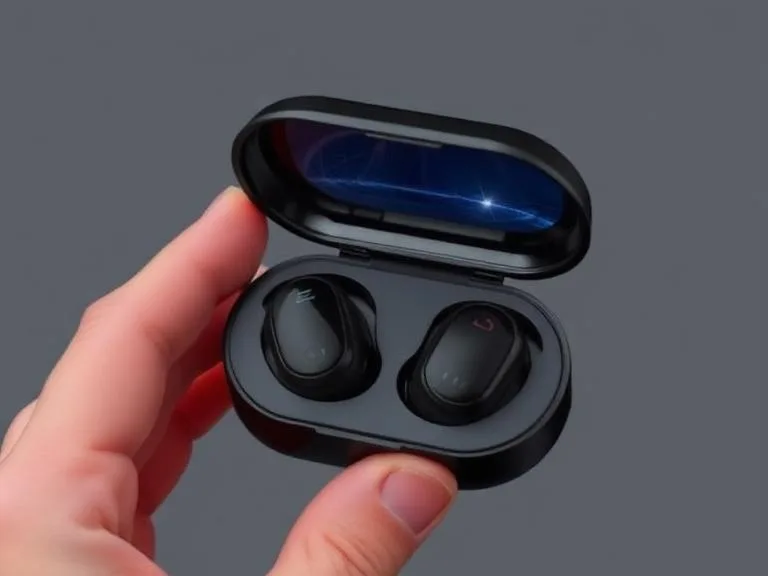
Imagine this: you're on a crowded subway, train, or plane, and with a simple tap, the cacophony of the world melts away, replaced by the crystal-clear notes of your favorite symphony or the sharp dialogue of a podcast. You don't see a single wire, yet the sound is undeniably present, vibrant, and tailored precisely for your ears. What sorcery is this? It's not magic, but a sophisticated symphony of miniaturized engineering playing out inside those tiny devices nestled in your auditory canal. Globally, more than 500 million wireless earbuds were shipped in 2023, according to Counterpoint Research, a testament to their pervasive presence in our daily lives. But what exactly happens when you press play, or when you activate that coveted noise-canceling feature? The journey from a digital file on your phone to an acoustic wave in your ear is far more complex and fascinating than you might assume.
- Wireless earbuds initiate a secure, low-latency Bluetooth connection to stream audio data from your device.
- Advanced digital-to-analog converters (DACs) and amplifiers meticulously transform digital information into audible sound waves.
- Multiple embedded sensors enable features like active noise cancellation (ANC), spatial audio, and intuitive gesture controls.
- Sophisticated power management systems optimize miniature batteries for extended listening and rapid charging.
The Invisible Handshake: How Bluetooth Connects Your World
The moment you pull your wireless earbuds from their case, a silent, high-speed negotiation begins. This isn't just a simple pairing; it's a meticulously choreographed dance orchestrated by Bluetooth technology. Your earbuds, typically equipped with a tiny Bluetooth Low Energy (LE) chip, constantly broadcast their presence. Your smartphone, also scanning for available devices, detects this signal. When you initiate pairing, a secure, encrypted link is established. This link isn't merely for transmitting data; it's a two-way communication channel, allowing your phone to send audio and control commands (like volume adjustments or track skips), and your earbuds to report their battery status or receive firmware updates.
The magic truly unfolds once the link is secured. Audio data, which originates as a compressed digital file (MP3, AAC, FLAC), is broken down into tiny packets. These packets are then encoded using specific audio codecs like SBC, AAC, aptX, or LDAC, each offering a different balance of compression and audio fidelity. Codecs determine how efficiently and how faithfully the audio is transmitted. For instance, AAC (Advanced Audio Coding) is prevalent in Apple devices, while aptX and LDAC often deliver higher-resolution audio on Android platforms, albeit at the cost of higher power consumption. Bluetooth 5.0 and newer versions, especially with the introduction of LE Audio, have significantly improved latency, connection stability, and power efficiency, making simultaneous, high-quality audio streams to both earbuds seamless, a major leap from older generations where one earbud often acted as a master, relaying sound to the other.
Bluetooth Protocols and Codecs: The Language of Sound
Think of Bluetooth protocols as the rules of engagement and codecs as the specific dialects within that language. The A2DP (Advanced Audio Distribution Profile) is the standard profile for streaming high-quality stereo audio. HFP (Hands-Free Profile) and HSP (Headset Profile) handle voice calls, enabling your earbuds' microphones to capture your voice and transmit it back to your phone. These profiles work in concert, allowing for a seamless transition between listening to music and taking a call. The choice of codec is critical. SBC (Subband Coding) is the baseline, universally supported, but offers lower fidelity. AAC provides better quality, especially for Apple users. AptX, aptX HD, and LDAC are premium codecs, capable of transmitting near-lossless or high-resolution audio, demanding more bandwidth but delivering a richer sound experience. The negotiation between your phone and earbuds ensures they utilize the best common codec available, prioritizing either audio quality or connection stability based on the environment and device capabilities.
From Bits to Bass: The Journey of Digital Audio
Once the digital audio packets arrive at your earbuds, their real transformation begins. This isn't just a simple pass-through; it's a meticulously engineered process designed to convert abstract data into tangible sound waves. Inside each earbud resides a tiny but powerful digital signal processor (DSP). This miniature brain is responsible for a multitude of tasks: decompressing the audio data, applying any necessary equalization profiles (like bass boost or treble enhancement), and correcting for environmental factors or user preferences. The DSP works at incredible speeds, performing millions of calculations per second to ensure the audio is pristine and tailored to the listener's settings.
After the DSP has done its work, the now-processed digital audio still isn't sound. It's just a stream of ones and zeroes. This is where the Digital-to-Analog Converter, or DAC, steps in. This crucial component is the bridge between the digital world of your phone and the analog world of your ears. The DAC takes the digital signal and converts it into a continuous electrical waveform that mirrors the original sound. This analog signal is then sent to a miniature amplifier, which boosts its strength to a level sufficient to drive the earbud's speaker, known as the driver. The quality of the DAC and amplifier significantly influences the overall sound fidelity, dynamic range, and clarity you perceive. High-end earbuds often boast custom-designed DACs and amplifiers that minimize distortion and maximize audio accuracy.
The DAC's Magic: Translating Data into Waves
The DAC's operation is a fascinating feat of electrical engineering. It samples the digital audio at an incredibly high rate, often tens of thousands of times per second (e.g., 44.1 kHz for CD-quality audio). For each sample, it generates an analog voltage that corresponds to the digital value. This results in a stair-step-like electrical waveform. A tiny filter then smooths out these steps, creating a continuous, flowing analog signal. This signal, now a faithful representation of the original sound wave, is amplified and sent to the driver. The driver itself is typically a tiny dynamic driver, akin to a miniature loudspeaker, or a balanced armature driver, often favored for its precision and compact size. It converts the electrical signal into physical vibrations, which in turn move the air inside your ear canal, creating the sound waves you hear. The entire process, from digital packet reception to acoustic wave generation, happens in mere milliseconds, a testament to the integrated circuit design and computational power packed into such a small form factor.
Silence and Immersion: The Science of Active Noise Cancellation and Spatial Audio
One of the most transformative features in modern wireless earbuds is Active Noise Cancellation (ANC). It's not just about blocking sound; it's about actively neutralizing it. This ingenious technology relies on miniature microphones embedded on the exterior and sometimes interior of the earbud. The outer microphones pick up ambient environmental noise – the hum of an engine, the chatter of a crowd, the roar of traffic. This sound is then fed to the earbud's DSP, which rapidly analyzes its waveform. The DSP then generates an "anti-noise" signal, an inverse sound wave that is precisely 180 degrees out of phase with the incoming noise. When these two waves meet, they effectively cancel each other out, reducing or eliminating the perceived external sound before it reaches your eardrum. Inner microphones often monitor the sound reaching your ear canal, allowing the ANC system to fine-tune its cancellation and compensate for any sound leakage or internal resonances.
Beyond silence, many premium earbuds offer Spatial Audio, a feature that immerses you in a three-dimensional soundscape. This goes beyond traditional stereo by creating the illusion that sounds are coming from specific points around you, rather than just left and right. Spatial Audio relies on sophisticated algorithms that process audio to simulate sound reflection and absorption within a virtual environment. Crucially, it often incorporates head-tracking technology. Accelerometers and gyroscopes within the earbuds constantly monitor your head movements. If you turn your head, the audio processing adjusts, ensuring that the sound source remains fixed in virtual space relative to your device (e.g., your smartphone or laptop). This creates a highly realistic and captivating audio experience, making you feel as if you’re in a movie theater or concert hall, with sounds emanating from distinct directions.
"The complexity of modern ANC lies not just in generating anti-noise, but in doing so dynamically and adaptively across a broad spectrum of frequencies," explains Dr. Anya Sharma, Lead Acoustic Engineer at Sonic Innovations. "Our research shows that combining feedforward and feedback microphone arrays, along with adaptive algorithms, can achieve up to 35-40 decibels of noise reduction in certain frequency bands, a significant improvement in user experience even in chaotic environments."
Beyond Sound: Smart Sensors and Their Secret Lives
Modern wireless earbuds are far more than just audio playback devices; they're miniature smart sensors that extend your interaction with the digital world. Beyond the microphones essential for ANC and calls, many earbuds integrate a suite of tiny sensors that enable a variety of intelligent features. Proximity sensors, often infrared or capacitive, detect when an earbud is inserted into or removed from your ear. This allows for automatic pause and play functionality, conserving battery life and ensuring you don't miss a beat. Think about it: when you pull an earbud out to talk to someone, the music instantly stops. That’s a proximity sensor at work.
Touch sensors, similar to those found in your smartphone’s display, transform the outer surface of your earbuds into an intuitive control panel. A tap, a double-tap, a swipe – these gestures can control playback, answer calls, activate voice assistants, or toggle ANC modes. This haptic feedback system relies on tiny electrodes that detect changes in capacitance when your finger makes contact, translating that physical interaction into a digital command. For more advanced features like spatial audio with dynamic head tracking, accelerometers and gyroscopes are essential. These Inertial Measurement Units (IMUs) continuously track the earbud's orientation and movement in 3D space, feeding this data to the DSP to adjust the soundstage dynamically. Some cutting-edge earbuds even incorporate heart rate monitors or other biometric sensors, hinting at a future where they could offer basic health tracking capabilities, creating a truly personal and proactive listening companion.
The Power Within: Miniature Batteries and Intelligent Charging
Powering this intricate array of microprocessors, sensors, and audio components requires an equally sophisticated power solution, all within a minuscule footprint. Each wireless earbud typically houses a tiny lithium-ion or lithium-polymer battery, often no larger than a pea. These batteries are engineered for high energy density, meaning they can store a significant amount of power relative to their size and weight. However, their small capacity necessitates careful power management. This is where the earbud's microcontroller comes into play, constantly optimizing power consumption across all components. It dynamically adjusts power to the Bluetooth module, DSP, and amplifier based on usage – reducing power during standby, increasing it during high-fidelity audio playback or intense ANC operation.
The charging case isn't just a protective shell; it's an indispensable mobile power bank. It contains a larger lithium-ion battery that recharges the earbuds multiple times. When you place your earbuds back into the case, tiny pogo pins or magnetic induction coils establish contact, initiating the charging process. The case itself charges via USB-C or, increasingly, wirelessly via Qi charging standards. This intelligent ecosystem manages charging cycles, preventing overcharging and optimizing battery health for both the earbuds and the case. Fast charging technologies, often proprietary, allow a few minutes of charging to provide hours of listening time, a critical feature for users on the go. This intricate dance of power storage and delivery ensures that your earbuds are ready when you are, maximizing their operational lifespan between wall outlet visits. If you're curious about why some chargers work faster than others, the principles of power delivery and current management are highly relevant here.
| Earbud Model | Battery Life (Earbuds only, ANC off) | Battery Life (With Case, ANC off) | Fast Charge (Minutes for Hours) | Wireless Charging |
|---|---|---|---|---|
| Model A (Premium) | 8 hours | 30 hours | 5 mins for 1 hour | Yes |
| Model B (Mid-Range) | 6 hours | 24 hours | 10 mins for 1.5 hours | Yes |
| Model C (Budget) | 5 hours | 20 hours | 15 mins for 1 hour | No |
| Model D (Sport) | 9 hours | 27 hours | 5 mins for 2 hours | Yes |
The Brains of the Operation: Microcontrollers and Firmware
At the heart of every wireless earbud is a tiny but mighty microcontroller, essentially the central nervous system that orchestrates all its complex functions. This System-on-a-Chip (SoC) integrates the Bluetooth radio, the DSP, the DAC, and often a dedicated processor for sensor fusion and user interface management. It’s responsible for executing the earbud’s firmware – the embedded software that defines its behavior, features, and overall performance. Think of the firmware as the operating system for your earbuds; it dictates everything from how quickly they pair to how effectively their noise cancellation works.
When you receive an over-the-air (OTA) update for your earbuds, you’re essentially downloading new firmware. These updates aren't just about bug fixes; they can introduce entirely new features, improve audio quality, enhance ANC algorithms, or optimize battery life. This upgradability is crucial for the longevity and evolving functionality of modern earbuds. The microcontroller, with its embedded memory, stores this firmware and executes its instructions in real-time. It manages the power distribution to various modules, processes input from touch sensors or accelerometers, and communicates seamlessly with your connected device. The constant interplay between the hardware (the physical components) and the software (the firmware) is what gives wireless earbuds their intelligence and adaptability, allowing them to perform a vast array of tasks far beyond simple audio playback.
"The market for truly wireless stereo (TWS) earbuds is projected to reach over $50 billion by 2027, driven significantly by advancements in ANC and smart features that enhance user experience beyond basic audio," states a 2023 report by Grand View Research.
Maintaining the Magic: Extending Your Earbuds' Lifespan
Given the intricate technology packed into these small devices, it's wise to take steps to prolong their life and maintain their peak performance. Here’s how you can keep your earbuds singing their best tunes:
- Keep Them Clean: Earwax and debris can accumulate in the speaker grilles and charging contacts, impairing sound quality and charging reliability. Use a soft, dry brush or a cotton swab with a little rubbing alcohol to gently clean these areas regularly.
- Protect from Moisture: While many earbuds are sweat-resistant, they are rarely fully waterproof. Avoid prolonged exposure to heavy rain, showers, or swimming. Always dry them thoroughly if they get wet before placing them back in the charging case.
- Mind the Battery: Lithium-ion batteries degrade over time. Avoid extreme temperatures (hot cars, freezing conditions) which can accelerate this degradation. While "deep cycling" (fully discharging and recharging) was once recommended for older battery types, modern lithium-ion batteries benefit more from partial discharges and charges.
- Store in Their Case: The charging case protects your earbuds from physical damage, dust, and also keeps them topped up. This is also where they often enter a low-power state, preventing unnecessary battery drain.
- Update Firmware: Regularly check for and install firmware updates. Manufacturers often release updates that improve performance, add features, or fix bugs, directly impacting sound quality, ANC effectiveness, and battery efficiency.
- Handle with Care: Avoid dropping your earbuds, as internal components and delicate drivers can be damaged. Use the correct size ear tips for a secure and comfortable fit, which also optimizes sound isolation and ANC performance.
What This Means For You
Understanding the intricate inner workings of your wireless earbuds isn't just about satisfying curiosity; it empowers you as a user. It helps you appreciate the engineering marvel you carry, make more informed purchasing decisions, and even prolong the life of your devices. Knowing about codecs helps you understand why some music sounds better than others, or why your battery drains faster when listening to high-resolution audio. Awareness of ANC's reliance on microphones can explain why a strong gust of wind might momentarily disrupt the silence. When you consider the array of hidden sensors inside your smartphone that facilitate seamless interaction, it becomes clear that your earbuds are part of an even larger, interconnected ecosystem. This deeper insight transforms them from simple gadgets into complex personal audio companions, deserving of both appreciation and proper care. The next time you slip them in, remember the silent, sophisticated symphony of technology playing out, just for you.
Frequently Asked Questions
How do wireless earbuds manage to play audio simultaneously without lag?
Modern wireless earbuds use advanced Bluetooth technologies like Bluetooth LE Audio, which allows for simultaneous, independent streaming to both earbuds (often called "true wireless stereo" or TWS). This eliminates the need for one earbud to relay audio to the other, significantly reducing latency and improving connection stability by having both earbuds connect directly to the source device.
What's the difference between active and passive noise cancellation?
Passive noise cancellation (PNC) relies on physical barriers, like well-fitting ear tips and the earbud's design, to block out external sound. Active noise cancellation (ANC), on the other hand, uses microphones to detect external noise and then generates an "anti-noise" sound wave that precisely cancels out the incoming sound, offering a much more effective reduction of low-frequency ambient noise.
Can wireless earbuds really damage my hearing?
Yes, prolonged listening at high volumes can certainly damage your hearing, regardless of whether you're using wired or wireless earbuds. The World Health Organization recommends keeping listening levels below 85 decibels for no more than eight hours a day to prevent noise-induced hearing loss. Many smartphones and earbuds offer volume limits and warnings to help users maintain safe listening habits.