
How Much Should You Actually Save?
The common advice is three to six months of expenses, but that range is a little too vague to act on. A more useful way to think about it:
- Starter goal: $1,000–$2,000. This covers most single unexpected expenses — a car repair, a broken appliance, an urgent vet bill — without touching a credit card.
- Full goal: 3 months of essential expenses if you have stable income, dual income in your household, or low job-loss risk.
- Full goal: 6 months of essential expenses if you're self-employed, single-income, work in a volatile industry, or have dependents relying solely on your income.
Use essential expenses for this calculation — rent, utilities, groceries, insurance, minimum debt payments — not your full current spending. You're calculating what it takes to survive a gap in income, not maintain your exact current lifestyle.
Calculating Your Real Number
Add up your essential monthly expenses, then multiply by your target number of months. For example, if essential expenses run $2,800/month and your household has a single income in a variable field, the full target is $16,800 (6 months). That can look intimidating as a single number — which is exactly why the starter goal exists as a nearer-term milestone before tackling the full target.
Where to Keep an Emergency Fund
The fund needs to be liquid (accessible within a day or two) and separate from your everyday checking account, so it isn't accidentally spent. A high-yield savings account is the standard choice — it's FDIC-insured, keeps the money separate, and earns meaningfully more interest than a typical checking or standard savings account. Avoid keeping emergency savings in investments (stocks, index funds); the risk of the balance dropping right when you need it defeats the purpose.
Some people choose a savings account at a different bank than their everyday checking, specifically to add a small amount of friction — no debit card, no instant transfer app already open — while still keeping the money accessible within a day or two if genuinely needed.
Building It Up When Money Is Already Tight
Start With the Starter Goal, Not the Full Goal
Trying to save six months of expenses from zero can feel so large it never gets started. Focus on the first $1,000 before thinking about the larger number — it covers the most common emergencies and builds momentum.
Automate a Fixed Amount
Set up an automatic transfer for the day after payday, even if it's just $25–$50 per paycheck. Consistency matters more than the size of each contribution early on.
Redirect Windfalls
Tax refunds, work bonuses, and cash gifts are ideal emergency fund contributions because they're not already budgeted into your regular spending — putting them toward savings doesn't require cutting anything else. A tax refund alone often covers a meaningful chunk of the starter goal in a single deposit.
Free Up Money With a Spending Review
Our guide on 25 ways to save money every month has specific ideas for freeing up $50–$200 monthly without a major lifestyle change, which can go directly toward the fund.
Use a Visual Tracker
A simple progress bar — in a spreadsheet, an app, or even a hand-drawn thermometer chart — makes the goal feel closer with every contribution. Seeing $340 of $1,000 filled in is more motivating than an abstract percentage.
How Long It Actually Takes
| Monthly contribution | Time to reach $1,000 | Time to reach $6,000 |
|---|---|---|
| $50/month | 20 months | 10 years |
| $100/month | 10 months | 5 years |
| $250/month | 4 months | 2 years |
| $500/month | 2 months | 1 year |
These numbers make the trade-off concrete: doubling the monthly contribution roughly halves the timeline. If the full goal feels impossibly distant at your current contribution rate, that's useful information for deciding whether to temporarily free up more room in the budget rather than a reason to give up on the goal.
What Counts as an Emergency (and What Doesn't)
| Emergency fund appropriate | Not an emergency — budget separately |
|---|---|
| Job loss or reduced hours | Holiday gifts |
| Urgent car repair | Annual car registration |
| Unexpected medical bill | Vacation |
| Essential home repair (broken furnace, roof leak) | Planned home upgrades |
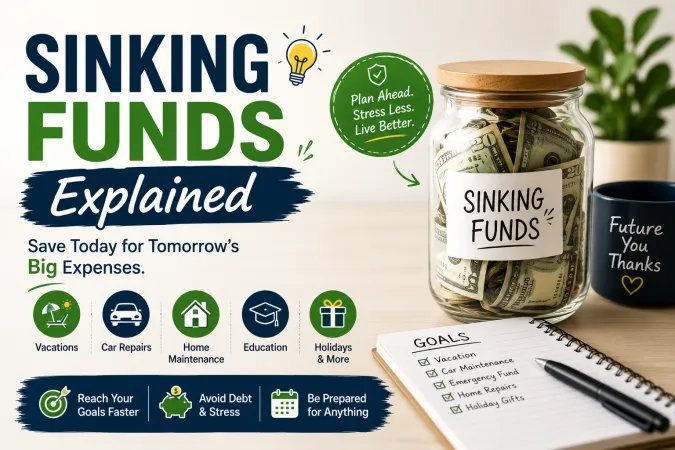
Predictable, non-urgent expenses like registration fees or gifts belong in a sinking fund, not the emergency fund — mixing the two makes it harder to know how protected you actually are. A useful test: if you could have seen the expense coming with reasonable planning, it probably belongs in a sinking fund instead.
Should You Pause Contributions to Pay Off Debt?
This is one of the more debated questions in personal finance, and the honest answer is that both approaches have merit depending on the debt. A common middle-ground approach: build the $1,000 starter fund first (so a single emergency doesn't create new debt), then pause emergency fund contributions to aggressively attack high-interest debt (anything above roughly 8–10% interest), then return to build the full 3–6 month fund once high-interest debt is cleared. Lower-interest debt (some student loans, for example) is less urgent to prioritize over building savings.
After You Hit Your Goal
Once your emergency fund is fully funded, redirect that monthly contribution toward other goals — extra debt payoff (see how to pay off debt faster) or investing (see our beginner's guide to investing). Revisit the fund's target amount roughly once a year, since it should grow if your essential expenses increase — see our annual financial planning guide for a full review checklist.
Replenishing After You've Used It
Using the emergency fund for an actual emergency is the system working as intended, not a failure. Treat replenishing it the same way you built it the first time — automate a fixed contribution and prioritize getting back to the starter goal before resuming other savings goals.
Common Mistakes
- Keeping it in a checking account where it's too easy to spend on non-emergencies.
- Investing it for higher returns, which introduces risk right when you might need the money.
- Waiting to start until you can save a "meaningful" amount. $25 per paycheck adds up faster than most people expect.
- Treating a predictable expense as an emergency, which quietly drains the fund and leaves less protection for a genuine one.
- Not replenishing it after using it, leaving the household unprotected for the next unexpected expense.


Comments (0)
Be the first to comment.