Where the 50/30/20 Rule Comes From
The framework was popularized by Senator Elizabeth Warren and Amelia Warren Tyagi in their book All Your Worth: The Ultimate Lifetime Money Plan. It wasn't designed as a strict rule but as a rough diagnostic — a way to check whether your spending is dangerously tilted toward fixed obligations, leaving no room for savings.
Breaking Down the Three Categories
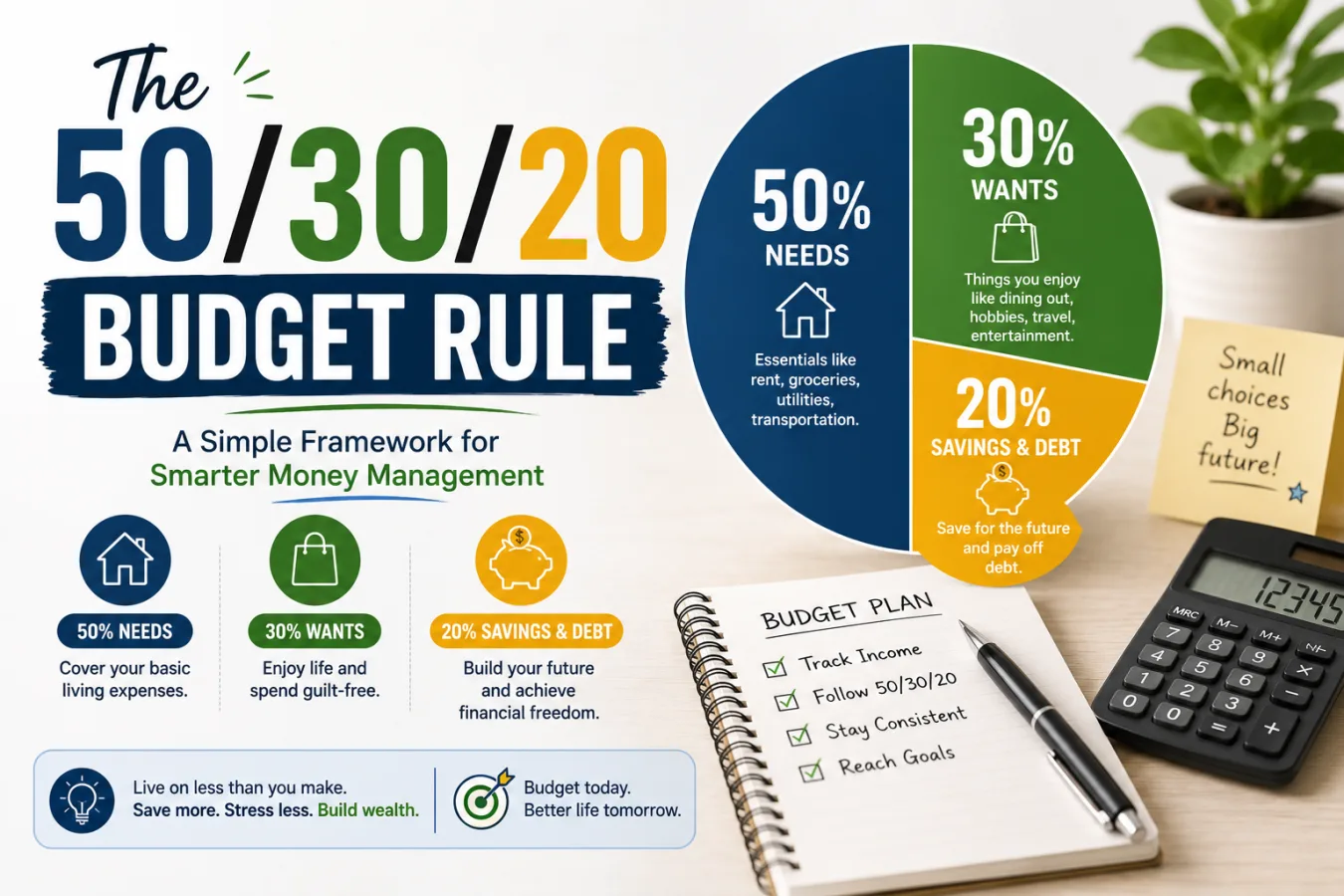
50% — Needs
Needs are expenses you can't reasonably eliminate without a major lifestyle change: rent or mortgage, utilities, groceries (not dining out), minimum debt payments, insurance, and basic transportation. A helpful test: if you'd still need to pay for it while unemployed and job hunting, it's probably a need.
30% — Wants
Wants are the flexible, quality-of-life spending: dining out, streaming subscriptions, hobbies, travel, upgraded versions of things you already need (a nicer apartment than the cheapest option, a newer car than strictly necessary). This category is usually the first place to look when a budget needs adjusting.
20% — Savings and Debt Payoff
This covers building an emergency fund, retirement contributions, and any debt payments beyond the required minimum (minimum payments count as a "need"). If you're aggressively paying off debt, this is where the extra payments live.
Applying It to Real Numbers
On $3,600 in monthly take-home pay, the split looks like this:
| Category | Percentage | Amount |
|---|---|---|
| Needs | 50% | $1,800 |
| Wants | 30% | $1,080 |
| Savings & extra debt payoff | 20% | $720 |
Add up your current needs spending first — for many people in higher cost-of-living areas, this alone exceeds 50%. That's useful information, not a failure. It usually means either the wants category needs to shrink below 30%, or it's time to look at reducing a specific fixed cost (housing, a car payment, insurance shopping).
When 50/30/20 Doesn't Fit
- High cost-of-living areas. If rent alone eats 40% of income, a strict 50% needs cap isn't realistic. Adjust to something like 65/20/15 and treat the original ratios as a long-term target, not an immediate requirement.
- Aggressive debt payoff. If you're following a debt snowball or avalanche plan, you may want to temporarily push savings/debt to 30% or more by trimming wants further.
- Irregular income. The percentages work best against a stable, predictable paycheck. See our guide on budgeting on an irregular income if your pay varies month to month.
- Very low or very high income. At a low income, needs can realistically exceed 50% no matter how carefully it's managed; at a high income, needs often fall well under 50%, freeing up more than 20% for savings without feeling restrictive.
50/30/20 vs. Zero-Based Budgeting
The 50/30/20 rule is faster to set up and easier to maintain, but less precise — it tells you roughly how much to spend on wants, not exactly which purchases to make. Zero-based budgeting is more detailed and better suited to hitting a specific dollar goal. Many people start with 50/30/20 to build the habit of budgeting, then move to zero-based budgeting once they have a concrete target like debt payoff or a house down payment.
A Middle Ground: 50/30/20 With Named Sub-Categories
People who like the simplicity of three buckets but want a bit more control sometimes add named sub-categories within each bucket without going fully zero-based — for example, splitting the 30% "wants" bucket into Dining Out, Entertainment, and Shopping sub-limits. This adds a little more structure and visibility without the full monthly rebuild that zero-based budgeting requires.
Adjusting the Ratios as Life Changes
The right ratios for a given household aren't fixed forever. A move to a more expensive city, a new child, or a big raise can all shift what's realistic. Revisiting the ratios during a annual financial review — rather than assuming the original split still applies — keeps the framework useful over time instead of becoming a source of repeated, unrealistic guilt.
Common Mistakes
- Miscategorizing wants as needs. Streaming services, a car nicer than necessary, and daily coffee runs are wants, even if they feel routine.
- Using gross income instead of take-home pay. This overstates how much you actually have to work with.
- Treating the ratios as fixed law. They're a starting diagnostic, not a rule that overrides your actual circumstances.
- Never revisiting the ratios after a major income or cost-of-living change.



Comments (0)
Be the first to comment.