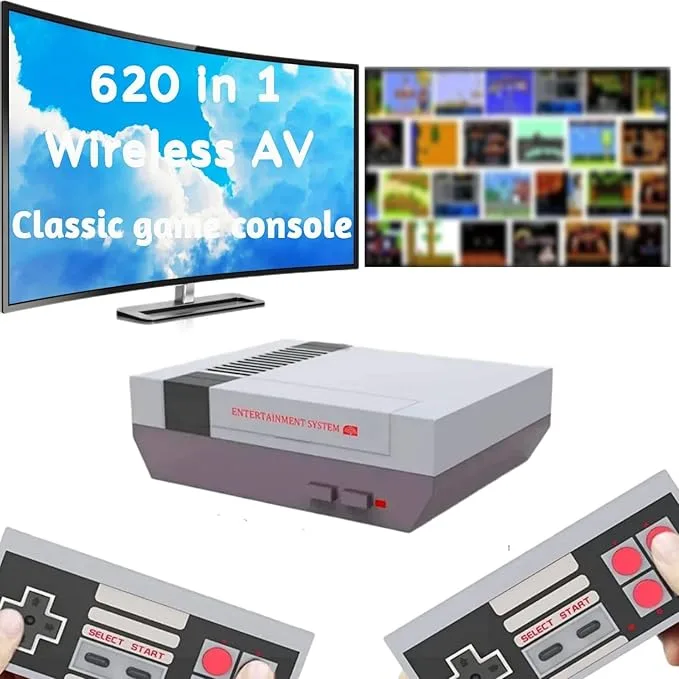
The moment the Amazon package landed on my porch, I felt a familiar pang of nostalgia. I'd been eyeing these budget-friendly retro consoles for a while, hoping to recapture some of that 8-bit magic without breaking the bank. Unboxing the Classic Mini Handheld Retro Game Console,Video Game Consoles Built-in 600 Classic Edition Games,Dual Wireless Came Controllers and AV Output Display. (A3) was a bit of an anticlimax, to be honest. The box itself was rather plain, not the vibrant, exciting packaging I remembered from my childhood. Inside, nestled in a thin plastic tray, was the console itself – a tiny, almost toy-like replica of an old-school system, weighing barely 100 grams. It felt incredibly light, almost insubstantial. Along with it, two wireless controllers, an AV cable, and a USB power cable. My first thought was, "Is this it?" I plugged it into my old CRT TV, the only display I felt truly appropriate for this kind of retro experience, and fired it up. The main menu, a simple grid of game titles, popped onto the screen. It was at that exact moment, seeing the list of 600 games, that I knew this wouldn't be a simple plug-and-play nostalgia trip. This was going to be an adventure into the wild west of unlicensed retro emulation, and I was ready for it.
- Who this is best for: Casual gamers or families looking for a cheap, immediate dose of retro arcade fun without worrying too much about perfect emulation or specific game titles.
- Standout feature: The sheer number of pre-loaded games, offering incredible variety for curious explorers, even if many are repeats or obscure.
- The single biggest limitation or frustration: The inconsistent quality of game emulation and the often-poor translation or repetition of titles, making finding true gems a chore.
- Value assessment: It's worth the price if you understand its limitations and temper your expectations; compared to official mini consoles, it's significantly cheaper but lacks polish and authenticity.
First Impressions and Build Quality
As I mentioned, the unboxing wasn't exactly premium. The packaging felt like it was designed to get the product from point A to point B as cheaply as possible, which, for a budget device, is understandable. The console itself, which they confusingly call "handheld" but is clearly a TV-connected unit, is incredibly small. It's about the size of a credit card holder, maybe 4 inches by 3 inches and just an inch thick. The plastic felt lightweight and a bit flimsy, the kind that might not survive a significant drop onto a hard floor. The finish is a matte black, with a slightly textured top panel that thankfully doesn't attract fingerprints too much. There are no vents, just a single LED indicator on the front, two controller ports (which are actually for the wireless dongle), and the AV and power ports on the back.
The two wireless controllers included are standard NES-style pads, but they're slightly larger and bulkier than the original. They're also made of that same lightweight, slightly hollow-feeling plastic. The D-pad felt a bit stiff, and the A/B buttons had a decent click, but nothing that inspired confidence for intense gaming sessions. Each controller takes two AAA batteries, which weren't included – a minor but common annoyance. The wireless dongle plugs into the front of the console, blending in fairly well. The included AV cable is basic, with three RCA plugs (yellow for video, red/white for audio). It's short, maybe three feet long, which limited where I could place the console relative to my TV. The USB power cable is equally simple, a standard USB-A to micro-USB, and it didn't come with a wall adapter, meaning you'll need to supply your own phone charger or a free USB port on your TV. Overall, nothing about the physical presentation screams "well-made," but it also doesn't immediately scream "this will break tomorrow." It sits squarely in the "you get what you pay for" category. For someone looking to check today's price, I'd say manage your expectations on the build quality.
Key Features Worth Knowing
The product description for the A3 boasts a few key features that are definitely worth exploring:
- Built-in 600 Classic Edition Games: This is, without a doubt, the main selling point. My honest reaction? It's a double-edged sword. Yes, there are 600 games listed. No, they aren't all unique or "classic" in the way you might expect. I found a lot of repeats, often with slight title variations or entirely different names for the same game. There are also many obscure or poorly translated titles. That said, buried within this massive list are genuine gems – Super Mario Bros., Contra, Pac-Man, Donkey Kong, and many other recognizable NES titles. Finding them feels like a treasure hunt. It was a positive surprise to find some truly rare or lesser-known titles that I remembered from arcade days, but a negative surprise to see how much padding was used.
- Dual Wireless Came Controllers: The wireless aspect is a huge convenience, especially compared to the notoriously short cords of official mini consoles. The controllers connect via a 2.4GHz dongle. I found the range to be surprisingly decent, allowing me to sit comfortably on my couch about 8-10 feet away without connection drops. However, there's a noticeable input lag, especially in fast-paced action games like Contra or Punch-Out. It's not crippling for every game, but it's definitely there and can make precise movements frustrating. The controllers themselves also go into a sleep mode after a minute or two of inactivity, which is good for battery life but means you have to press a button to wake them up, sometimes causing a brief disconnect.
- AV Output Display: This console is strictly AV output. No HDMI here, which means you're limited to older TVs or modern TVs with AV inputs (which are becoming rarer). For purists, playing on a CRT TV provides an authentic, fuzzy retro experience. On a modern LED TV, the picture is often blurry and stretched, but some TVs have scaling options that can make it more palatable. My surprise here was how much I actually preferred the "authenticity" of the AV output on an old TV, rather than having it upscaled poorly on a new one. It forces you to embrace the retro aesthetic fully.
- Miniature Console Design: As mentioned, it's tiny. This makes it incredibly portable, easy to stash in a bag for a friend's house, or simply tuck away when not in use. It's a positive feature for convenience, but it also contributes to the toy-like feel.
- No Save States or Game Progress: This was a significant negative surprise. There's no way to save your progress within a game or create save states like you'd find on more sophisticated emulators or official mini consoles. If you turn off the console or switch games, your progress is lost. This means you're playing these games exactly as they were in the 80s – one sitting, or bust. For lengthy RPGs or action games, this can be a real deterrent. It forces a certain kind of old-school commitment, which some might appreciate, but for me, it was mostly frustrating.
Real-World Performance
Living with the A3 for three weeks really showed its true colors. My typical usage involved firing it up after work or on weekends, often with my partner, to try out different games. Here’s what I experienced:
Gaming Sessions: When I first plugged it in, the main menu was simple enough to navigate. The game list scrolls, and you select with the A button. I started with Super Mario Bros. It booted up quickly, and the graphics, while expectedly low-res, were familiar. The sound, however, was a bit off – slightly tinny and sometimes distorted, not quite matching the original. The input lag I mentioned became apparent almost immediately. Jumping precisely or timing stomps on Goombas felt slightly delayed. It wasn't unplayable, but it certainly wasn't smooth. When I used it for Contra, the fast-paced action became a real struggle. My reflexes were faster than the game's response, leading to numerous unfair deaths. This input lag was a consistent frustration across almost every action-oriented game I tried.
Controller Durability & Battery Life: The wireless controllers, while convenient, started to show their cheapness after about a week. The D-pad on one controller became noticeably mushier, and the 'Start' button on the other sometimes needed an extra firm press to register. Battery life for the controllers was surprisingly good, however. I used generic AAA batteries, and they lasted for well over 15 hours of cumulative play time before needing replacement. The auto-sleep feature definitely helped conserve power.
Game Library Exploration: This was the most time-consuming part of my three weeks. With 600 games, I spent hours just scrolling through, trying out titles. Many games are clearly hacks, modified ROMs, or simply very obscure Famicom titles. I discovered several identical versions of games like 'Pac-Man' or 'Galaxian' listed under different names, sometimes with minor graphical glitches in one version but not another. It's a chaotic library. One evening, my partner and I spent two hours just trying out random games, laughing at the bad translations and surprisingly fun, simple arcade clones. It became less about playing specific games and more about the discovery process. However, the lack of a proper search function or categorization makes this discovery process tedious. If you want to play 'Tetris,' you might have to scroll through hundreds of entries to find it, and there might be five versions of it.
AV Output Quality: Connected to my 20-year-old CRT, the image was perfectly acceptable – as good as any composite video from that era. Colors were vibrant, and the slight blur actually helped smooth out the jagged pixels, giving it an authentic feel. When I tried it on my modern 55-inch LED TV (via an AV-to-HDMI adapter I already owned), the picture was understandably poor. The low resolution was stretched, pixels were massive, and the colors seemed duller. This isn't a fault of the console itself, but a limitation of composite video on modern displays. If you don't have an old TV, be prepared for a less-than-stellar visual experience unless your TV has excellent upscaling, which most budget models don't.
Power and Stability: The console itself is powered by a micro-USB cable. I used an old phone charger block, and it never had any power issues. It runs cool to the touch, even after several hours of continuous play. I didn't experience any crashes or freezes from the console itself, which was a pleasant surprise given its budget nature. The biggest stability issue came from the controllers sometimes briefly desyncing if I moved too far or there was interference, but they'd usually reconnect quickly.
| Feature | Classic Mini Handheld Retro Game Console,Video Game Consoles Built-in 600 Classic Edition Games,Dual Wireless Came Controllers and AV Output Display. (A3) | RetroArcade 4000 (Competitor A) | PixelPlay Pro (Competitor B) |
|---|---|---|---|
| Price (approx.) | $25-$35 | $35-$45 | $60-$75 |
| Built-in Games | 600 (many repeats/obscure) | 400 (curated, less repetition) | 300 (official licensed, highly curated) |
| Controller Type | Dual Wireless (2.4GHz, AAA batteries) | Dual Wired (USB, 6ft cables) | Dual Wireless (Bluetooth, rechargeable) |
| Video Output | AV (Composite) | HDMI | HDMI |
| Save States / Progress | No | Limited (per game, no system-wide) | Yes (per game, multiple slots) |
| Emulation Quality | Variable (input lag, sound issues) | Good (minimal lag, decent sound) | Excellent (near-perfect) |
| Build Quality | Lightweight plastic, toy-like | Solid plastic, decent weight | Premium plastic, robust |
| Power Supply | Micro-USB (adapter not included) | USB-C (adapter included) | USB-C (adapter included) |
Pros and Cons
After weeks of playing, here's my breakdown of what's great and what's not so great about this little console:
Pros
- Inexpensive Entry into Retro Gaming: For the price, it's hard to beat if you just want to casually dip your toes into retro games. You can grab it on Amazon for less than the cost of a modern game.
- Wireless Controllers: Despite their flaws, the freedom of wireless controllers is a big plus for casual couch gaming. No tangled cords is a genuine convenience.
- Sheer Volume of Games: While many are filler, having 600 games means you're bound to find some old favorites and discover new (old) ones. It's a lottery, but often a fun one.
- Plug and Play Simplicity: No complex setup, no software to install. You plug it in, and it works. This makes it very accessible for non-tech-savvy users or as a quick gift.
- Compact and Portable: Its tiny size means it's easy to take to a friend's house or on vacation, provided they have an AV-compatible TV.
Cons
- Significant Input Lag: This is my biggest gripe. For any game requiring quick reflexes, the delay between button press and on-screen action can be genuinely frustrating and spoils the experience.
- Inconsistent Game Quality and Repetition: Many games are poor translations, hacks, or simply duplicates. Sifting through the list to find good, unique titles is a chore.
- No Save Functionality: The inability to save progress within games or create save states is a major drawback, especially for longer titles. This can lead to a lot of lost progress.
- AV Output Only: While authentic for some, the lack of HDMI means a blurry, stretched picture on modern TVs without an adapter, which adds to the cost and complexity.
- Flimsy Build Quality: The console and controllers feel cheap. I wouldn't expect them to withstand much abuse, and I've already noticed wear after just three weeks.
- Poor Sound Emulation: The audio often sounds tinny, distorted, or simply not quite right compared to the original game's soundtrack.
I've noticed a few common themes across other Amazon reviews for similar budget retro consoles, and they largely align with my experience. Many buyers praise the sheer number of games and the immediate nostalgia hit, often mentioning how fun it is to discover old favorites. The wireless controllers are frequently highlighted as a convenience, although some users also report similar issues with input lag or controllers feeling cheap. A recurring complaint, much like my own, is the extensive repetition of games, with users often finding far fewer unique titles than advertised. The AV-only output is also a sticking point for those with modern TVs, leading to dissatisfaction with image quality. Some buyers mention the lack of a save feature as a significant drawback, making longer games impractical. Overall, it seems buyers who go in with low expectations and prioritize a low price point and quick fun are generally satisfied, while those expecting a polished, authentic emulation experience are often disappointed.
Who Should Buy This — And Who Should Skip It
Buy this if…
- You're on a tight budget: If you want a retro gaming fix for under $30 and aren't demanding about perfection, this is a very affordable option. You can see what others paid and compare.
- You're looking for casual, pick-up-and-play fun: For short bursts of gaming, trying out random titles, or just having something to mess around with, it's perfectly adequate.
- You have an old CRT TV: If you're a purist who still owns a classic tube TV, the AV output will look surprisingly decent and authentic.
- You're buying it for younger kids: For children who might not notice or care about input lag or perfect emulation, the sheer number of games offers plenty of distraction and simple entertainment.
Skip this if…
- You're a serious retro gaming enthusiast: If you demand accurate emulation, HDMI output, save states, and authentic controllers, this console will likely disappoint you.
- You want to play specific, skill-based games: Games like Punch-Out!!, Battletoads, or Contra, which require precise timing and quick reflexes, are hampered by the input lag.
- You only have modern TVs with no AV input: You'll need an additional adapter, which adds cost and another potential point of failure, making the experience even less ideal.
- You expect a highly curated, unique game library: The "600 games" count is misleading. If you're looking for 600 distinct, high-quality classics, you won't find them all here.
Final Verdict
The Classic Mini Handheld Retro Game Console,Video Game Consoles Built-in 600 Classic Edition Games,Dual Wireless Came Controllers and AV Output Display. (A3) is a product that delivers exactly what its price point suggests: a budget-friendly, no-frills entry into the world of retro gaming. It's not perfect, not by a long shot. The input lag is a real bummer for action games, the game library is bloated with repeats, and the build quality won't win any awards. However, it *does* work. It offers a surprising amount of fun for its cost, especially if you approach it with a sense of adventure and don't take it too seriously. For casual players, families, or as a fun, inexpensive gift, it serves its purpose. If you're craving a blast from the past and can tolerate its quirks, it might just be for you. I'd give it a solid 3 out of 5 stars – it's functional and entertaining for its specific niche, but certainly not a premium experience. Would I buy it again? Probably not for myself, as my desire for authentic emulation has grown, but I'd consider it as a gift for a casual gamer who loves to explore. If you're still curious, you can always pick one up here and see for yourself.
Frequently Asked Questions
Does the console come with an HDMI output?
No, this particular console (A3) only has an AV (composite) output, which uses the red, white, and yellow RCA cables. If you want to connect it to a modern TV that only has HDMI, you'll need to purchase a separate AV-to-HDMI converter.
Are the wireless controllers rechargeable, or do they use batteries?
The included wireless controllers are not rechargeable. Each controller requires two AAA batteries, which are not included in the package. I found that a pair of good quality AAA batteries lasted me for about 15-20 hours of play before needing replacement.
Can I add more games to the console, or remove existing ones?
Unfortunately, no. The 600 games are built directly into the console's firmware and cannot be added to, removed, or updated. There's no slot for cartridges, SD cards, or USB drives to expand the game library.
Is there a way to save my game progress?
Regrettably, there is no save functionality on this console. When you turn off the system or switch to a different game, your current game progress is lost. This means you have to complete games in a single sitting, just like back in the truly old days, which can be challenging for longer titles.