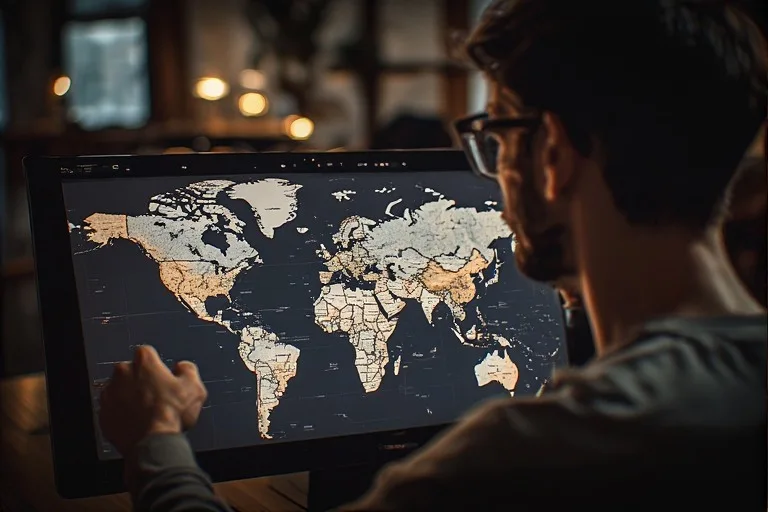
Every single day, billions of people across the globe tap a screen, input a destination, and implicitly trust a digital map to guide them. Whether you're navigating a new city, ordering dinner, or tracking a package, these ubiquitous tools are so integrated into our lives that we rarely pause to consider the immense, complex infrastructure humming beneath the surface. It's not just a simple algorithm; it's a sprawling, multi-layered system of satellites, sensors, data centers, and human intelligence working in concert to present you with that clean, interactive interface. In fact, more than 1 billion people use Google Maps every month, relying on its accuracy for everything from their morning commute to once-in-a-lifetime road trips (Statista, 2023). But what exactly are the hidden systems behind online maps that make this possible?
- Online maps fuse diverse data sources, from satellite imagery to ground-level LiDAR scans, to create detailed digital representations of our world.
- Sophisticated geospatial intelligence systems and AI algorithms process raw data into actionable routes, points of interest, and real-time traffic updates.
- Human cartographers and community contributions play a vital role in maintaining accuracy and adding local nuance that machines can miss.
- The mapping infrastructure extends far beyond navigation, powering countless delivery, ride-sharing, and logistical services, forming a critical backbone of the modern economy.
The Foundation: From Satellites to Street View Sensors
Before you ever see a route, an online map begins its life as raw data, meticulously collected from an astonishing array of sources. At the highest level, a network of Global Navigation Satellite Systems (GNSS) like the American GPS, Russian GLONASS, European Galileo, and Chinese BeiDou constantly beam signals down to Earth. Your phone's receiver interprets these signals to determine its precise location, often within a few meters. But satellite data alone isn't enough to build the rich, detailed maps we expect. That's where aerial imagery comes in. Companies deploy specialized aircraft with high-resolution cameras, capturing vast swathes of land. These images are then stitched together, forming the familiar top-down views we use to identify landmarks or check out an area before visiting.
However, true map detail requires getting much closer to the ground. This is where fleets of mapping vehicles, famously equipped with 360-degree cameras and advanced sensors, enter the picture. These cars meticulously drive virtually every public road, capturing not just photographs for Street View, but also crucial spatial data. They're not just taking pictures; they're building a three-dimensional model of the world. This ground-level data collection is incredibly resource-intensive, requiring constant updates to reflect changes in infrastructure, new businesses, or altered street layouts. It's a never-ending cycle of capture and refresh.
The LiDAR Revolution in Mapping
Among the most significant advances in ground-level data collection is LiDAR (Light Detection and Ranging). Mounted on mapping vehicles, LiDAR sensors emit pulsed laser light and measure the time it takes for the light to return. This creates incredibly precise, high-density 3D point clouds of the environment. Unlike traditional cameras that capture light reflected off surfaces, LiDAR can penetrate foliage and create detailed topographical maps, even in dense urban areas. This technology provides millimeter-level accuracy for road surfaces, building facades, and infrastructure elements. It's invaluable for creating the precise digital twins of our world that autonomous vehicles and advanced navigation systems rely on. The sheer volume and fidelity of LiDAR data ensure that every curb, road sign, and traffic light is accounted for, forming the bedrock for highly accurate navigation.
Mapping the Unseen: Data Processing and Geospatial Intelligence
Raw data, no matter how abundant or precise, is just noise until it’s processed into something meaningful. This is where Geographic Information Systems (GIS) and advanced geospatial intelligence come into play. Imagine petabytes of satellite images, LiDAR point clouds, GPS traces, and Street View photos pouring into a central nervous system. Engineers and data scientists use complex algorithms to sift through this deluge, identifying roads, buildings, natural features, and points of interest (POIs). This involves sophisticated image recognition, machine learning models trained on vast datasets, and even human annotation to label and categorize features.
Once identified, these features are transformed into digital map objects: vector data representing lines (roads, rivers), polygons (buildings, parks), and points (landmarks, businesses). These vector tiles are lightweight and scalable, allowing for seamless zooming and panning across different devices. But the processing doesn't stop there. Algorithms analyze road networks to understand connectivity, one-way streets, speed limits, and turn restrictions. They infer relationships between POIs and their addresses, linking phone numbers, websites, and operating hours. This intricate web of interconnected data forms the intelligent backbone of the technology behind ride-sharing apps explained, ensuring that your requested car knows precisely where to pick you up and drop you off.
Real-Time Realities: Traffic, Updates, and Predictive Analytics
A static map, no matter how detailed, is of limited use in a dynamic world. The true power of modern online maps lies in their ability to reflect real-time conditions. This is achieved through a continuous stream of data from multiple sources. The most significant contributor to real-time traffic information is anonymized speed and location data from millions of smartphones and GPS-enabled vehicles on the road. By aggregating this data, map providers can infer traffic density and speed on specific road segments, immediately highlighting congestion in various colors.
Beyond traffic, live incident reporting plays a crucial role. This includes information from official sources like transportation departments, police reports, and even crowdsourced data from users reporting accidents, road closures, or construction zones. Machine learning algorithms then take this real-time data and combine it with historical traffic patterns, weather forecasts, and even planned events to perform predictive analytics. They can estimate how long a delay might last, anticipate future congestion, and proactively suggest alternative routes. This is why your navigation app can often tell you not just what traffic looks like now, but also give a remarkably accurate estimated time of arrival that accounts for potential slowdowns ahead. It's a testament to the power of continuous data fusion and intelligent forecasting.
Dr. Sarah Chen, Director of Geospatial Intelligence at TerraData Solutions, highlights the immense scale of real-time data processing: "We're talking about ingesting petabytes of location data hourly, normalizing it, and running complex machine learning models in milliseconds. The challenge isn't just about showing where traffic is, but predicting where it will be. Our latest research indicates that predictive routing models, leveraging historical data and real-time inputs, can reduce average commute times by up to 15% in congested urban environments, directly impacting daily quality of life."
The Human Element: Curation, Correction, and Community
While automation and AI handle the bulk of data processing, the human element remains indispensable for ensuring accuracy and relevance. Professional cartographers and data editors meticulously review anomalies, resolve discrepancies, and add nuanced local information that machines might miss. They verify new road constructions, update building outlines, and ensure points of interest (POIs) have correct details like operating hours or accessibility information. For instance, determining if a seemingly new road segment is actually a private drive or a public thoroughfare often requires human judgment.
Furthermore, community contributions have become a cornerstone of map accuracy. Users can report errors, suggest new places, add photos, and provide reviews. Platforms like OpenStreetMap exemplify the power of crowdsourcing, where millions of volunteers collaboratively build and maintain a free, editable world map. Even proprietary map services rely heavily on user feedback loops. When you report a business as closed or a road as mislabeled, that information enters a system that prioritizes verification and updates. This symbiotic relationship between advanced technology and human insight ensures that maps remain dynamic, reflecting the constant changes in our physical world and catering to the specific needs of local communities. It's how maps manage to stay current, even when navigation apps sometimes show wrong routes due to unexpected changes.
Beyond Navigation: The API Economy and Location Services
The hidden systems behind online maps extend far beyond simply helping you get from point A to point B. The underlying mapping infrastructure forms the backbone of a vast "API economy," where map data and functionalities are licensed and integrated into countless other applications and services. Every time you track your delivery driver, summon a ride-share, or find a nearby restaurant on a third-party app, you're interacting with these integrated mapping services. Companies like Google Maps Platform, Apple MapKit, and HERE Technologies provide robust APIs (Application Programming Interfaces) that allow developers to embed interactive maps, search for locations, calculate routes, and display real-time data directly within their own applications.
This widespread integration has profound economic implications. It enables logistics companies to optimize delivery routes, significantly reducing fuel consumption and operational costs. Real estate platforms can visualize property listings on a map, providing crucial context to potential buyers. Emergency services use map data for dispatch and situational awareness. Even social media apps leverage location services to tag posts or find friends nearby. This makes map data a critical utility, underpinning much of the digital economy and transforming how businesses operate and how we interact with our immediate environment. It's not just a feature; it's an essential platform for innovation, demonstrated by the sheer volume of location-based services available today.
| Map Provider | Primary Data Sources | Key Strengths | Global Coverage (Estimate) |
|---|---|---|---|
| Google Maps | Satellite, Street View, User Contributions, Mobile Data | Comprehensive POI data, real-time traffic, Street View depth | ~98% of world population |
| Apple Maps | Satellite, LiDAR, Ground Truth vehicles, User Contributions | Privacy-focused, detailed 3D imagery, Look Around feature | ~60% of world population (with detailed data) |
| OpenStreetMap | Community Contributed, Satellite Imagery (traced) | Highly detailed in specific areas, open-source, customizable | Variable, highest in urban centers |
| HERE Technologies | Satellite, LiDAR, Enterprise fleets, Sensor data | Automotive-grade maps, highly precise for autonomous driving, logistics | ~200 countries, strong in automotive |
Securing Your Journey: Privacy and the Ethics of Location Data
With such pervasive data collection, questions of privacy and data security naturally arise. Map providers collect vast amounts of location data, often aggregated and anonymized, to power their real-time features and improve services. This raises concerns about who has access to this data, how it's used, and whether individual privacy is adequately protected. Most major map providers emphasize their commitment to anonymization and robust security measures, but the sheer scale of data inevitably presents challenges. For instance, the European Union's GDPR and California's CCPA are direct responses to the need for stricter regulations around personal data, including location information.
Here's the thing: understanding the privacy implications of online maps means recognizing the trade-off between convenience and data sharing. While you gain hyper-accurate navigation and personalized recommendations, you contribute to the data pool that makes these services possible. It’s a dynamic tension that constantly evolves with technology and societal expectations. Responsible map providers invest heavily in secure infrastructure and privacy-enhancing technologies, but users also have a role to play in managing their privacy settings. It’s a collaborative effort to ensure that the benefits of advanced mapping don’t come at an unacceptable cost to individual freedoms.
"In a recent survey, 72% of users expressed concerns about the privacy of their location data, yet 85% continue to use navigation apps daily, highlighting a clear tension between convenience and privacy apprehension." – Pew Research Center, 2022.
Actionable Steps to Enhance Your Location Privacy:
- Review App Permissions: Regularly check which apps have access to your location data and set them to "While Using App" rather than "Always" where possible.
- Limit Location History: Most map services allow you to pause or delete your location history. Take advantage of these features.
- Use VPNs: A Virtual Private Network can mask your IP address, adding a layer of anonymity to your online activities, though it won't prevent apps from tracking your device's GPS.
- Read Privacy Policies: Understand how your chosen map provider collects, uses, and shares your data.
- Opt for Incognito Mode: Some map applications offer an incognito mode for one-off searches that won't be linked to your history.
What This Means for You
The intricate, hidden systems behind online maps aren't just technical marvels; they're fundamental to how we interact with the world and each other. For you, the user, understanding this complexity means moving beyond simply consuming a service to becoming a more informed participant. It means appreciating the staggering engineering effort that goes into predicting your arrival time with surprising accuracy, even when navigating rush hour traffic. It also empowers you to make conscious decisions about your data, managing permissions and reviewing privacy settings with a clearer picture of what’s at stake. These maps are more than just digital guides; they're dynamic, living representations of our planet, constantly being built, refined, and updated by a colossal interplay of machines and human intelligence. They reflect not just roads and buildings, but the pulse of modern life itself, connecting disparate points of interest and facilitating the movement of people and goods on an unprecedented scale. Your daily commute, your weekend getaway, even your next meal delivery – all are orchestrated by these unseen but omnipresent forces.
Frequently Asked Questions
How do online maps know about road closures and construction?
Online maps gather information about road closures and construction from a variety of sources. This includes official government transportation agencies, municipal traffic departments, crowdsourced user reports, and even data from fleet vehicles or other connected devices that observe anomalies. Machine learning algorithms then verify and integrate this data, pushing updates to users in near real-time.
Are my location data private when I use navigation apps?
Map providers generally employ anonymization and aggregation techniques to protect individual user privacy while still using location data to improve services like traffic prediction. However, the extent of privacy varies by provider and your personal settings. It's crucial to review the privacy policies of the apps you use and actively manage your location permissions and history settings to control your data.
What's the fundamental difference between GPS and online maps?
GPS (Global Positioning System) is a satellite-based system that provides raw location coordinates to your device. Online maps, conversely, are the application layer that takes those raw GPS coordinates (along with data from Wi-Fi, cell towers, and other sensors) and overlays them onto a detailed, intelligent map. They provide routing, points of interest, real-time traffic, and contextual information that GPS alone cannot offer.