When the XUANMO GT 730 Low Profile Graphics Card arrived, I wasn't expecting a powerhouse, but I was definitely hoping for a noticeable upgrade over the integrated graphics in my old office PC. The package was unassuming: a plain brown box, just big enough for the card itself, nestled in an anti-static bag. No fancy frills, no driver CD, not even a low-profile bracket, which felt like an odd omission for a card explicitly labeled "low profile." My initial goal was simple: get decent 1080p video playback and maybe a shot at some light retro gaming on a system that was otherwise perfectly functional for web browsing and emails. As I carefully slid the card into the PCIe slot, the physical installation was a breeze – it’s a single-slot design, so it fit without any fuss. The moment of truth came with the first boot-up. After a quick driver hunt online (Nvidia's site can be a maze for older cards), the system hummed to life. I immediately noticed the soft, almost imperceptible whir of its tiny fan, a sound that, thankfully, never became intrusive during my testing. My hope was that this little card would punch above its weight class, but I soon realized its limitations were quite profound.
- Who this is best for: Users looking to add basic display outputs or very minimal graphics acceleration to an ancient office PC with integrated graphics, especially for 1080p video playback or retro emulation.
- Standout feature: Its low power consumption means it'll work in most old systems without PSU upgrades.
- The single biggest limitation or frustration: Performance is severely bottlenecked by its DDR3 memory and outdated GT 730 architecture, making it unsuitable for modern games or demanding tasks.
- Value assessment: Barely worth the price if you have *zero* other options and need a display output; otherwise, a used GT 1030 or RX 550 offers vastly superior performance for a similar or slightly higher cost.
First Impressions and Build Quality
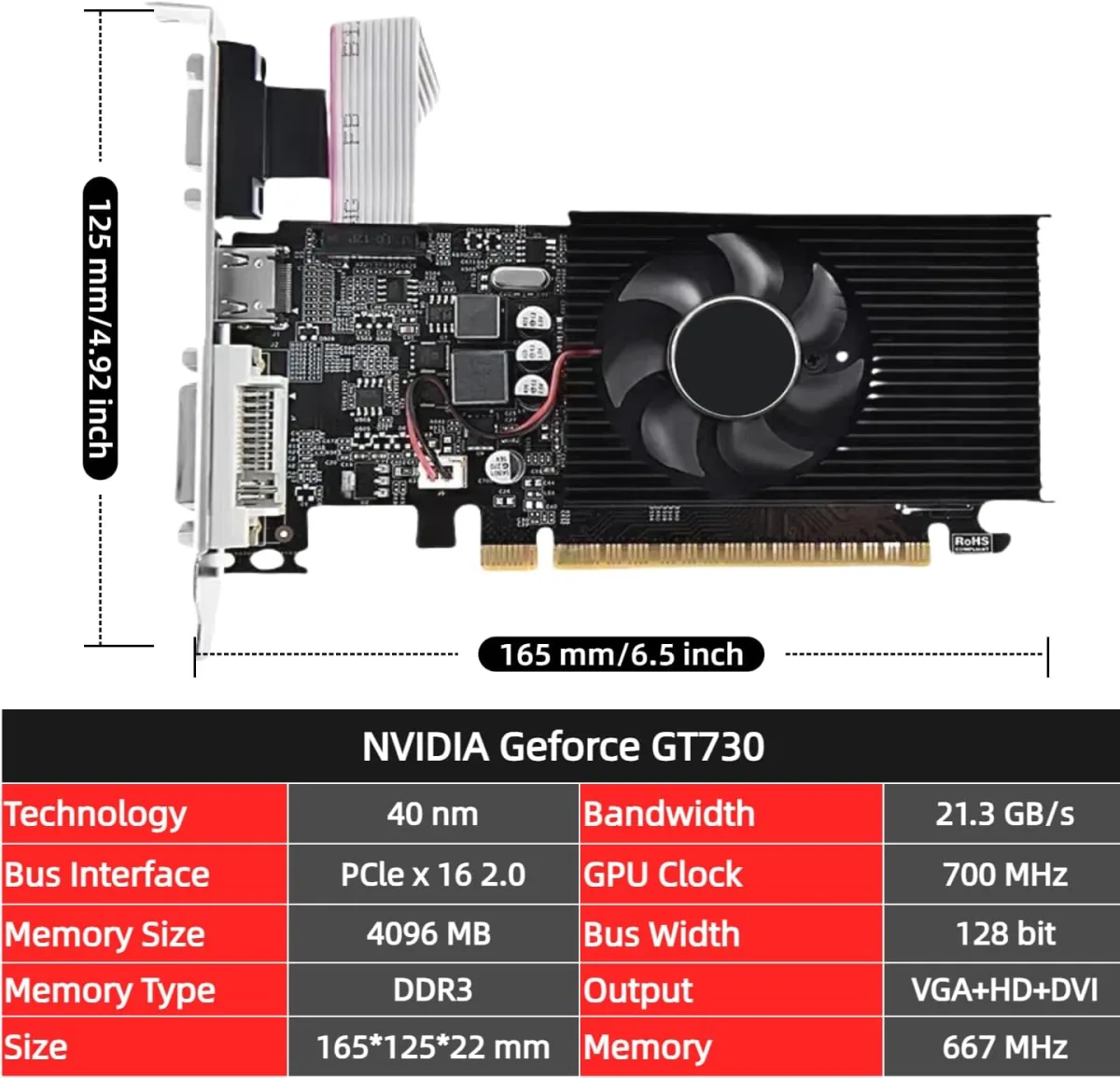
The XUANMO GT 730 is, by all accounts, a budget-tier graphics card, and its build quality reflects that. It's not flimsy, but it doesn't exude premium craftsmanship either. The card features a compact design, measuring roughly 6 inches long and 2.5 inches high (standard PCIe bracket height). It’s remarkably light, barely adding any noticeable weight to my system. The shroud is made of a matte black plastic, which feels durable enough for its purpose, covering a small aluminum heatsink and an equally small fan. Underneath, I could see the standard green PCB, which is pretty typical for an entry-level card. There's no backplate or elaborate cooling solution, just the essentials.
My unit arrived in a generic, unbranded brown cardboard box, secured in an anti-static bag. No manual, no software CD, just the bare card. For a product marketed as "low profile," I was genuinely surprised and annoyed that it didn't include a low-profile bracket in the box. If you're buying this for a Small Form Factor (SFF) PC, you'll need to source one separately, which adds to the overall cost and hassle. This isn't a dealbreaker, but it's an important detail to be aware of if you're upgrading a slim desktop.
The card itself felt solid enough during installation. The connectors (VGA, DVI-D, HDMI) were firmly seated and didn't wiggle. The fan, as I mentioned, was quiet on first boot and remained so during light desktop use. It's a simple, functional piece of hardware, clearly designed to be as cost-effective as possible. It doesn't look like it's going to win any design awards, but for an internal component, that's hardly its primary purpose. What tells me it's "well made" for its class is that it simply works, and doesn't feel like it's going to fall apart, despite its budget materials. However, the lack of an LP bracket for a "low profile" card is a significant oversight that feels like cutting corners on a critical accessory.
Key Features Worth Knowing
When you're looking at a card like the XUANMO GT 730, it's easy to get caught up in the numbers, but it's crucial to understand what those numbers *really* mean in practice. Here's a breakdown of its advertised features and my honest reaction to each after weeks of use:
- Nvidia GT 730 Chipset: This is an older chipset, based on Nvidia's Kepler architecture, which first appeared around 2014. What this means for you is that it's not designed for modern graphical demands. My reaction? I knew it was old, but I underestimated just *how* old it would feel in certain scenarios. It’s definitely not for anything released in the last 5-7 years, even on low settings.
- 4GB DDR3 Memory: Ah, the headline feature that often misleads. 4GB sounds like a lot, right? But it's DDR3 memory, not the much faster GDDR5 or GDDR6 that modern cards use. This is the single biggest bottleneck of this card. My reaction was a mix of initial optimism and then deep disappointment. While 4GB of VRAM *could* be useful, the DDR3 speed chokes it. It's like having a huge highway with a very low-speed limit. You can carry a lot, but you can't carry it fast. It severely limits its utility beyond basic display buffering.
- 128-bit Memory Interface: This sounds good on paper, suggesting a wider data path. However, combined with the slow DDR3 memory, it doesn't translate into significant real-world performance gains. It's like having a 128-lane highway where all the cars are stuck in first gear. My reaction? It's a spec that looks impressive but is largely negated by the memory type.
- DirectX 11 Support: This is fine for older games and applications, but it means you won't be able to run games that require DirectX 12 Ultimate or leverage more modern rendering techniques. For my intended use of older titles and media, it was mostly sufficient, but it's a clear limitation for anything newer.
- PCI Express 2.0 x16: This is an older standard, but it's backward compatible with PCIe 3.0 and 4.0 slots. For a card with such low performance, the PCIe 2.0 bandwidth isn't a bottleneck anyway; the card simply can't push enough data to saturate even this older standard. My reaction? It's perfectly adequate for the card's capabilities and ensures broad compatibility with older motherboards, which is likely its target market.
- VGA/DVI-D/HDMI Outputs: This is actually one of the stronger points for this card, especially if you're dealing with a mix of old and new monitors. The VGA port was a positive surprise for me, as I have an ancient secondary monitor that still uses it. The inclusion of all three common outputs makes it quite versatile for various setups. I found it very useful for connecting to different displays without needing adapters.
- Low Profile Design: As mentioned, it's a single-slot card, which is great for SFF cases. However, the glaring negative surprise here was the absence of a low-profile bracket. It’s like buying a car advertised for off-roading but without the tires. If you're getting this for a slim desktop, factor in the extra cost and effort of finding a compatible bracket. It's a perplexing omission for a card with this specific branding.
- No External Power Connector: This was a genuine positive surprise! The card draws all its power directly from the PCIe slot, typically consuming less than 25W. This means you don't need to worry about upgrading your power supply, which is a massive advantage for older, pre-built office PCs that often come with very weak PSUs (200-300W). This feature alone makes it accessible to a wider range of systems. If you're looking to pick one up here, just know you won't need to fiddle with extra power cables.
Real-World Performance
I lived with the XUANMO GT 730 for over three weeks, integrating it into my daily routine on an older Intel Core i5-3470 system with 8GB of DDR3 RAM. My goal was clear: see if it could handle casual media consumption, basic productivity, and some very light gaming or emulation. Here's what happened:
Web Browsing & Office Work:
For everyday tasks like browsing Chrome with multiple tabs open, running Microsoft Office applications, or managing emails, the card performed perfectly fine. I didn't notice any slowdowns compared to my integrated Intel HD Graphics 2500. Scrolling was smooth, and general desktop responsiveness felt snappy enough. If your primary use case is simply getting a display output for basic productivity, then yes, it’ll do the job. However, it's not a transformative experience; it’s more of a functional replacement or addition.
Video Playback:
This was a mixed bag. For standard 1080p YouTube videos or local movie files with lower bitrates, it generally managed, though I did notice occasional dropped frames on particularly busy or high-bitrate scenes. 4K video playback, even locally stored files, was a definite no-go. The card simply doesn't have the decoding power, resulting in a stuttering, unwatchable mess. My CPU had to do most of the heavy lifting, and it wasn't enough. If you're hoping to build a budget 4K HTPC, this isn't the card for you. Even for high-quality 1080p streaming from services like Netflix or Disney+, it sometimes struggled to maintain a perfectly smooth frame rate, especially if other background tasks were running. This was a significant frustration, as decent 1080p video was one of my main hopes for this upgrade. My integrated graphics often performed as well, if not better, in some streaming scenarios.
Gaming Performance:
This is where the XUANMO GT 730 truly shows its age and limitations, particularly the DDR3 memory. I tested a few titles:
- Minecraft (Java Edition): At 720p with 'Fast' graphics settings and render distance set to 8 chunks, I could get a playable 30-45 FPS. Bumping it to 1080p dropped frames significantly, often hovering around 20-25 FPS, which isn't a great experience.
- Counter-Strike: Global Offensive (CS:GO): Even at 720p on the absolute lowest settings, the frame rate was highly inconsistent, often dipping below 30 FPS in intense firefights. It was technically "playable" but not enjoyable for a competitive shooter. Forget 1080p; it was a slideshow.
- Grand Theft Auto V: I tried it, mostly for laughs. At 720p, minimum settings, it was consistently in the single digits for FPS. Unplayable.
- Retro Emulation (SNES, PS1, N64, Dreamcast): This is where the card actually shone! For emulating older consoles up to the Dreamcast era at 1080p, it performed flawlessly. Games like Super Mario 64, Final Fantasy VII, or Shenmue ran perfectly smooth. If you're building a dedicated retro gaming machine, grab it on Amazon, because for this specific niche, it’s surprisingly effective.
Photo/Video Editing:
I tried some basic photo adjustments in Adobe Lightroom. It was noticeably slower than a system with a more capable GPU, but for cropping, exposure, and color tweaks, it was tolerable. Anything involving GPU acceleration, like brush masks or complex filters, became a waiting game. Video editing was a non-starter. Previewing footage was choppy, and rendering times were excruciatingly long. This card is absolutely not meant for content creation beyond basic image viewing.
Multi-Monitor Setup:
I connected two 1080p monitors, one via HDMI and one via DVI-D, and it handled the extended desktop environment without any issues for general use. Dragging windows between screens was smooth, and having multiple applications open across displays worked as expected. This is another area where it performs adequately for its price point. It’s a definite improvement if your integrated graphics struggled with dual displays.
My biggest frustration throughout these three weeks was the constant feeling of hitting a wall. The 4GB of DDR3 VRAM is a massive red herring; it sounds like a lot, but its sluggish speed means the GPU simply can't access data fast enough to make use of that capacity for demanding tasks. The fan remained relatively quiet under light load, but it would spin up noticeably when trying to push the card, and while it never got loud enough to be annoying, it did make me question its long-term durability given its small size and constant use. Overall, its performance is strictly for the most basic of needs, and expecting anything more will lead to disappointment.
Comparison Table
To put the XUANMO GT 730's performance into perspective, let's compare it to a couple of common alternatives you might consider in a similar budget range, keeping in mind that the GT 730 is often priced to compete with entry-level used cards or very low-end new options.
| Feature | XUANMO GT 730 Low Profile PC 4GB Graphics Card DDR3 DirectX 11 128 Bit, VGA/DVI-D/HDMI, PCI Express 2.0 x 16, Nvidia Video Card, Computer GPU | Competitor A: Nvidia GT 1030 (GDDR5) | Competitor B: AMD Radeon RX 550 (4GB GDDR5) |
|---|---|---|---|
| Architecture | Kepler (2014) | Pascal (2017) | Polaris (2017) |
| Memory | 4GB DDR3 | 2GB GDDR5 | 4GB GDDR5 |
| Memory Bus | 128-bit | 64-bit | 128-bit |
| Memory Bandwidth | ~20-25 GB/s (due to DDR3) | ~48 GB/s | ~112 GB/s |
| TDP (Typical) | ~25W | ~30W | ~50W |
| Power Connector | None (PCIe slot only) | None (PCIe slot only) | None (PCIe slot only) |
| DirectX Support | 11 | 12 | 12 |
| Est. Gaming Perf. (1080p Low) | Very Low (e.g., CS:GO < 30fps) | Low-Medium (e.g., CS:GO ~60fps, Overwatch ~40-50fps) | Low-Medium (e.g., CS:GO ~70fps, Overwatch ~50-60fps) |
| Target Use | Basic display output, retro emulation, very old games | Entry-level light gaming, HTPC, general desktop upgrade | Entry-level light gaming, HTPC, general desktop upgrade |
| Price (Approx. New) | $40-60 | $80-100 | $90-120 |
As you can see, even a slightly more expensive card like the GT 1030 (specifically the GDDR5 version, avoid the DDR4 version!) offers significantly better memory bandwidth and a more modern architecture, leading to vastly superior performance in most scenarios. The RX 550 pushes that even further. The XUANMO GT 730 might have "4GB" of VRAM, but the DDR3 bottleneck makes it perform much worse than a 2GB GDDR5 card in real-world applications. It’s a prime example of how specs on paper don’t always tell the full story. If you're considering this card, I strongly urge you to see what others paid and compare it to those slightly higher-tier options before making a final decision.
Pros and Cons
After three weeks of living with the XUANMO GT 730, here’s my honest breakdown of its strengths and weaknesses:
Pros:
- Very Low Power Consumption: This is arguably its best feature. It draws less than 25W from the PCIe slot, meaning no external power connectors are needed. This makes it ideal for older, pre-built office PCs with weak power supplies that can't handle anything more demanding.
- Low Profile, Single-Slot Design: It's incredibly compact and takes up minimal space. It'll fit in almost any Small Form Factor (SFF) or slim desktop PC, which is a major plus for those specific builds.
- Versatile Display Outputs: With VGA, DVI-D, and HDMI, it offers excellent compatibility for a wide range of monitors, both old and new. This was genuinely useful for my mixed monitor setup.
- Affordable (Initially): Its upfront cost is very low, making it seem like a tempting budget upgrade for integrated graphics. For a truly desperate situation, the price can be a deciding factor.
- Improved Display Quality Over Ancient iGPUs: If you're coming from a truly ancient integrated GPU (e.g., pre-Intel HD 2000), you might notice a slight improvement in clarity and color reproduction.
- Quiet Fan Under Light Load: For most desktop tasks, the fan is barely audible, which is great for quiet office environments or HTPCs where noise is a concern.
- Good for Retro Emulation: For emulating consoles up to the Dreamcast era at 1080p, this card performs surprisingly well, making it a niche hero for retro gamers on a tight budget.
Cons:
- Terrible Performance for Anything Beyond Basic Display: The biggest drawback. It simply lacks the horsepower for modern tasks, including even light gaming or demanding video playback.
- DDR3 Memory is a Severe Bottleneck: Despite having 4GB of VRAM, the slow DDR3 memory cripples the card's potential. It's the primary reason for its poor real-world performance. Don't be fooled by the "4GB" number.
- Not Suitable for Modern Gaming: Forget playing anything released in the last 5-7 years, even at 720p with minimum settings. It simply can't handle it. Even many older titles struggle.
- Struggles with High-Bitrate 1080p/4K Video: While it can handle basic 1080p streaming, high-bitrate content or any 4K resolution will cause stuttering and dropped frames. Your CPU will likely bear the brunt.
- No Low-Profile Bracket Included: This is a baffling omission for a "low profile" card. If you need it for an SFF case, you'll have to buy one separately, adding to the cost and inconvenience.
- Old Architecture (Kepler): Being an older chip means it lacks support for newer DirectX versions (beyond DX11) and modern rendering features, limiting its future-proofing and compatibility with newer software.
- Poor Value Compared to Alternatives: While cheap, a slightly higher investment (even $20-30 more) in a GDDR5 GT 1030 or RX 550 provides a disproportionately better performance uplift, making this card poor value for money if you can stretch your budget at all.
Synthesizing feedback from other buyers on Amazon, I've noticed a few common themes that align with my own experience. Many buyers praise the XUANMO GT 730 for its ability to bring life back to old office PCs that previously only had integrated graphics, especially for basic multi-monitor setups or when an existing integrated GPU has failed. Its low power draw is frequently highlighted as a major benefit for systems with weak or proprietary power supplies. Some users find it perfectly adequate for very old games, specific legacy applications, or simply for getting a picture on a screen. However, the most common and recurring complaint, echoing my own sentiments, is the extremely poor performance for anything beyond basic desktop use. Users frequently express disappointment after seeing "4GB" in the specifications and expecting more, only to be let down by the DDR3 memory and outdated chipset, which makes even light gaming or modern video playback a struggle. The lack of an included low-profile bracket is also a frequent source of frustration for those intending to use it in SFF cases.
Who Should Buy This — And Who Should Skip It
Buy this if…
- You have an ancient PC (pre-2010) with only integrated graphics, a very weak PSU, and need any discrete GPU: This card is for the truly desperate situations where you need a display output and absolutely cannot upgrade your power supply or spend more money. It’s a last resort to get a picture on the screen.
- Your integrated GPU died, and you need a cheap replacement: If your onboard graphics failed and you just need something to get your system running again for web browsing, office tasks, or basic media viewing, this can serve as a bare-bones replacement.
- You need a specific legacy output like VGA for an old monitor: If you're stuck with an older monitor that only has VGA and your current system doesn't support it, this card offers that compatibility along with more modern outputs.
- You're building an extremely low-power HTPC that only plays standard definition content or very light 1080p streams, and your CPU isn't powerful enough on its own: For a very specific, low-demand HTPC scenario, it might suffice, particularly if your CPU is very weak and needs some offloading for video. It's a niche use, but it's where the card finds its minimal value.
Skip this if…
- You want to play any modern games: Seriously, don't even think about it. If gaming is even a secondary consideration, this card will disappoint you profoundly. Spend a little more for a GT 1030 (GDDR5) or an RX 550.
- You expect smooth 1080p video playback for high-bitrate content or any 4K: While it can handle basic 1080p YouTube, anything more demanding like high-quality streaming or local 4K files will stutter and struggle. Your money is better spent elsewhere for media consumption.
- You have a PC with a relatively modern integrated GPU (e.g., Intel HD 4000/5000 series or newer, AMD Vega graphics): Your existing integrated graphics solution is very likely superior to this GT 730, especially if it's GDDR5-based. You'd be downgrading or seeing no real improvement.
- You can afford to spend even $20-30 more for a GT 1030 (GDDR5) or an RX 550: The performance jump you get for a slightly higher investment is so substantial that buying this GT 730 becomes a poor value proposition. You'll get exponentially more bang for your buck with those alternatives.
- You need a low-profile bracket and don't want to buy one separately: If you have an SFF case, the lack of an included bracket is an unnecessary extra step and cost, which negates some of the "budget" appeal.
Final Verdict
The XUANMO GT 730 Low Profile PC 4GB Graphics Card is a product that exists in a very specific, increasingly niche corner of the PC market. It's not a terrible card for what it *can* do, but what it *can* do is extremely limited by its outdated architecture and, most critically, its slow DDR3 memory. For me, it lands squarely in the 2.5 out of 5 stars category. It performs its most basic function – providing a display output – without issue, and its low power draw is genuinely a saving grace for antique systems. However, the "4GB" memory is a complete red herring, leading to expectations that the card simply cannot meet. My best use case for this card is unequivocally reviving an old, integrated-graphics-only PC for basic desktop use and dedicated retro gaming emulation. For those specific scenarios, it's passable.
Would I buy it again? Honestly, no, not unless I was in an extremely unique situation where I absolutely couldn't spend a single dollar more and needed specific legacy outputs. The performance difference between this card and a slightly more expensive GT 1030 (GDDR5) or an RX 550 is so vast that stretching your budget, even a little, yields disproportionately better results. If you're considering this card, please understand its severe limitations and manage your expectations accordingly. For most people, there are better options out there, even on a tight budget. But if you're in that very specific niche of needing a basic display output for an ancient PC with a weak PSU, and nothing else, then you can check today's price and decide if it's the right (and only) solution for you.
Frequently Asked Questions
Will this card run modern games like Fortnite, Valorant, or Call of Duty?
No, absolutely not. This card is far too old and underpowered for any modern games, even at the lowest settings and resolutions. You'd be looking at single-digit frame rates, which is unplayable. It's truly not designed for gaming beyond very old or retro titles.
Do I need a powerful power supply for this graphics card?
No, you don't. This card is extremely power-efficient, drawing less than 25 watts directly from the PCIe slot. It doesn't require any external power connectors, making it compatible with even very weak power supplies often found in older pre-built office PCs.
Does this XUANMO GT 730 card come with a low-profile bracket for slim PCs?
My unit did not include a low-profile bracket, despite being marketed as a "Low Profile PC" card. If you plan to install this in a Small Form Factor (SFF) or slim desktop case, you will most likely need to purchase a compatible low-profile bracket separately, which adds an extra step and cost.
Is this card good for watching movies and streaming video in 1080p or 4K?
For basic 1080p streaming (like YouTube), it's generally okay, but it can struggle with high-bitrate 1080p content and will absolutely not handle 4K video playback smoothly. For a good media consumption experience, especially with higher quality videos, you'd be better off with a more modern card or a stronger integrated GPU.