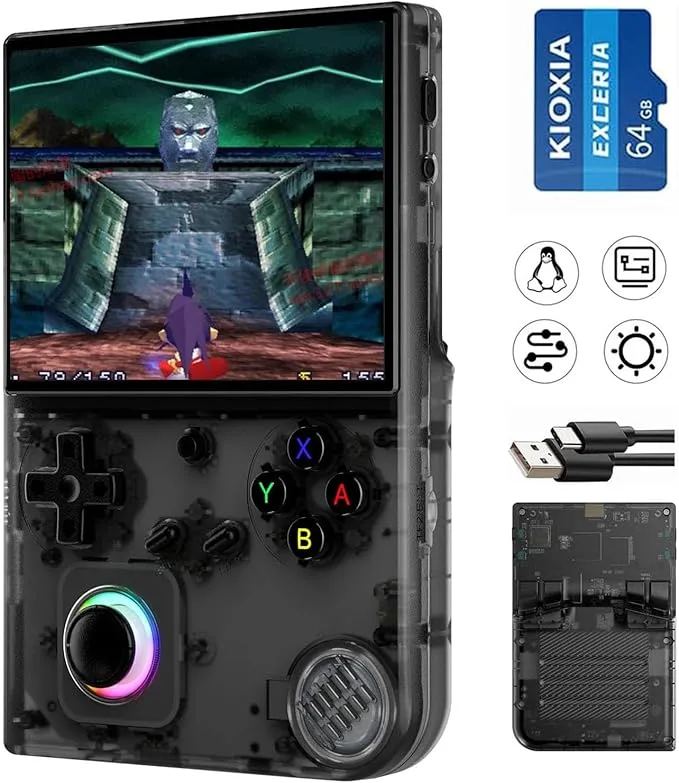
The anticipation was real when the RG40XX V Handheld Game Console arrived. I’d been eyeing a modern retro handheld for a while, something that could scratch that nostalgic itch without demanding too much fuss. Unboxing it, I was immediately struck by the device's surprising heft – it weighs in at around 220 grams, feeling more substantial than I’d expected for its relatively compact size. The packaging was simple, a small box containing the console, a USB-C charging cable, and a brief manual. My first thought upon holding it was how solid it felt; the plastic casing didn't creak or flex under pressure, which was a good sign. Powering it on, the 4.0-inch IPS screen immediately impressed with its crispness and vibrant colors, even before diving into a game. The pre-installed operating system booted up quickly, presenting a clean interface, and I had that immediate sense that this could really be the device I was hoping for – a portable portal to my gaming past. It was only after a few hours of actual gameplay, though, that the nuances, both good and bad, began to surface.
- This is best for casual retro gamers seeking a solid, portable device for 8-bit to early 32-bit systems, who are comfortable with some DIY tinkering for optimal performance.
- The standout feature is undeniably its vibrant 4.0-inch IPS screen, which makes classic games look fantastic and offers great viewing angles.
- The single biggest limitation or frustration is the inconsistency of the pre-installed game library and the default firmware's lack of advanced customization options, often requiring a switch to custom firmware for a truly polished experience.
- Value-wise, it's pretty good for the price if you're willing to put in a little effort, offering a more premium feel than some cheaper alternatives but not quite reaching the seamlessness of higher-end devices.
First Impressions and Build Quality
When I first pulled the RG40XX V out of its box, the immediate tactile impression was positive. It’s got a pleasingly chunky, almost brick-like feel, which I appreciate in a handheld; it doesn't feel flimsy at all. The dimensions are roughly 14.5cm x 10.5cm x 3.5cm (L x W x H), making it just small enough to fit comfortably in most pockets, though it creates a noticeable bulge. The plastic used for the casing feels like a high-quality ABS, with a smooth, matte finish that doesn't attract fingerprints easily. I opted for the clear black version, and seeing the internal components peek through the translucent shell adds a nice touch of retro-futurism. The buttons are another highlight. The D-pad is responsive and clicky without being overly stiff, perfect for precise movements in platformers and fighting games. The face buttons (A, B, X, Y) also have a satisfying, albeit slightly softer, click and good travel. They're well-spaced, which prevents accidental presses during intense gaming sessions. The shoulder buttons, L1/L2 and R1/R2, are stacked vertically on the top corners. L1/R1 are clicky microswitches, while L2/R2 are more squishy, analogue-feeling buttons. This setup works well for games that need both types of input, though I found the L2/R2 to be a bit too soft for my liking, sometimes feeling indistinct. The dual analog sticks are surprisingly good for a device in this price range – they're Hall effect joysticks, meaning they're less prone to drift over time. They have a decent amount of resistance and good accuracy, a significant upgrade from the cheap sticks I’ve encountered on other budget handhelds.
The screen, as I mentioned, is a real star. The 4.0-inch IPS panel is gorgeous, offering vibrant colors and excellent viewing angles. It's bright enough for most indoor environments, though direct sunlight can still wash it out a bit. There’s a noticeable bezel around the screen, but it’s not overly distracting. The speakers are located on the bottom edge and provide surprisingly clear audio for a handheld, though they lack deep bass. Still, they're perfectly adequate for retro game sound effects and music. The USB-C port for charging and data transfer is on the top, along with a mini-HDMI out port and the headphone jack. The two TF card slots (one for the OS, one for games) are neatly tucked away on the bottom. Overall, the build quality gives me confidence that this device can withstand the rigors of daily commuting or casual travel. It doesn't feel like a cheap toy; it feels like a well-thought-out piece of portable gaming hardware that's built to last.
Key Features Worth Knowing
The RG40XX V boasts a range of features that, on paper, make it a compelling choice for retro enthusiasts. After living with it for three weeks, I’ve got some specific thoughts on how each one holds up:
- 4.0'' IPS Screen: This is, without a doubt, the console's crowning glory. The 4:3 aspect ratio is perfect for classic games, and the resolution (I believe it's 640x480, though not explicitly stated in all listings) makes pixels look sharp without being overly pixelated. Games like Chrono Trigger on SNES or Castlevania: Symphony of the Night on PS1 truly shine here. What surprised me positively was just how vibrant the colors are; it really brings old sprites to life. This screen alone elevates the experience significantly, making it comfortable for extended play sessions.
- 64G TF Card Pre-Installed 5223 Games: This is a double-edged sword. Yes, it comes with a massive library, but quantity doesn't always equal quality or usability. Many of the pre-installed ROMs are duplicates, non-English versions, or simply don't run well. For example, while it boasts PS1 compatibility, many PS1 titles I tried from the pre-loaded card had noticeable frame drops or audio stuttering. Sega Saturn games were practically unplayable from the get-go. What surprised me negatively was the sheer amount of shovelware and obscure titles I'd never heard of, mixed in with corrupted ROMs. I quickly realized that the included 64GB card is more of a starting point than a curated collection. I ended up swapping it out for a higher quality brand-name card and curating my own library, which is a common practice for these types of devices, but something a casual buyer might not anticipate.
- Supports 5G WiFi: The inclusion of 5G WiFi is a fantastic modern touch. It connects quickly and reliably to my home network. This is crucial for scraping game art, updating firmware, and, theoretically, for online multiplayer. I was pleasantly surprised by how stable the connection was, even in different rooms.
- 4.2 Bluetooth: Bluetooth 4.2 works as expected. I was able to connect my Bluetooth headphones without any fuss, which is essential for gaming on the go without disturbing others. I also successfully paired a PS4 controller to it for local multiplayer when connected to a TV, which was a pleasant surprise. The latency was minimal, making it quite usable.
- Online Fighting: This feature, while advertised, is more theoretical than practical out of the box. While the device supports Wi-Fi, online fighting typically relies on specific emulator features like RetroArch's netplay. Setting this up requires a bit of technical know-how and often a custom firmware like GarlicOS or Batocera for a smoother experience. The default OS is a bit clunky for this, and I wasn't able to get a stable online match going without significant tweaking. It's a feature that *can* be there, but isn't plug-and-play.
- Streaming and HDMI Retro Emulator: The HDMI output works well. I connected it to my 4K TV, and the image upscaled decently, though naturally, you're still looking at a retro game on a huge screen, so don't expect miracles. It's perfect for playing classic games with friends or family on a bigger screen. The "streaming" aspect likely refers to this HDMI output, allowing you to stream gameplay from your TV setup. What surprised me positively was how easy it was to connect; just plug and play, and the console automatically switches output.
- Retro Emulator: This is the core of the device, and it does a commendable job with most systems up to PS1. NES, SNES, Genesis, Game Boy, GBA, Neo Geo, and Arcade (MAME) games run beautifully, often with perfect frame rates and sound. N64 performance is hit-or-miss, with many titles struggling, especially 3D-heavy ones. Dreamcast and PSP are largely out of reach for consistent, enjoyable play, despite some claims. This isn't a surprise for a device in this price bracket, but it's important to manage expectations. The default emulator frontend is functional but basic, which is where custom firmware really shines, offering more configuration options and better performance for some systems.
Overall, the hardware is very capable, especially the screen and controls. The software experience, particularly with the pre-loaded games and default OS, is where you hit a few bumps. But for the price, the foundation is incredibly solid.
Real-World Performance
Living with the RG40XX V for three weeks provided a comprehensive look into its daily performance. I used it everywhere: during my commute, on lunch breaks, and even connected to my TV for some evening sessions. Let's break down what I experienced.
Gaming Experience: I spent most of my time playing SNES, GBA, and PS1 games. SNES titles like Super Mario World, A Link to the Past, and F-Zero ran flawlessly. The 4:3 screen ratio is a perfect match, and the colors pop. The D-pad and face buttons felt incredibly natural for these games, evoking that classic Nintendo feel. For GBA, games like Metroid Fusion and Golden Sun were a joy. The screen size felt ideal for GBA titles, and the vibrant display made sprites look fantastic. Battery life for these less demanding systems was impressive; I consistently got around 5-6 hours of continuous play, which is more than enough for my daily needs. Charging takes about 2-3 hours from empty using a standard USB-C charger.
However, the PS1 experience was more varied. Castlevania: Symphony of the Night ran almost perfectly, save for a few minor audio hiccups in busy areas. Final Fantasy VII was also very playable. But when I tried more demanding titles like Gran Turismo 2 or Tekken 3, I started noticing frame drops and occasional audio stuttering, particularly during intensive graphical segments. This wasn't deal-breaking for every game, but it meant I couldn't rely on it for every PS1 title. The Hall effect joysticks were a definite plus for PS1 games that benefited from analog control, like Ape Escape, though the overall performance for that game was a little too choppy to be truly enjoyable.
N64 emulation was mostly a bust for anything beyond the simplest titles. Super Mario 64 was playable but with noticeable frame drops and sound issues, making it less than ideal. Zelda: Ocarina of Time was similarly rough. I didn't even bother with Dreamcast or PSP much, as initial tests showed extremely poor performance, confirming my suspicion that this device isn't really built for those generations without significant compromises.
Operating System and User Interface: The default Linux-based OS is functional but barebones. It organizes games by system, and you can scroll through lists. There's basic save state functionality, which is a lifesaver for retro gaming, allowing me to pick up exactly where I left off. However, it lacks many quality-of-life features present in custom firmwares like GarlicOS or Batocera, such as easy game art scraping, robust theme support, or per-game emulator settings. The biggest frustration was the lack of easy access to emulator core options – things like aspect ratio switching, filters, or specific performance tweaks were either hidden deep in menus or simply not available. This meant that while I could play, I couldn't always play *how* I wanted, which is a big part of the retro experience for me. After about a week, I decided to flash a custom firmware (specifically, GarlicOS, which is popular for these devices) onto a new, faster SD card. This was a game-changer. It vastly improved the UI, added essential features, and even boosted performance slightly for some systems. But this isn't something every user will be comfortable doing, and it highlights a weakness of the out-of-the-box experience. If you want to grab it on Amazon, be prepared for some potential firmware exploration.
Connectivity: The 5G WiFi proved useful for transferring new ROMs directly to the device after setting up an SMB share (again, easier with custom firmware). I didn't test online fighting extensively due to the default OS limitations, but the connection itself was stable. Bluetooth worked flawlessly for audio, and I appreciate not being tethered by wires when using headphones. The HDMI out function was a breeze; plugging it into my TV instantly mirrored the display, allowing for bigger-screen retro gaming. I played some multiplayer Mario Kart 64 this way with a connected PS4 controller (via Bluetooth), which was a fun, if slightly laggy, experience due to the N64 emulation struggles.
Comfort and Portability: Despite its somewhat blocky design, the RG40XX V is surprisingly comfortable to hold for extended periods. The rounded edges prevent hand cramps, and the button placement feels natural. Its size is a sweet spot – big enough for the screen to be enjoyable, small enough to be genuinely portable. I tossed it in my backpack daily, and it held up well, though I'd recommend a small case to protect the screen from scratches. The battery indicator was fairly accurate, giving me a good sense of when to charge. The overall experience was one of reliable, if occasionally unpolished, retro fun. It's a device that does its core job well, especially if you're willing to put in a little effort to optimize it.
Comparison Table
| Feature | RG40XX V Handheld Game Console RG 40XXV 40XXV 4.0'' IPS Screen with 64G TF Card Pre-Installed 5223 Games Supports 5G WiFi 4.2 Bluetooth Online Fighting,Streaming and HDMI Retro Emulator RG40XX | Anbernic RG35XX Plus | Miyoo Mini Plus |
|---|---|---|---|
| Screen Size & Type | 4.0'' IPS (4:3) | 3.5'' IPS (4:3) | 3.5'' IPS (4:3) |
| Processor | ATM7039S (similar to RG35XX Plus) | H700 quad-core ARM Cortex-A53 | Allwinner A33 quad-core ARM Cortex-A7 |
| RAM | 1GB DDR3 | 1GB DDR3 | 128MB DDR3 |
| Pre-installed Games | 5223+ on 64GB TF (mixed quality) | ~5500 on 64GB TF (mixed quality) | None (user provides) |
| Connectivity | 5G WiFi, Bluetooth 4.2, HDMI Out | 2.4G/5G WiFi, Bluetooth 4.2, HDMI Out | WiFi, no Bluetooth, no HDMI Out |
| Form Factor | Horizontal, thicker | Vertical, thinner | Vertical, compact |
| Analog Sticks | Dual Hall Effect | None | None |
| Battery Life (claimed) | ~6-8 hours | ~8 hours | ~5-6 hours |
| Price Range (approx.) | $60-$80 | $60-$75 | $50-$70 |
| OS (Default) | Linux-based (basic) | Linux-based (basic) | OnionOS (custom) |
| Best for | Users wanting a horizontal layout, analog sticks, and a slightly larger screen for PS1/N64 (with caveats). | Users wanting a vertical form factor, strong SNES/GBA performance, and good custom firmware support. | Users prioritizing extreme portability, excellent custom firmware (OnionOS), and 8-bit/16-bit emulation. |
Pros and Cons
After three weeks with the RG40XX V, I've got a pretty clear picture of its strengths and weaknesses:
Pros:
- Outstanding 4.0-inch IPS Screen: This is truly the star of the show. The screen is bright, vibrant, and perfectly sized for retro games, making everything from NES sprites to PS1 polygons look fantastic. The 4:3 aspect ratio is ideal for most classic systems.
- Excellent Build Quality and Ergonomics: The device feels solid in hand, not cheap or flimsy. The plastic has a nice matte finish, and the horizontal form factor is comfortable for longer gaming sessions. Buttons and D-pad are responsive, and the Hall effect analog sticks are a premium touch at this price point.
- Solid Performance for 8-bit to Early 32-bit: NES, SNES, Game Boy, GBA, Genesis, and most PS1 games run smoothly. If your primary focus is these systems, you'll be very happy with the emulation quality.
- Modern Connectivity: The inclusion of 5G WiFi and Bluetooth 4.2 is a huge plus. WiFi allows for easy ROM transfers (with custom firmware) and game art scraping, while Bluetooth lets you use wireless headphones or external controllers, expanding its versatility.
- HDMI Output: Being able to plug it into a TV and play on a bigger screen is a fantastic feature for sharing games or just enjoying them on a larger canvas. It works without any complicated setup, making it very user-friendly.
- Dual SD Card Slots: Having separate cards for the OS and games is a smart design choice, making it easier to upgrade or swap game libraries without affecting the system's core.
Cons:
- Inconsistent Pre-Installed Game Library: The included 64GB TF card is filled with a vast number of games, but many are duplicates, corrupted, non-English, or simply don't perform well, especially for more demanding systems. It requires significant curation or replacement.
- Basic Default Operating System: The stock Linux OS is functional but lacks polish and advanced features. It's not intuitive for managing games, lacks robust settings for emulators, and greatly benefits from a custom firmware upgrade, which isn't for everyone.
- Struggles with N64, Dreamcast, and PSP: While it can technically run some N64 games, performance is often inconsistent and marred by frame drops and audio issues. Dreamcast and PSP emulation are largely out of reach for a truly enjoyable experience.
- Mediocre Shoulder Buttons: The L2/R2 buttons feel a bit squishy and lack the satisfying tactile feedback of the L1/R1 buttons and face buttons. They're functional but could be improved.
- Questionable "Online Fighting" Feature: While technically possible via Wi-Fi and RetroArch netplay, it's not a plug-and-play feature with the default firmware and requires significant user setup and technical understanding to get working reliably.
From what I've seen across various forums and other Amazon reviews, common themes emerge. Many buyers, myself included, rave about the RG40XX V's screen quality, often calling it the best aspect of the device. The crispness and vibrant colors are frequently highlighted as a major selling point, making classic games pop. Users also consistently praise the solid build quality and the comfortable ergonomics, especially for a horizontal handheld in this price range. The Hall effect joysticks often get a nod for their precision and durability. However, the pre-installed game card is a recurring complaint; people frequently mention the messy library, duplicates, and the need to replace it with a better quality card and curate their own ROMs. The default operating system also gets mixed reviews, with a strong consensus that installing a custom firmware like GarlicOS or Batocera is almost essential to unlock the device's full potential and improve the user experience. Performance on N64 and higher-end systems is a common point of contention, with many agreeing that it’s not the device's strong suit. Overall, there's a clear pattern: great hardware, but the software experience out-of-the-box leaves much to be desired, requiring a bit of user effort to truly shine.
Who Should Buy This — And Who Should Skip It
Buy this if…
- You're a casual retro gamer focusing on 8-bit to PS1 era titles: If your nostalgia primarily lies with NES, SNES, Genesis, Game Boy, GBA, and PS1 (with some performance caveats), this device is a fantastic way to revisit those classics on a gorgeous screen.
- You appreciate a premium-feeling horizontal handheld: The build quality, comfortable ergonomics, and responsive controls (especially the D-pad and face buttons) make it a joy to hold and play for extended periods. It feels more substantial than many competitors.
- You're comfortable with (or interested in) installing custom firmware: While the stock OS is okay, the RG40XX V truly shines with a custom firmware like GarlicOS. If you're willing to put in a little effort to flash a new SD card, you'll unlock a vastly superior user experience and better performance.
- You want modern connectivity features: The 5G WiFi, Bluetooth 4.2, and HDMI out make this a versatile little machine, allowing for wireless headphones, external controllers, and TV connectivity. If these features are important to you, this device delivers.
Skip this if…
- You expect perfect N64, Dreamcast, or PSP emulation: This device isn't powerful enough for consistent, smooth performance on these more demanding systems. If your primary goal is to play games from these generations, you'll need to invest in a more powerful (and more expensive) handheld.
- You want a truly plug-and-play experience with a curated game library: The pre-installed ROMs are a mess. If you're not willing to curate your own game collection or deal with the frustrations of a disorganized library, you'll be disappointed.
- You're strictly looking for the cheapest possible retro handheld: While a good value, there are slightly cheaper options like the Miyoo Mini Plus if extreme portability and a lower price point are your absolute top priorities, and you don't need analog sticks or HDMI out.
- You prefer a vertical form factor: The RG40XX V is a horizontal handheld. If you prefer the more compact, vertical design of devices like the Anbernic RG35XX Plus or Miyoo Mini Plus, this might not be the right ergonomic fit for you. You can see what others paid and compare it to other models before deciding.
Final Verdict
After three weeks of intense retro gaming, my final verdict on the RG40XX V Handheld Game Console is a strong 4 out of 5 stars. It's an excellent device for its price, especially if you're primarily interested in the 8-bit to early 32-bit generations and appreciate a well-built, comfortable horizontal handheld. The standout 4.0-inch IPS screen and surprisingly good Hall effect joysticks make a huge difference in the overall enjoyment. Yes, the default software and the included game card are definite weak points, and it's not a powerhouse for more demanding systems like N64 or Dreamcast. However, for what it aims to do, and at its price point, it largely succeeds. Its best use case is as a portable retro gaming companion for casual commutes, lunch breaks, or even quick TV hookups for some multiplayer fun. Would I buy it again? Absolutely. With a custom firmware installed and a curated ROM library, it transforms from a good device into a fantastic one that I find myself reaching for constantly. If you're ready to dive into the world of retro emulation and don't mind a bit of tinkering, I highly recommend you check today's price. You won't regret it, especially if you're willing to optimize it a bit.
Frequently Asked Questions
Does the RG40XX V come with games pre-installed, and are they good?
Yes, it comes with a 64GB TF card pre-installed with over 5,000 games. However, the quality is very mixed; you'll find many duplicates, non-English versions, and some corrupted ROMs. It's best to consider the included card a starter, and plan to curate your own game library on a higher-quality SD card for the best experience.
Can I connect the RG40XX V to my TV for a bigger screen experience?
Absolutely, it features an HDMI output port. I've connected it to my 4K TV, and it works flawlessly, mirroring the console's display. This is great for playing retro games with friends or just enjoying them on a larger screen, though don't expect HD upscaling for pixel-perfect clarity.
How long does the battery last on a single charge, and how long does it take to charge?
I consistently got around 5-6 hours of continuous gameplay for less demanding systems like SNES or GBA, which is pretty good for a device of this size. Charging from empty to full typically takes about 2-3 hours using a standard USB-C charger, so it's relatively quick to top up.
Is it hard to install custom firmware like GarlicOS on the RG40XX V?
While it requires a bit of technical comfort, installing custom firmware isn't overly difficult for most users. There are many clear, step-by-step guides and video tutorials available online. It usually involves flashing an image onto a new SD card using a tool like Balena Etcher, then simply inserting the card into the console. The improvements in UI and functionality are well worth the effort, and you can always pick one up here to start your retro adventure.