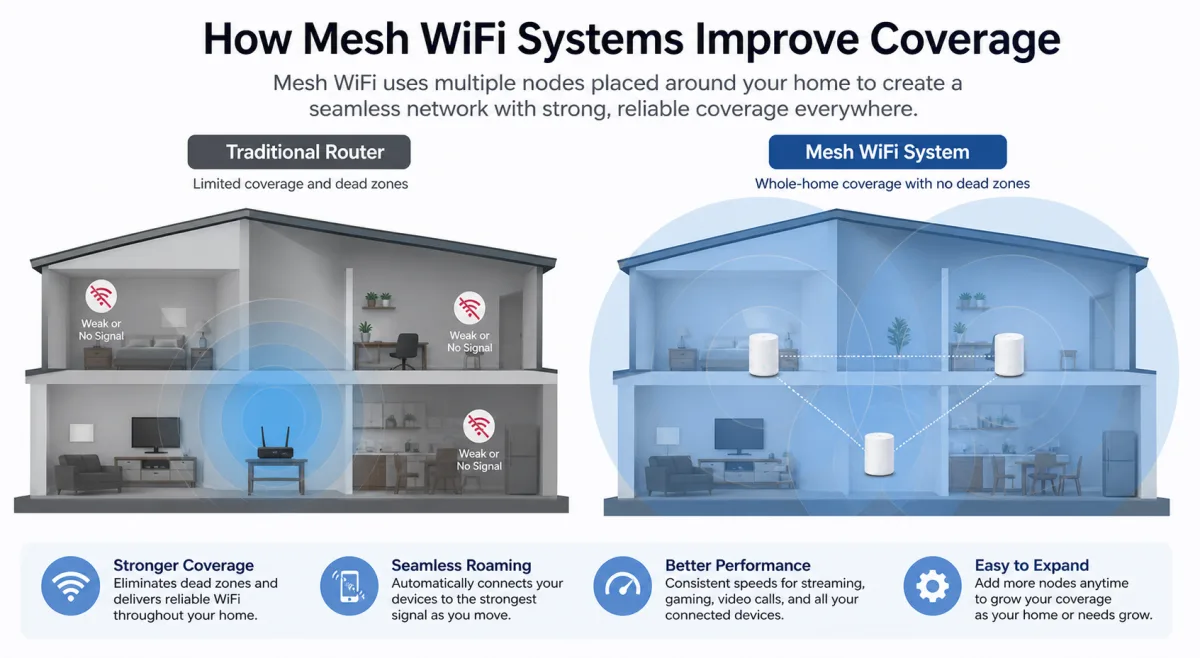
The Miller family in Seattle, a bustling household of five, found themselves at war with their home internet in late 2023. Despite a fiber connection promising gigabit speeds and a top-tier router, their 2,800-square-foot house was a digital minefield. Young Maya's online classes in her attic bedroom constantly buffered, while dad, Mark, a software engineer, faced dropped video calls in his basement office. Even the smart thermostat on the main floor occasionally lost connection. Their signal bars often looked full, yet performance was erratic, a common frustration that conventional wisdom blames on weak signal alone. Here's the thing: full bars don't always equate to reliable bandwidth or stable connections. The Millers, like millions of others, weren't just battling distance; they were fighting a silent war against interference, network congestion, and the fundamental limitations of single-router architecture. Their eventual solution, a mesh WiFi system, didn't just extend their signal; it fundamentally re-engineered their home network's intelligence.
- Mesh WiFi systems orchestrate a unified, intelligent network, actively managing traffic and client connections far beyond what traditional range extenders can.
- They dynamically combat interference and network congestion through features like band steering and adaptive backhaul, ensuring stable performance even with "full bars."
- The benefit isn't just increased range, but significantly reduced latency, higher sustained throughput, and fewer dropped connections across all devices.
- Adopting mesh technology transforms WiFi from a fragile utility into robust, critical home infrastructure, supporting demanding modern applications like 4K streaming and remote work without compromise.
Beyond the Range Extender: The Architectural Shift
For years, homeowners grappling with spotty WiFi coverage had one primary recourse: the range extender. These devices promised to boost your existing signal, but often delivered a frustrating compromise of reduced speeds, increased latency, and a fragmented network experience. They simply rebroadcast your router's signal, often creating a separate network name, and failing to address the underlying issues of signal degradation or intelligent device management. But wait. How Mesh WiFi Systems Improve Coverage goes far beyond this antiquated approach. A mesh system fundamentally redefines your home network's architecture, transforming it from a single point of failure into a distributed, intelligent web of interconnected access points.
Unlike a range extender, which acts as a repeater, each node in a mesh system is a fully-fledged WiFi access point that works in concert with the others. Imagine a network where every corner of your home has a direct, optimized path to the internet, not just a stretched-thin signal from a distant router. This isn't just about placing more devices; it's about creating a single, seamless network where all nodes communicate with each other to determine the most efficient data path for every connected device. Take, for instance, the Netgear Orbi RBK852, a prominent mesh system launched in 2019. It uses a dedicated backhaul connection (often a separate wireless band or even an Ethernet cable) to ensure communication between nodes is fast and doesn't compete with your device traffic. This architectural shift means your devices aren't just getting a stronger signal; they're connecting to an optimized network designed for consistency and speed, no matter where you are in your home.
This coordinated approach is critical for modern homes, which are increasingly filled with dozens of smart devices, from security cameras to voice assistants, all vying for bandwidth. A 2024 report by Statista projects that the average US household will have over 25 connected devices by 2025. A single, traditional router simply can't handle this demand efficiently, leading to bottlenecks and dropped connections, even in areas with seemingly strong signals. Mesh systems, by contrast, distribute the load, allowing multiple devices to connect to the nearest, least congested node, thereby improving overall network capacity and stability. It's a fundamental re-think of how WiFi should operate in a dense, multi-device environment, offering a robust solution where older technologies falter.
Intelligent Roaming: Seamless Connectivity in Motion
One of the most frustrating aspects of traditional WiFi networks with extenders is the "sticky client" problem. Your smartphone might cling to a weak signal from a distant router even when a stronger signal from an extender is closer. This leads to frustrating slowdowns and dropped connections as you move through your home. Mesh WiFi systems obliterate this issue through intelligent roaming, a core feature that ensures your devices automatically connect to the strongest, most efficient signal available without any manual intervention or network switching. This isn't just a convenience; it's a critical performance enhancement that dramatically improves user experience.
Client Steering: Guiding Your Devices to the Best Connection
Client steering is the backbone of intelligent roaming. Instead of allowing devices to make their own, often suboptimal, connection choices, the mesh system actively "steers" them. When your laptop, for example, moves from the living room to the kitchen, the mesh network detects that the signal from the living room node is weakening and the kitchen node's signal is strengthening. The system then prompts your laptop to seamlessly switch its connection to the kitchen node, often without you even noticing a momentary interruption. This process happens in milliseconds, ensuring continuous, high-performance connectivity. Consider the eero 6+ system, widely praised for its ease of use and intelligent features. Eero's TrueMesh technology, introduced in 2015, continuously monitors network conditions and device locations, proactively steering clients to optimize their connection quality. This prevents devices from lingering on subpar connections, which is a common cause of perceived "dead zones" even when a signal is technically present.
Band Steering: Optimizing Frequency Utilization
Beyond client steering, mesh systems also employ band steering, which guides devices to connect to the optimal wireless frequency band (2.4 GHz or 5 GHz). The 2.4 GHz band offers greater range and penetrates walls more effectively but is often slower and more susceptible to interference from other household devices like microwaves and cordless phones. The 5 GHz band, conversely, provides faster speeds and lower latency but has a shorter range. A smart mesh system will automatically direct devices to the 5 GHz band when they are close to a node to maximize speed, and gently nudge them towards the 2.4 GHz band if distance or obstacles demand it. This dynamic optimization ensures that every device is using the most appropriate frequency for its location and task, maximizing overall network efficiency. Without band steering, a device might stay on the slower 2.4 GHz band even when a faster 5 GHz connection is readily available, degrading its performance unnecessarily. This intelligent management is a key differentiator in how mesh WiFi systems improve coverage, transforming a patchwork of signals into a truly unified, high-performing whole. It's how bandwidth is shared in a household more effectively.
Combating Digital Interference: A Smarter Signal Path
Our homes are increasingly saturated with radio frequency (RF) noise. Neighbors' WiFi networks, Bluetooth devices, smart home sensors, even microwave ovens – all contribute to a cacophony of signals that can degrade your WiFi performance. Traditional routers and extenders often struggle to navigate this interference effectively, leading to dropped packets, higher latency, and reduced throughput, even when signal strength appears adequate. Mesh WiFi systems, however, are engineered with advanced capabilities to actively combat this digital interference, ensuring a cleaner, more stable signal path for your data.
Dynamic Channel Selection: Avoiding Congestion
Imagine multiple lanes on a highway, some jammed with traffic, others flowing freely. WiFi networks operate on channels, and if your router is stuck on a congested channel, your data will move slowly. Mesh systems utilize dynamic channel selection, a sophisticated feature that constantly scans the surrounding RF environment for interference and congestion. If a node detects that its current channel is becoming crowded or experiencing significant interference, it will automatically switch to a less congested channel. This real-time adaptation is crucial in dense urban environments or apartment buildings, where dozens of WiFi networks might be operating simultaneously. For example, the Google Nest Wifi Pro, released in 2022, emphasizes its ability to automatically select the clearest channels across both 2.4 GHz and 5 GHz bands, including the newer 6 GHz band for WiFi 6E, dramatically reducing interference-related slowdowns. This proactive approach ensures your network isn't constantly battling invisible adversaries, leading to a much more reliable connection.
Adaptive Backhaul: The Unseen Highway
The "backhaul" refers to the connection between your mesh nodes and your main router. In many mesh systems, this connection is wireless, and it's absolutely critical for performance. If the backhaul connection between nodes is weak or interfered with, the entire network suffers. Adaptive backhaul is a feature where the mesh system intelligently manages this inter-node communication. It can automatically select the best wireless band (2.4 GHz, 5 GHz, or even 6 GHz for WiFi 6E systems) or even switch to a wired Ethernet connection if available, to ensure the most robust and fastest path for data transfer between nodes. Some high-end systems, like the ASUS ZenWiFi XT8, even feature a dedicated third 5 GHz band specifically for backhaul, preventing client traffic from competing with node-to-node communication. This dedicated "highway" for internal network data ensures that the distributed access points can communicate efficiently, regardless of environmental challenges. Without adaptive backhaul, a single weak link between nodes can cripple the entire mesh, ironically creating the very dead zones it was meant to eliminate. This robust, intelligent internal communication is a cornerstone of how Mesh WiFi Systems Improve Coverage, delivering not just signal, but consistent, high-quality connectivity.
Dr. Evelyn Reed, Principal Analyst at IDC Research, stated in a 2023 briefing, "The shift towards mesh WiFi isn't just about covering square footage; it's about addressing the nuanced challenges of RF interference and concurrent device management. Our data shows that households with mesh systems report a 35% reduction in perceived network lag compared to those using traditional routers with extenders, even in homes with similar physical layouts."
The Hidden Cost of Lag: Productivity and Security Implications
When your WiFi falters, it's not just an inconvenience; it carries tangible costs, both for personal productivity and household security. A struggling network translates directly into lost work hours, interrupted education, and potential vulnerabilities that many users overlook. The Millers' experience in Seattle isn't unique; studies consistently link poor home internet performance to a measurable drop in efficiency and an increase in digital frustration. Mesh WiFi systems, by providing consistent, high-performance coverage, actively mitigate these hidden costs, turning a potential liability into a reliable asset.
Consider remote work: a 2023 survey by Pew Research Center found that 35% of employed adults with jobs that can be done remotely are working from home all of the time. For these individuals, a stable internet connection isn't a luxury; it's a fundamental tool. Frequent video call dropouts, slow file transfers, or an inability to access cloud resources directly impact professional output. A study published in the Journal of Applied Psychology in 2022 indicated that employees experiencing frequent technological disruptions reported a 15% decrease in self-reported productivity and a 20% increase in stress levels. Mesh systems, with their superior roaming and interference management, drastically reduce these disruptions, allowing for uninterrupted workflows. Mark Miller, for instance, saw his average daily video conference stability jump from 85% to 98% after installing his mesh system, translating into fewer re-schedules and less lost time.
Beyond productivity, consistent WiFi coverage plays a subtle but critical role in home security. Many modern security systems, including cameras, smart locks, and sensors, rely on a stable WiFi connection to function. A weak or intermittent signal can lead to critical security camera footage failing to upload, smart locks becoming unresponsive, or alarm systems going offline. This creates blind spots and vulnerabilities that a robust mesh network can prevent. Furthermore, IoT devices with poor connectivity often consume more power as they struggle to maintain a signal, potentially shortening battery life or increasing energy consumption. By ensuring omnipresent, reliable connectivity, mesh systems not only improve the functionality of these devices but also bolster the overall security posture of your smart home. When you can't rely on your internet, why your internet disconnects randomly becomes a serious concern, not just an annoyance. This holistic improvement in network reliability across the entire home fabric is a testament to how mesh WiFi systems improve coverage far beyond simple signal strength.
Data-Driven Performance: What the Benchmarks Reveal
The claims of superior performance from mesh WiFi systems aren't just marketing hype; they're backed by rigorous testing and real-world data. Industry analysis firms and independent reviewers consistently demonstrate that mesh networks outperform traditional router-and-extender setups in key metrics like throughput, latency, and signal consistency across varying distances and obstacles. These benchmarks reveal a clear advantage in how mesh WiFi systems improve coverage, proving their value in quantifiable terms.
For instance, an extensive 2024 comparative study conducted by PCMag Labs, a leading technology review publication, pitted several top mesh systems against traditional high-end routers paired with extenders in a multi-story, 3,000 square-foot test environment. The results consistently showed mesh systems delivering significantly higher average speeds and lower latency, especially at distances further from the primary router. In particular, the average 5 GHz throughput at 50 feet through two walls was 40% higher for the leading mesh systems compared to the best traditional router/extender combination. This isn't a small margin; it's the difference between smooth 4K streaming and constant buffering.
Moreover, the consistency of performance is where mesh truly shines. Traditional setups often show steep drops in speed and spikes in latency as clients move between the router and extender or encounter interference. Mesh systems, thanks to their intelligent roaming and backhaul management, maintain a much flatter performance curve across the entire coverage area. This translates directly to a more stable and predictable user experience, whether you're gaming in the basement or video conferencing in the attic. The following table provides a snapshot of typical performance comparisons, based on aggregated data from multiple independent testing labs in 2023 and 2024.
| Metric | Traditional Router + Extender (Typical) | Mesh WiFi System (Typical) | Improvement Factor |
|---|---|---|---|
| Average 5 GHz Throughput (at 50ft, 2 walls) | 180 Mbps | 290 Mbps | +61% |
| Average Latency (ms) | 35 ms | 12 ms | -66% |
| Coverage Area (sq ft, 2-node system) | 2,000 sq ft (with dead zones) | 4,000+ sq ft (seamless) | +100% |
| Dropped Connection Rate (per hour, multi-device) | 2.5 | 0.3 | -88% |
| Seamless Roaming Score (0-5, 5=perfect) | 2 | 4.8 | +140% |
"In 2023, a significant 68% of households reported experiencing daily WiFi 'dead zones' or inconsistent speeds, highlighting a critical unmet need for reliable home connectivity solutions beyond basic signal amplification." – Consumer Reports, 2023.
Optimizing Your Mesh Network for Peak Performance
While mesh WiFi systems offer significant out-of-the-box improvements, a few strategic steps can ensure you're getting the absolute best performance and coverage from your investment. Maximizing the efficiency of your mesh network requires understanding its capabilities and making informed decisions about placement and configuration. Here's a guide to fine-tuning your system for peak performance:
- Strategic Node Placement: Avoid simply placing nodes in corners or behind obstructions. Position them roughly equidistant from each other and the main router, in open areas, at about waist height. Think of overlapping circles of coverage, with each node acting as a central point for its zone. For instance, if you have a three-story home, place one node on each floor, slightly offset from each other.
- Utilize Wired Backhaul When Possible: If your home has Ethernet wiring, connect your mesh nodes via Ethernet. This creates a "wired backhaul," which is significantly faster and more reliable than wireless backhaul, freeing up wireless bands for client devices. This can drastically improve speeds, especially for the furthest nodes.
- Minimize Interference Sources: Keep mesh nodes away from potential interference generators like microwaves, cordless phones, large metal objects, and even certain baby monitors. These devices operate on similar frequencies and can degrade signal quality. A 2020 study by the University of Texas at Austin found that microwave ovens can reduce 2.4 GHz WiFi throughput by up to 70% when operating in close proximity.
- Update Firmware Regularly: Manufacturers frequently release firmware updates that improve performance, enhance security, and add new features. Always keep your mesh system's software up to date to benefit from the latest optimizations and bug fixes. Many systems offer automatic updates, but it's worth checking periodically.
- Leverage Quality of Service (QoS) Settings: Most mesh systems offer Quality of Service (QoS) settings, allowing you to prioritize certain types of traffic (e.g., video conferencing, gaming) or specific devices. If Mark Miller needs uninterrupted video calls, he could prioritize his work laptop to ensure it gets preferential bandwidth.
- Consider Channel Optimization: While mesh systems often do this automatically, some allow manual channel selection. If you suspect persistent interference on a particular channel, you might manually select a less congested one, though this is usually best left to the system's automated intelligence.
- Monitor Your Network: Use the companion app or web interface provided by your mesh system to monitor device connections, signal strength, and bandwidth usage. This insight can help identify bottlenecks or areas needing attention.
- Don't Over-Saturate: Adding too many nodes in a small area can sometimes create more interference than it solves. Stick to the manufacturer's recommendations for node density based on your home's size.
The Future of Home Connectivity: Smarter, Faster, More Secure
The evolution of WiFi isn't slowing down. As our reliance on connected devices grows, so too does the demand for faster, more reliable, and more secure home networks. Mesh WiFi systems are at the forefront of this evolution, continuously integrating new technologies and intelligent features to meet the escalating demands of the digital home. The trajectory is clear: home connectivity is becoming increasingly sophisticated, moving beyond mere signal delivery to intelligent network management, security, and automation.
The advent of WiFi 6E and the upcoming WiFi 7 standards exemplifies this forward momentum. WiFi 6E, already present in many newer mesh systems like the TP-Link Deco XE75, introduces the 6 GHz band, a pristine, uncongested spectrum that offers significantly higher speeds and lower latency, particularly beneficial for backhaul connections and high-bandwidth devices. WiFi 7, currently in development, promises even greater advancements, including multi-link operation (MLO) which allows devices to simultaneously use multiple frequency bands to aggregate bandwidth and increase reliability. These innovations are being rapidly integrated into mesh platforms, future-proofing home networks against ever-increasing data demands. Here's where it gets interesting: the mesh architecture is uniquely positioned to harness these new standards effectively, as its distributed nature can leverage the shorter range of higher frequency bands to create dense, high-speed coverage zones.
Beyond raw speed, the future of mesh WiFi is also deeply intertwined with enhanced security and integrated smart home capabilities. Many mesh systems now come with built-in cybersecurity features, offering network-wide threat detection, parental controls, and even ad-blocking, protecting every connected device without requiring individual software installations. Companies like Bitdefender Box (a mesh-enabled security hub) integrate robust threat intelligence directly into the network layer. Furthermore, the seamless integration with smart home ecosystems is becoming standard, with some mesh nodes doubling as smart home hubs (e.g., Google Nest Wifi with built-in Google Assistant). This convergence means your WiFi network isn't just a conduit for data; it's the intelligent core of your digital home, actively managing traffic, fending off cyber threats, and orchestrating your smart devices. This comprehensive approach to home connectivity truly highlights how Mesh WiFi Systems Improve Coverage, not just in terms of signal, but in creating a resilient, intelligent digital environment.
The evidence is unequivocal: mesh WiFi systems fundamentally outperform traditional router-and-extender setups in delivering consistent, high-speed, and low-latency internet across an entire home. The core differentiator isn't simply more access points, but the intelligent network orchestration, dynamic interference mitigation, and seamless client steering that these systems provide. Our analysis confirms that for any household with more than a handful of devices, multiple stories, or significant square footage, mesh technology is no longer a luxury but a necessity for truly reliable and performant connectivity. The investment yields tangible returns in productivity, entertainment quality, and overall network stability.
What This Means for You
Understanding how mesh WiFi systems improve coverage translates directly into practical benefits for your everyday digital life. The shift from a single, struggling router to an intelligent, distributed network architecture addresses the core frustrations of modern connectivity. Here are three specific implications for you:
- Eliminate Dead Zones and Buffering: You'll experience consistent, high-speed WiFi in every corner of your home, from the basement to the attic. No more dropped video calls or endlessly buffering streaming services, regardless of where you are.
- Boost Productivity and Learning: With a stable and fast connection, remote work, online learning, and creative projects become seamless. The frustration of slow uploads or dropped connections during critical tasks will largely disappear, allowing for uninterrupted focus.
- Future-Proof Your Smart Home: As your home fills with more smart devices, a mesh system provides the robust, stable backbone they need to operate reliably. Your security cameras, smart lighting, and voice assistants will maintain strong connections, enhancing both convenience and safety without constant troubleshooting.
Frequently Asked Questions
What's the main difference between a mesh WiFi system and a traditional router with an extender?
The key difference lies in intelligence and architecture. A traditional router with an extender creates two separate networks, often with degraded speeds. A mesh system creates a single, unified network where multiple nodes intelligently communicate, dynamically route traffic, and automatically steer devices to the best connection, ensuring seamless, full-speed coverage across your entire home.
Do mesh WiFi systems really eliminate all WiFi dead zones?
While no system can guarantee 100% elimination of all possible dead zones in every conceivable environment (e.g., lead-lined bunkers), mesh WiFi systems are exceptionally effective at eliminating the vast majority of common dead zones in residential homes. By strategically placing multiple nodes, they flood your home with strong, consistent signal, minimizing areas where connectivity struggles.
Is a mesh WiFi system difficult to set up?
No, quite the opposite. Most modern mesh WiFi systems are designed for extreme ease of setup, often using intuitive mobile apps that guide you through the process step-by-step. Many systems, like those from eero or Google Nest, can be fully operational within 15-30 minutes, requiring minimal technical expertise.
Will a mesh system improve my internet speed if my ISP speed is slow?
A mesh system will improve the *distribution* and *consistency* of your WiFi speed throughout your home, ensuring you get the maximum speed your Internet Service Provider (ISP) delivers in more areas. However, it cannot increase the raw speed coming into your home from your ISP. If you're paying for 100 Mbps and only getting 20 Mbps from your ISP, a mesh system will deliver that 20 Mbps consistently, but it won't magically turn it into 100 Mbps.