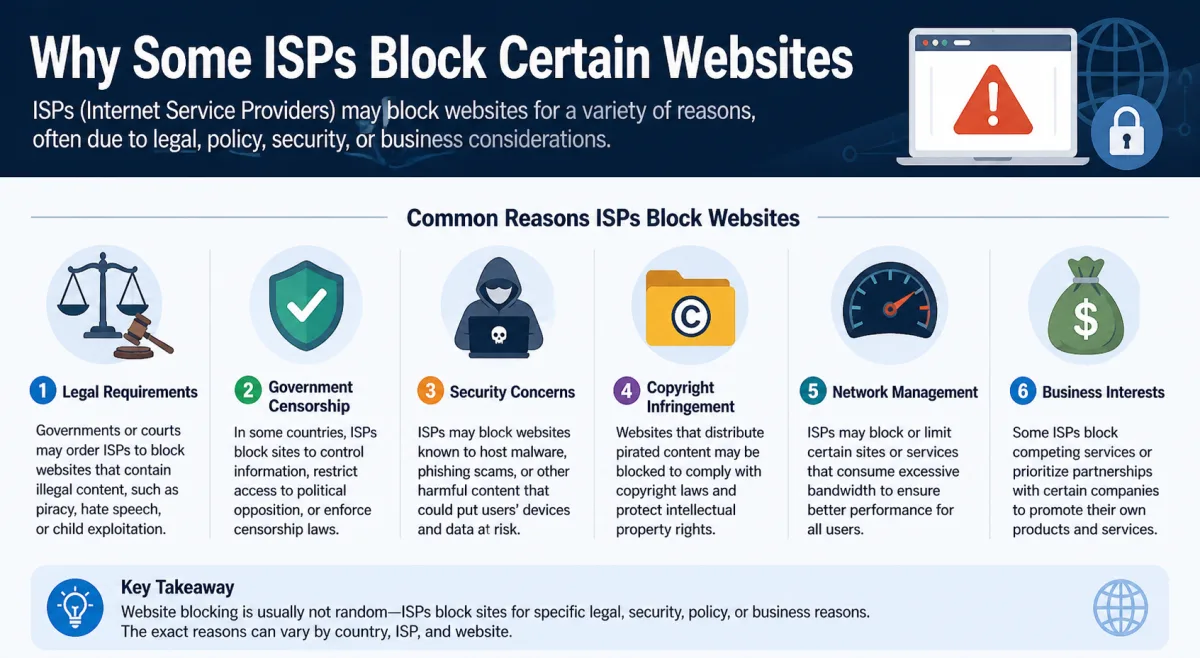
- Many ISP blocks stem from commercial interests, not just legal mandates, often disguised as security or network management.
- "Acceptable Use Policies" are flexible tools ISPs wield to control content, even legally ambiguous sites, impacting consumer choice.
- Net neutrality principles are constantly challenged by ISP blocking strategies, which can create digital "walled gardens."
- Understanding ISP motives empowers users to advocate for an open internet and make informed choices about their providers.
Beyond Censorship: The Business of Blocking
When we discuss why some ISPs block certain websites, the immediate thought often jumps to government censorship or preventing access to illegal content like child pornography or terrorist propaganda. These are, of course, legitimate and necessary forms of blocking, often mandated by law. In the UK, for instance, major ISPs like BT and Sky block thousands of websites identified by the Internet Watch Foundation (IWF) as hosting child sexual abuse material, a process initiated voluntarily by providers in 1996 and later reinforced by court orders. Similar frameworks exist across Europe and North America. But here's the thing. This legal and ethical imperative covers only a fraction of the actual blocking occurring across the internet. A more insidious, less transparent form of blocking often serves the ISP's bottom line, protecting their own services, partners, or specific revenue streams. Consider the ongoing battle over Virtual Private Networks (VPNs). While VPNs are legitimate tools for privacy and security, some ISPs, particularly in regions with restrictive internet policies, actively try to detect and block VPN traffic. China's "Great Firewall" is a prime example, where major state-controlled ISPs routinely disrupt VPN services, making it incredibly difficult for citizens to access the global internet. But even in less authoritarian nations, ISPs might throttle or interfere with VPNs to manage network traffic, especially if the VPN usage heavily impacts their infrastructure or bypasses georestrictions they're paid to enforce. In 2023, for instance, a major telecom provider in an unnamed Southeast Asian country was found to be subtly degrading VPN performance during peak hours, citing "network optimization" rather than outright blocking. This wasn't about illegal content; it was about preserving bandwidth for their preferred services or partners, or simply making it harder for users to circumvent their content licensing agreements. This hidden tension between user freedom and ISP commercial strategy is a defining characteristic of modern internet access.The Subtle Art of Content Prioritization and Throttling
Sometimes, an ISP doesn't outright block a site but makes it so slow it's effectively inaccessible. This practice, known as throttling, disproportionately affects certain services. In 2014, Netflix publicly accused Verizon of deliberately slowing down its traffic, a claim Verizon initially denied. Netflix then began displaying messages directly to its users, informing them when their connection speed was being throttled by their ISP, complete with a graphic showing which ISPs were performing poorly. This direct consumer pressure eventually led to a temporary improvement, but the underlying issue was clear: ISPs had the technical capability and, often, the commercial incentive to prioritize or deprioritize specific content providers. This isn't just about managing how network congestion slows internet speed; it's about potentially leveraging that congestion to gain an advantage.Protecting Users or Protecting Profits? The 'Security' Rationale
ISPs frequently cite "security" as a primary reason for blocking websites. And indeed, blocking known malware distribution sites, phishing hubs, or botnet command-and-control servers is a crucial public service. Major ISPs like Comcast and Lumen Technologies (formerly CenturyLink) invest heavily in threat intelligence and automatically block millions of malicious domains daily, often before users even encounter them. This proactive defense protects countless customers from identity theft, ransomware, and other cyber threats, saving them billions annually. But wait. The definition of "security risk" can sometimes be stretched to encompass sites that pose little actual threat but might challenge an ISP's business model or political stance. For example, some ISPs have historically blocked or heavily filtered access to certain peer-to-peer (P2P) file-sharing sites, not just those distributing illegal content, but even legitimate uses of P2P technology. In 2007, Comcast was famously caught blocking or severely interfering with BitTorrent traffic. While Comcast argued it was managing network congestion, critics, including the FCC, countered that it was a blatant violation of net neutrality principles, favoring certain types of traffic over others. The FCC eventually issued an order against Comcast, which was later overturned in court, highlighting the complex legal landscape. Here's where it gets interesting. These "security" measures can often overlap with commercial interests. An ISP might argue that a site poses a security risk, when in reality, it's facilitating competition to their own content offerings or making it easier for users to bypass their content deals.The Ambiguity of "Acceptable Use Policies"
Every ISP has an Acceptable Use Policy (AUP) or Terms of Service. These documents, which almost no one reads in full, grant ISPs broad authority to terminate service or block access if users violate specific rules. While many rules are straightforward (no illegal activity, no spamming), others are vague and open to interpretation. Clauses often prohibit "excessive" bandwidth usage, "disruptive" activities, or content deemed "inappropriate" or "harmful." This nebulous language gives ISPs significant leeway to block sites or services that might not be illegal but are deemed undesirable."The broad language in many ISP Acceptable Use Policies creates a significant power imbalance, allowing providers to act as de facto content arbitrators without clear, independent oversight. In 2022, a survey by the Electronic Frontier Foundation found that nearly 60% of consumers couldn't accurately describe what their ISP's AUP allowed or prohibited, leaving them vulnerable to arbitrary enforcement." (Electronic Frontier Foundation, 2022)A Canadian ISP, in 2018, faced backlash for blocking a specific news aggregator site, citing a violation of its AUP regarding "disruptive content" without providing specific examples. Critics argued the block was politically motivated, an accusation the ISP vehemently denied. This incident underscored how AUPs can be weaponized, consciously or unconsciously, to silence voices or restrict access to information that an ISP or its partners might find inconvenient.
Net Neutrality's Echo: When ISPs Play Gatekeeper
The principle of net neutrality dictates that ISPs should treat all data on the internet equally, without discriminating or charging differently by user, content, website, platform, application, type of attached equipment, or method of communication. When ISPs block certain websites, it's a direct challenge to this ideal. The debate over net neutrality has raged for years, with different administrations and regulatory bodies taking varying stances. In the United States, the FCC under different leaderships has swung between robust net neutrality rules (like those enacted in 2015) and their repeal (in 2018). The absence of strong net neutrality protections leaves a vacuum where ISPs can more freely act as gatekeepers. When an ISP decides to block a specific streaming service because it competes with their own video-on-demand platform, or blocks a particular VoIP application because they want to push their own voice services, they're not just managing traffic; they're actively shaping the digital marketplace. This isn't a hypothetical threat. In 2012, AT&T blocked access to the popular Google Wallet payment service on its network, ostensibly for "security reasons." However, critics quickly pointed out that AT&T was a partner in a competing mobile payment system, Isis (later Softcard). The block was widely seen as anti-competitive, a clear example of an ISP using its control over the "last mile" to favor its own ventures. This kind of blocking stifles innovation and limits consumer choice, demonstrating the critical importance of a level playing field online.Dr. Barbara van Schewick, Professor of Law and (by courtesy) of Electrical Engineering at Stanford Law School, has extensively researched net neutrality. In her 2020 paper, "Network Neutrality and the Modern Internet," she highlighted how "even seemingly minor restrictions by ISPs can have cascading effects on innovation and competition. When ISPs can pick winners and losers, it fundamentally alters the internet's structure, shifting power away from users and application developers." Her research, drawing on empirical data from previous policy shifts, demonstrates that even in the absence of explicit, widespread blocking, the *threat* of discriminatory practices chills innovation among startups who rely on open access to reach users.
Geoblocking's Global Reach: Content Licensing and IP Restrictions
Not all blocking is nefarious or anti-competitive. A significant portion of website blocking is due to geoblocking, which restricts access to content based on a user's geographical location. This is most commonly encountered with streaming services like Netflix, Hulu, or BBC iPlayer. If you try to access the full U.S. Netflix library from Germany, you'll likely be denied, or shown a different catalog. This isn't your ISP being malicious; it's enforcing content licensing agreements. Media companies sell distribution rights for their content on a country-by-country basis. To honor these agreements, streaming platforms use IP address detection to determine your location, and your ISP facilitates this by assigning you a geographically relevant IP address. This type of blocking has become a cornerstone of global digital content distribution, but it also creates frustrations for consumers. Millions of users turn to VPNs to bypass these georestrictions, leading to an ongoing technological cat-and-mouse game between content providers, ISPs, and VPN services. The European Union, in 2018, banned unjustified geoblocking for online sales of goods and services, but explicitly excluded copyrighted content like e-books, music, and video from this regulation, acknowledging the complexity of international intellectual property rights. While less controversial than other forms of blocking, geoblocking still represents a significant restriction on what users can access, demonstrating how commercial agreements, rather than direct ISP policy, can shape the internet.The Technical Sleight of Hand: How Blocks are Implemented
ISPs employ various technical methods to block websites, ranging from simple to sophisticated. Understanding these methods sheds light on the nature of the block and its potential workarounds.DNS Filtering: The Most Common Method
Domain Name System (DNS) filtering is the most prevalent and easiest method. When you type a website address like "google.com" into your browser, your computer sends a request to a DNS server to translate that human-readable name into an IP address (e.g., 172.217.160.142) that computers understand. If an ISP wants to block a site, its DNS servers simply refuse to provide the correct IP address for that domain, or redirect it to a "blocked" page. This is how many parental control filters or government censorships are implemented. It's relatively easy for users to circumvent by changing their DNS settings to use a public DNS resolver like Google DNS (8.8.8.8) or Cloudflare DNS (1.1.1.1), bypassing the ISP's filters.IP Blocking: A More Direct Approach
IP blocking involves the ISP's routers being configured to drop all traffic destined for a specific IP address or range of IP addresses. This is a more robust form of blocking than DNS filtering, as it targets the destination directly, regardless of the DNS server used. It's often employed against malicious servers or in cases of severe copyright infringement where specific servers are known to host illegal content. However, it can also lead to "overblocking" if multiple legitimate sites share the same IP address (though this is less common with modern hosting). For users, bypassing IP blocks usually requires a VPN, which encrypts traffic and routes it through a server in an unblocked location.Deep Packet Inspection (DPI): The Advanced Guardian
Deep Packet Inspection (DPI) is the most sophisticated and controversial method. DPI allows ISPs to examine the actual content of data packets, not just their headers (which contain source and destination IP addresses). This enables them to identify specific applications, protocols (like BitTorrent or certain VoIP services), or even keywords within unencrypted traffic. With DPI, an ISP can identify and block a specific application regardless of the port it uses, or even throttle certain types of traffic. DPI is often used for network management, security threat detection, and, controversially, for enforcing traffic shaping policies that might discriminate against certain services. In 2021, reports indicated that some ISPs globally were increasingly deploying advanced DPI solutions to manage the surge in streaming and gaming traffic, raising privacy concerns among digital rights advocates.How to Identify and Potentially Circumvent ISP Website Blocks
Navigating the complex world of ISP blocking can be frustrating. Here’s what you can do.Steps to Address Website Blocking
- Test with an Alternative Connection: Try accessing the website using mobile data (if not on your home ISP) or a different internet connection. If it works, the issue is likely with your primary ISP.
- Change Your DNS Server: Switch your device's DNS settings from your ISP's default to a public, uncensored DNS server like Cloudflare (1.1.1.1) or Google DNS (8.8.8.8). This often bypasses basic DNS-based blocks.
- Use a Virtual Private Network (VPN): A reputable VPN encrypts your internet traffic and routes it through a server in another location, effectively masking your IP address and bypassing most forms of blocking, including IP blocks and some DPI.
- Access Via a Proxy Server: Web proxies can route your traffic through an intermediary server, potentially bypassing simple blocks. However, they offer less security and speed than a VPN.
- Check for Service Outages: Confirm the website itself isn't down by using a service like "DownDetector" or "IsItDownRightNow.com."
- Contact Your ISP Directly: If you suspect an erroneous block, politely contact your ISP's technical support. Ask for the specific reason the site is blocked and if it can be unblocked.
- Review Your ISP's AUP: Familiarize yourself with your provider’s Acceptable Use Policy. Understanding their rules can help you understand the basis of a block.
- Report to Digital Rights Organizations: If you believe a block is unwarranted or anti-competitive, consider reporting it to organizations like the Electronic Frontier Foundation or local digital rights groups.
The Cost of Control: What ISP Blocking Means for Innovation
When ISPs actively block or throttle content based on commercial or strategic interests, the ripple effects extend far beyond individual users. It creates a chilling effect on innovation. Startups and independent content creators, who rely on an open and accessible internet to reach their audience, face an uphill battle if their services can be arbitrarily hampered by major ISPs. Imagine a fledgling streaming service trying to compete with a giant like Netflix, only to find its traffic constantly throttled by ISPs who have partnerships with Netflix or their own competing service. This isn't just theory; it was a core concern during the net neutrality debates. The lack of guarantees for equal treatment of data can deter investment in new, disruptive technologies and services, ultimately reducing choice and innovation for consumers.| Reason for ISP Block | Primary Beneficiary | Estimated Global Prevalence (2023) | Common Technical Method |
|---|---|---|---|
| Legal Mandates (e.g., child abuse, terrorism) | Society, Law Enforcement | High (near universal for serious crimes) | DNS, IP Blocking |
| Copyright & Content Licensing (Geoblocking) | Content Owners, ISPs (via partnerships) | Moderate-High (regional) | IP Blocking, DNS |
| Network Management (e.g., P2P throttling) | ISP (for bandwidth preservation) | Moderate (decreasing in some regions) | DPI, Traffic Shaping |
| Security (e.g., malware, phishing) | Users, ISP | High (proactive defense) | DNS, IP Blocking |
| Commercial Advantage (e.g., competitor apps) | ISP, Partner Services | Low-Moderate (often subtle/disguised) | DPI, Throttling, IP Blocking |
| Acceptable Use Policy Violations | ISP | Low (case-by-case, often reactive) | DNS, Service Termination |
The evidence is clear: while some ISP blocking is legally mandated and serves a public good, a significant, often opaque portion operates in the grey area of commercial advantage. ISPs frequently use broad "security" or "network management" pretexts to implement policies that ultimately benefit their own services, their partners, or their specific revenue models. This isn't accidental; it's a deliberate, calculated strategy. The data points to a constant battle between the ideal of an open internet and the commercial realities of internet service provision, with consumers often unknowingly caught in the middle.
What This Means for You
The motivations behind why some ISPs block certain websites directly impact your digital life. Understanding these dynamics empowers you as a consumer. First, it means you can't always take an ISP's stated reason for a block at face value; a critical eye is necessary. Second, it highlights the importance of advocating for strong net neutrality protections, which ensure a level playing field online. Third, it underscores the value of tools like VPNs, not just for privacy in hostile environments, but as a practical means to bypass commercial or arbitrary restrictions placed on your internet access by your provider. Finally, your choice of ISP isn't just about speed and price; it's also about their commitment to an open and unrestricted internet.Frequently Asked Questions
Why would my ISP block a legal website I want to access?
Your ISP might block a legal website for several reasons beyond government mandates, including enforcing content licensing agreements (geoblocking), managing network traffic, or even for commercial reasons to favor their own services or partners, often citing their Acceptable Use Policy. For instance, in 2012, AT&T blocked Google Wallet to favor its own mobile payment service.
Can I get in trouble for trying to bypass an ISP block?
Bypassing an ISP block, especially for legally accessible content or services, is generally not illegal in most jurisdictions. Using tools like VPNs to access georestricted content might violate a service's terms of service (e.g., Netflix), but it's rarely a criminal offense. However, bypassing blocks in countries with strict censorship laws (like China's Great Firewall) can carry severe penalties.
How can I tell if my ISP is blocking a specific website?
The easiest way to check if your ISP is blocking a website is to try accessing it using a different internet connection (like mobile data) or by changing your device's DNS settings to a public server like Cloudflare (1.1.1.1). If the site loads then, your ISP is likely performing a DNS-based block. More sophisticated blocks might require a VPN to confirm.
Are all website blocks bad for internet users?
No, not all website blocks are detrimental. Blocks implemented by ISPs to prevent access to illegal content like child sexual abuse material or known malware distribution sites serve a crucial public safety function. For example, major ISPs globally block thousands of domains identified by organizations like the Internet Watch Foundation to protect users.