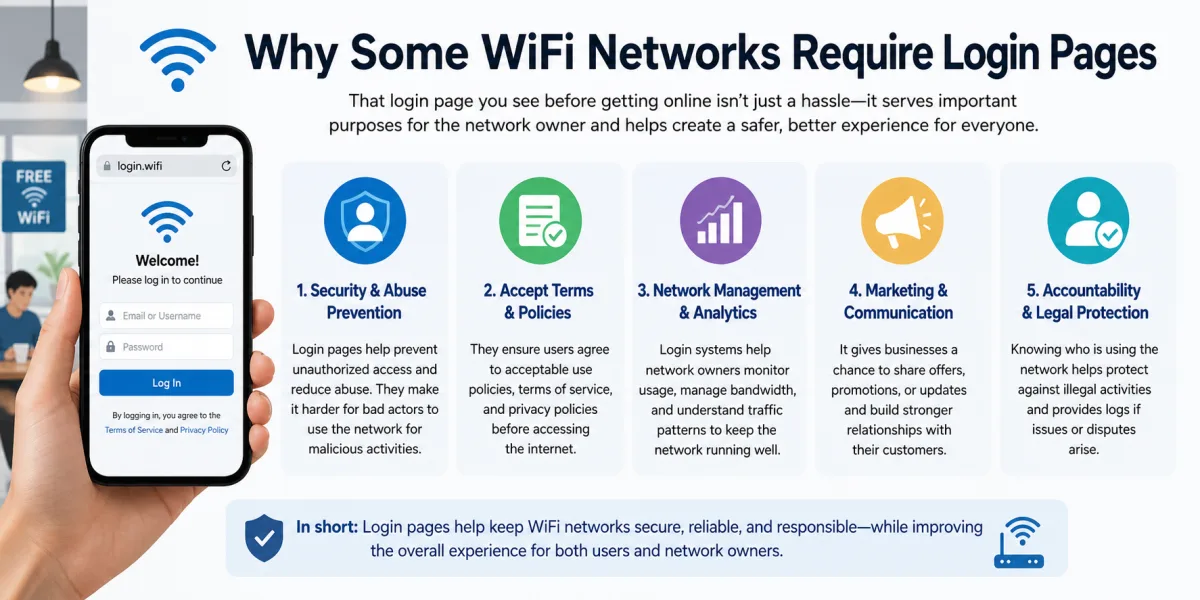
- Captive portals are primarily data collection and compliance tools, not just access gates.
- "Free" Wi-Fi often means you're consenting to targeted advertising and profile building.
- Legal frameworks like GDPR and CCPA mandate these pages for explicit user consent.
- Understanding the hidden costs of public Wi-Fi protects your privacy and data.
The Evolution of Captive Portals: From Gatekeepers to Data Harvesters
The concept of a login page for Wi-Fi, technically known as a "captive portal," isn't new. Early iterations, dating back to the late 1990s and early 2000s, were rudimentary. They primarily served as simple authentication gateways, ensuring only paying customers in a hotel or subscribers to an ISP could access the network. Think T-Mobile HotSpots at Starbucks in 2003, where you'd punch in a prepaid code. The goal was straightforward: restrict access and charge for it. Here's the thing. Over the past two decades, this function has dramatically expanded. Today, the login page is a multi-faceted instrument that not only manages who gets online but, more crucially, what data can be gathered from them. Consider the global airport Wi-Fi provider Boingo Wireless, which serves over 75 airports worldwide, including Chicago O'Hare and London Heathrow. While they offer paid tiers, their "free" access almost universally requires an email address or social media login. This isn't just for identification; it's to build a rich dataset on user demographics, travel patterns, and online behaviors. This data, anonymized or aggregated, becomes incredibly valuable for targeted advertising, operational insights, and even urban planning. It's a fundamental shift from simple gatekeeping to active data harvesting, transforming every login into a potential intelligence brief.The Shift from Transactional to Behavioral Data
Early captive portals were transactional: you pay, you get access. The data collected was minimal – perhaps a credit card number and an IP address. But as the internet became ubiquitous and "free" Wi-Fi a customer expectation, the business model pivoted. Companies began to realize that if they couldn't charge directly for access, they could charge for the data generated by that access. A 2023 report by the Identity Theft Resource Center revealed that over 3,205 data compromises occurred in the U.S. that year alone, emphasizing the increasing value and vulnerability of personal information. For public Wi-Fi providers, collecting an email isn't just about sending promotional offers; it's often the first step in correlating your physical location with your online identity, enabling more precise profiling. Major retail chains like Macy's and Starbucks, for instance, utilize their Wi-Fi portals not just to provide internet but to track customer dwell times, repeat visits, and even in-store navigation when combined with other technologies. This allows them to optimize store layouts and target marketing efforts with unprecedented accuracy.Legal Imperatives: Compliance, Consent, and the GDPR Shadow
One of the most compelling reasons why some WiFi networks require login pages today isn't purely technical or commercial; it’s profoundly legal. Landmark data privacy regulations like the European Union's General Data Protection Regulation (GDPR), enacted in 2018, and California's Consumer Privacy Act (CCPA), effective 2020, have fundamentally reshaped how organizations handle personal data. These laws mandate explicit consent for data collection and processing, granting individuals greater control over their information. A Wi-Fi login page serves as the perfect legal touchpoint for obtaining this consent. Without a clear "I agree" checkbox or a visible link to a privacy policy, a business risks hefty fines for non-compliance. For instance, in 2022, Meta Platforms Inc. was fined €405 million by the Irish Data Protection Commission for GDPR violations related to children's data, highlighting the severe consequences of inadequate consent mechanisms. Businesses like hotels, cafes, and public venues offering Wi-Fi must demonstrate that users understand and agree to the terms under which their data is collected, used, and stored. This includes not just your email, but potentially your device MAC address, browsing habits, and location data.“The modern Wi-Fi login page is less a technical barrier and more a legal gateway,” explains Dr. Evelyn Reed, Senior Legal Counsel specializing in data privacy at the Stanford Center for Internet and Society in 2024. “With GDPR and CCPA, businesses can’t just assume consent. They must obtain explicit agreement, and the captive portal offers an auditable, verifiable method to secure that consent before any data collection or processing begins. It’s a critical compliance checkpoint, protecting the organization from significant legal exposure.”
Ensuring Accountability and Traceability
Beyond initial consent, these regulations also demand accountability and traceability. If a user complains about data misuse, the network provider must be able to demonstrate that consent was obtained, what data was collected, and how it was processed. Login pages often record timestamps, IP addresses, and unique device identifiers (like MAC addresses) associated with each connection. This creates an audit trail. In 2021, the German Federal Network Agency (Bundesnetzagentur) cracked down on several Wi-Fi providers for failing to adequately secure user data and obtain proper consent, underscoring the importance of such logs. This level of detail isn't just for legal defense; it also helps in identifying users if illicit activities occur on the network. If someone uses a public Wi-Fi to engage in illegal downloading or cyberbullying, the login records can often assist law enforcement in tracing the activity back to a specific individual or device, protecting the network provider from liability.Monetizing Connectivity: The Business Case for Your Data
Many public Wi-Fi networks are branded as "free," but this term is often a misnomer. While you might not pay with currency, you're frequently paying with your data. This is where the business case for elaborate login pages truly shines. For companies, providing free Wi-Fi is an operational cost. To offset this, and often to turn a profit, they engage in various data monetization strategies. A common approach involves creating detailed user profiles. When you log in with your email or social media account, you're providing a direct link to a wealth of personal information. This data can then be used for targeted advertising, either directly through the Wi-Fi portal itself (displaying ads before access) or by selling anonymized, aggregated insights to third-party marketers. Here's where it gets interesting. According to a 2021 McKinsey & Company report, businesses that effectively leverage customer data for personalization can increase revenue by 5-15%. This financial incentive drives the continued sophistication of captive portals. Consider the case of LinkNYC kiosks, which replaced old phone booths in New York City. They offer free Wi-Fi in exchange for data collection, including email addresses and anonymized usage patterns, which are then used to fund the project through advertising revenue. The login page is the critical funnel for this exchange of value.Targeted Advertising and Customer Relationship Management
The data collected via Wi-Fi login pages isn't just sold off; it's also used internally for powerful customer relationship management (CRM) and marketing efforts. By understanding who is connecting, when, and for how long, businesses can tailor their offerings. A hotel, for instance, might track repeat guests via their Wi-Fi login, offering personalized promotions or upgrades during their stay. A coffee shop could send a coupon for a pastry to customers who frequently connect during morning hours. The seamless integration of Wi-Fi data with CRM systems allows for a hyper-personalized customer experience that encourages loyalty and repeat business. In 2022, Salesforce reported that 71% of consumers expect companies to deliver personalized interactions. The Wi-Fi login page is a direct pipeline for gathering the necessary information to meet that expectation, turning a utility into a dynamic marketing channel. This detailed profiling also informs broader business decisions, from inventory management to staffing levels, making the "free" Wi-Fi a core operational asset rather than a mere amenity.Bandwidth Management and Network Security: Beyond Simple Access
While data monetization and legal compliance are significant drivers, the foundational reasons for login pages – bandwidth management and network security – remain critically important, albeit more sophisticated than ever. Public Wi-Fi networks face unique challenges: managing potentially hundreds or thousands of concurrent users, preventing network abuse, and protecting both the network infrastructure and its users from cyber threats. A captive portal acts as the primary enforcement point for these policies. It allows administrators to allocate bandwidth fairly, preventing a single user from hogging resources with large downloads or streaming, which could degrade service for everyone else. For example, many airports and convention centers, such as the Las Vegas Convention Center, implement tiered access through their login pages, offering basic free Wi-Fi at limited speeds and premium paid tiers for faster connections. This system ensures service quality and provides an additional revenue stream. Furthermore, these pages are crucial for basic network hygiene. They can enforce acceptable use policies, block access to malicious websites, and even quarantine devices exhibiting suspicious behavior before they can compromise the wider network. It's a proactive defense mechanism. For more on how networks protect themselves, consider reading about Why Some Domains Are Blacklisted.Protecting the Network from Malicious Actors
The internet is a wild place, and public Wi-Fi networks are prime targets for cybercriminals. Without a login page and associated authentication, anyone within range could connect, potentially launching attacks, distributing malware, or engaging in illegal activities. The login process, even if it's just a "click to accept," provides a minimal layer of accountability and often allows the network to isolate users or implement stricter security protocols for unverified devices. For instance, many corporate guest networks, accessible via a captive portal, operate on a segmented VLAN (Virtual Local Area Network) that prevents guest devices from accessing internal company resources. This fundamental isolation is enforced at the login stage. A 2020 report from the Pew Research Center found that 64% of Americans are concerned about government surveillance of their online activities, and 61% are concerned about corporations tracking them. While login pages don't eliminate all risks, they allow network administrators to implement initial security policies, such as requiring encrypted connections (WPA2/3 Enterprise), and to monitor for unusual traffic patterns that might indicate a security breach. They're a first line of defense in a complex digital environment.The User Experience Paradox: Convenience vs. Privacy
The proliferation of Wi-Fi login pages presents a paradox for the user: they offer convenience, granting immediate access to the internet, but often at the cost of personal privacy. On one hand, the login page is a familiar, relatively simple step that bypasses the need for complex network configurations or asking staff for passwords. This ease of access is a major driver of customer satisfaction in environments like hotels, cafes, and retail stores. A 2020 survey by Statista indicated that 80% of consumers consider free Wi-Fi a "very important" or "somewhat important" amenity when choosing a hotel. Businesses recognize this expectation and use the login page to deliver on it. However, this convenience often masks a deeper exchange of value. The average user, eager to connect, rarely reads the lengthy terms and conditions that pop up. These documents can grant the network provider extensive rights to collect, analyze, and even share your data with third parties. This creates a significant privacy deficit, where users unknowingly consent to practices they might otherwise reject. The tension between the desire for seamless connectivity and the imperative to protect personal data is a defining characteristic of the modern digital landscape.The Illusion of "Free" and User Agency
The term "free Wi-Fi" itself contributes to this paradox, creating an illusion that access comes without cost. But as we've explored, the cost is frequently your data, your attention, and your digital footprint. Users often feel a lack of agency when confronted with a login page; refusing to agree means no internet access, which in many contexts, isn't a viable option. Imagine being at an airport with a delayed flight, needing to rebook, and the only Wi-Fi requires agreeing to terms you don't fully understand. What choice do you have? This dynamic exploits a fundamental human need for connectivity, pushing users into accepting terms they might find objectionable if they had a genuine alternative. Companies like Google, for instance, offer free Wi-Fi in certain public spaces, leveraging the data collected to enhance their advertising profiles. The question isn't just "Why some WiFi networks require login pages?" but "What are we truly giving up when we click 'Accept'?" The answer, often hidden in plain sight, can be a lot more than just five minutes of our time.Navigating the Digital Gauntlet: Best Practices for Public Wi-Fi Use
Understanding why some WiFi networks require login pages and the hidden implications is the first step toward protecting yourself. Using public Wi-Fi safely requires a proactive approach, recognizing that convenience often comes with a trade-off. Here's a concise guide to minimize your exposure and protect your data.How to Protect Your Privacy on Public WiFi
- Assume Zero Privacy: Treat all public Wi-Fi networks as inherently insecure. Never transmit sensitive information (banking, passwords, personal health data) over unencrypted public Wi-Fi.
- Use a VPN (Virtual Private Network): A VPN encrypts your internet traffic, creating a secure tunnel between your device and the VPN server. This makes it much harder for anyone, including the Wi-Fi provider, to intercept or monitor your data.
- Limit Personal Information: If a login page requests personal data (email, phone number, social media login), consider if the access is truly worth the data exchange. Use a disposable email address if available, or decline if you're uncomfortable.
- Disable Auto-Connect: Prevent your device from automatically connecting to unknown Wi-Fi networks. This reduces the risk of connecting to malicious "rogue" hotspots.
- Keep Software Updated: Ensure your operating system, browser, and all applications are up-to-date. Software updates often include critical security patches that protect against known vulnerabilities.
- Use HTTPS Everywhere: Look for "https://" in website addresses, indicating an encrypted connection. Browser extensions like "HTTPS Everywhere" can help enforce this for all compatible sites.
- Review Privacy Policies: If you must use a network and are concerned, take a moment to skim the privacy policy linked on the login page. It might reveal what data is collected and how it's used.
- Consider Mobile Hotspot: For truly sensitive tasks or if you're deeply concerned about privacy, use your smartphone's mobile hotspot feature. This leverages your cellular data and bypasses public Wi-Fi entirely.
"In 2023, 72% of consumers worldwide expressed concerns about their data privacy when using public Wi-Fi networks, yet only 38% consistently use a VPN." – GlobalWebIndex (GWI), 2023.
The Unseen Costs: What "Free" Wi-Fi Really Means
The narrative of "free Wi-Fi" is compelling, but it obscures the genuine costs involved, not just for the provider but also for the user. For the provider, there's the capital expenditure of hardware, ongoing maintenance, bandwidth subscriptions, and the personnel to manage it all. But for the user, the cost is often paid in the currency of personal data. This data, once collected through the login page, fuels an entire ecosystem of targeted advertising, personalized marketing, and sometimes, less ethical data brokerage. It’s a transaction, albeit an asymmetrical one, where the terms are heavily skewed in favor of the network operator. This isn't necessarily malevolent; it's simply the prevailing business model for many public services in the digital age. Just as search engines and social media platforms offer "free" services in exchange for your data, so too do many Wi-Fi providers. The login page is the digital equivalent of a toll booth, except instead of money, you're paying with information. Understanding this exchange is crucial for navigating our increasingly connected world.Our investigation reveals that the primary drivers behind mandatory Wi-Fi login pages have evolved significantly. While security and bandwidth management remain foundational, the overwhelming evidence points to data monetization and stringent legal compliance, particularly post-GDPR and CCPA, as the dominant forces. Businesses aren't just granting access; they're actively creating auditable consent records and harvesting valuable user data to fuel targeted advertising, improve customer relationship management, and offset operational costs. The "free" Wi-Fi model is demonstrably a data-for-access exchange, where user privacy is the hidden commodity.
What This Means for You
The ubiquitous Wi-Fi login page is no longer a simple formality; it’s a sophisticated mechanism with profound implications for your digital life. Here's what you need to internalize: 1. **Your Data is the Product:** Every time you agree to terms on a "free" Wi-Fi network, you're likely consenting to some form of data collection and potential monetization. This could range from anonymized analytics to direct profile building for targeted ads. 2. **Legal Protections are a Double-Edged Sword:** While regulations like GDPR aim to protect your privacy, they simultaneously compel businesses to implement login pages as a means of formally obtaining your consent, often without you fully understanding the depth of that agreement. 3. **Active Vigilance is Required:** You can't rely on the network provider to prioritize your privacy. It's incumbent upon you to use tools like VPNs, critically evaluate terms, and limit the personal information you share on public networks. 4. **The Convenience Tax:** The ease of connecting to public Wi-Fi often comes at the "cost" of your privacy. Be mindful of this trade-off, especially when conducting sensitive online activities.Frequently Asked Questions
Why do I have to log in to Wi-Fi at hotels and airports?
Hotels and airports implement Wi-Fi login pages primarily for security, bandwidth management, and legal compliance. For instance, the San Francisco International Airport (SFO) uses a captive portal to ensure network stability for its millions of annual passengers and to comply with data privacy regulations by obtaining user consent for data collection.
Is it safe to enter my email address on a public Wi-Fi login page?
Entering your email on a public Wi-Fi login page typically isn't a direct security risk in terms of interception, but it does allow the network provider to link your device and browsing activity to a persistent identifier. This can lead to targeted advertising and data profiling, as seen with providers like AT&T Wi-Fi at various U.S. venues, which use collected data for marketing purposes.
What kind of data do these Wi-Fi networks collect about me?
Wi-Fi networks with login pages can collect a wide range of data, including your device's MAC address, IP address, browsing history (if unencrypted), location data, and any personal information you provide (like email or social media login). According to a 2024 analysis by the World Economic Forum, aggregated data from public Wi-Fi is increasingly used for urban planning and consumer behavior analysis.
Can I avoid using the login page for public Wi-Fi?
Generally, no. The login page (captive portal) is a mandatory step enforced by the network to grant you internet access. Bypassing it is usually not possible, as it's designed to authenticate your device and enforce network policies, as evidenced by nearly all major public Wi-Fi providers like those found in Starbucks or McDonald's locations globally.